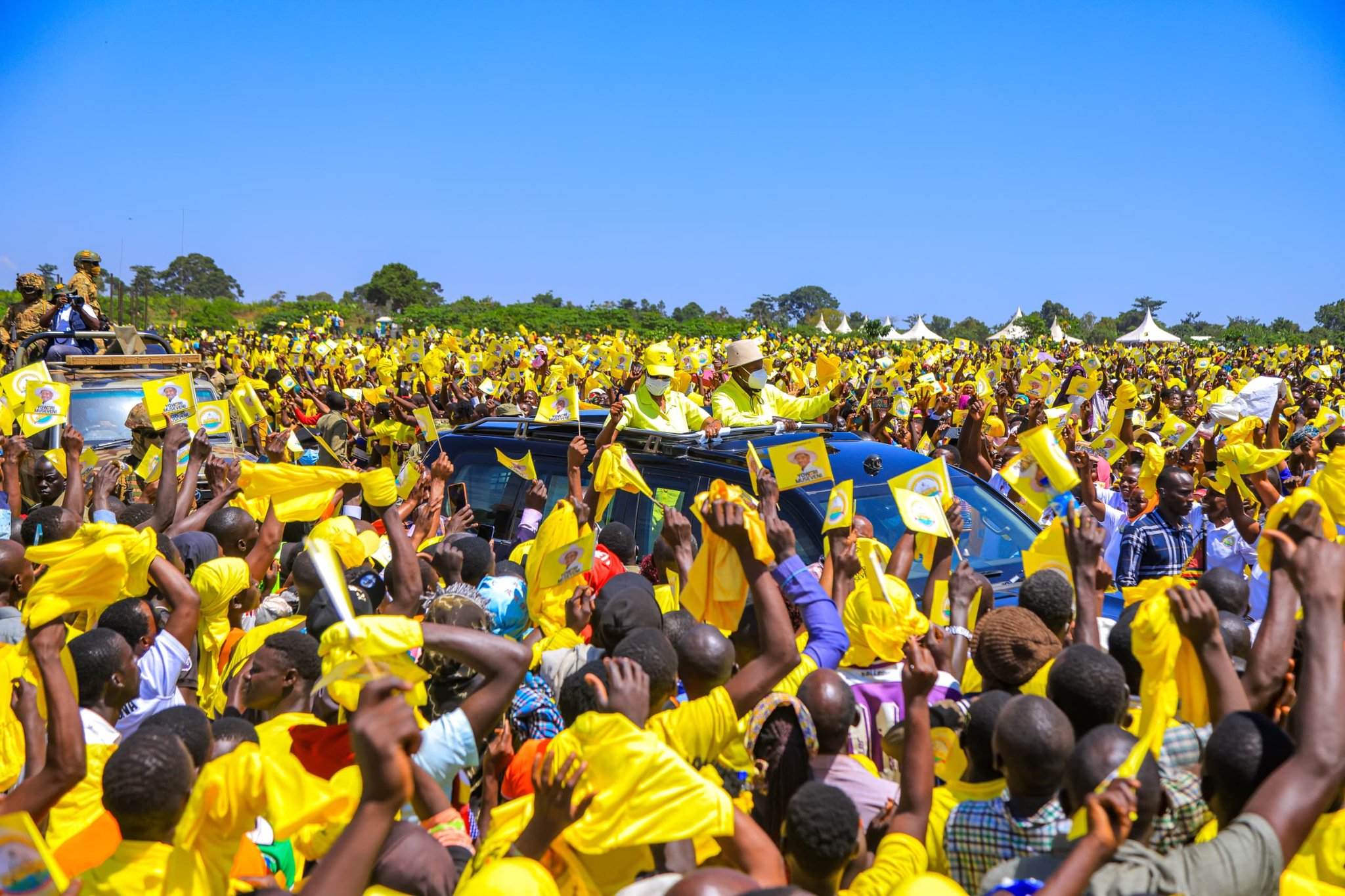
President Yoweri Museveni has pledged sweeping political and economic reforms for Buvuma Island, promising a second parliamentary constituency, major infrastructure upgrades, and renewed investment in palm oil and fishing as he campaigned on the island on Saturday.
Addressing residents, Museveni acknowledged Buvuma’s rapidly growing population, now estimated at 110,000, and said the district deserves stronger representation in Parliament.
“One MP is no longer enough for the whole of Buvuma. You deserve a second constituency so that your issues are properly represented,” Museveni said.
The President placed palm oil production at the centre of his development vision for the island, urging residents to fully embrace the crop as a long-term source of wealth and jobs. He assured them that government would resolve outstanding challenges affecting the sector, including compensation for bibanja holders who gave up land for palm oil farming.
“The money is available. What remains is agreeing on how to compensate the landowners. This issue will be concluded,” he said.

Museveni confirmed that plans are underway to establish a palm oil processing mill on Buvuma, a move expected to create jobs and cut the high costs of transporting palm oil to Kalangala for processing.
Fishing, another key livelihood on the island, also featured prominently. The President warned against overfishing and the destruction of breeding grounds, saying such practices threaten the future of the industry.
“We must protect breeding areas. Those who destroy them are destroying your future,” Museveni said, adding that government would support the construction of fish ponds to provide alternative sources of income.
On infrastructure, Museveni outlined ambitious plans to transform the island, including tarmac roads, solar-powered water systems, and reliable electricity. He announced that Buvuma will be connected to the national power grid through a marine cable from Kalangala, alongside short-term solar and mini-grid solutions.
“We shall start with solar power in trading centres and mini-grids within six months. The marine cable will follow in phases to ensure stable electricity across the island,” he said.
The power project will be implemented in two stages: an initial rollout of solar and mini-grids for smaller islands, followed by a marine cable from Mayuge to Buvuma to supply the main areas within a year.
Museveni also pledged to upgrade existing health centres into district hospitals and establish at least two boarding schools to support children from fishing families.
Calling for unity, the President urged residents to diversify their economy beyond palm oil and fishing into coffee growing, fruit farming, and tourism, citing Kalangala as a model for island-based development.
First Lady Janet Museveni, who accompanied the President, thanked the people of Buvuma for their support and urged them not to be complacent.
“Large rallies are not enough. When the time comes, we must turn up and vote,” she said.
NRM Vice Chairperson for Buganda, Haruna Kasolo, welcomed the President’s commitments, saying residents were particularly encouraged by the promise of marine transport and electricity.
“The compensation issue must be resolved so the investor can build the palm oil mill here. Transporting palm oil to Kalangala is expensive and inefficient,” Kasolo said.
With promises of better representation, electricity, infrastructure and job creation, Buvuma residents now look to government to turn campaign pledges into lasting transformation for the island district.