



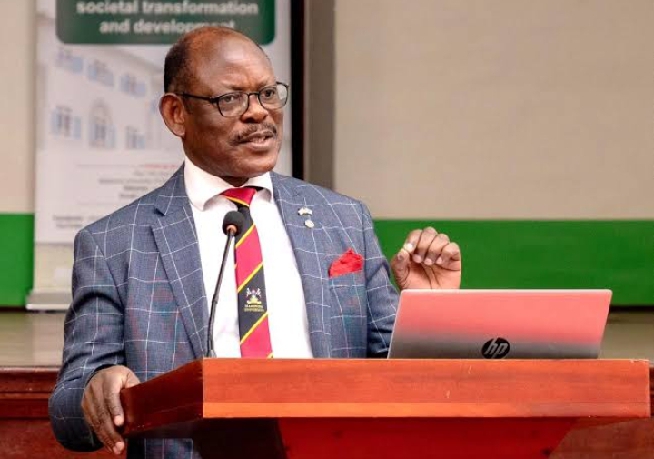
KAMPALA, Uganda (UGNEWSLINE) – President Yoweri Museveni has appointed Makerere University Vice-Chancellor Prof. Barnabas Nawangwe to chair Uganda’s higher education regulator, raising questions about potential conflicts of interest if he retains his university position while overseeing the institution responsible for regulating it.
Nawangwe was appointed chairman of the National Council for Higher Education (NCHE) for a five-year term, according to an appointment instrument dated November 14, 2026.
His appointment takes effect when he assumes office.
He replaces Prof. Joy Kwesiga, the Vice-Chancellor of Kabale University.
The appointment places Nawangwe at the helm of an institution with significant regulatory powers over Uganda’s universities, including Makerere, where he has served as Vice-Chancellor since September 2017. He was reappointed in 2022 for a second five-year term.
Established under the Universities and Other Tertiary Institutions Act, the NCHE is mandated to regulate and guide the development of higher education in Uganda while ensuring that institutions provide accessible, relevant and quality education.
Its responsibilities include evaluating and monitoring universities and other tertiary institutions, registering higher education institutions, accrediting academic and professional programmes, investigating complaints and enforcing minimum academic and institutional standards.
The council also advises the government on higher education policy, recommends the establishment and accreditation of institutions, sets standards for student admission and academic programmes, and determines the equivalence of qualifications obtained from foreign institutions.
It is therefore a powerful regulatory institution whose decisions can affect the operations, academic programmes and accreditation status of universities across the country.
Can Nawangwe hold both positions?
One immediate question arising from the appointment is whether Nawangwe can assume the NCHE chairmanship while remaining Makerere’s Vice-Chancellor.
The Universities and Other Tertiary Institutions Act, which establishes the council and provides for its composition, does not expressly state in the provisions governing NCHE membership that a serving university Vice-Chancellor is automatically disqualified from becoming its chairman.
Section 7 provides for the composition of the council and stipulates that the council recommends two of its members from whom the President appoints the chairperson. It also provides for a five-year term for appointed members, subject to the statutory provisions.
However, the absence of an explicit prohibition in the NCHE Act does not necessarily settle the question of whether holding both offices simultaneously would be legally or administratively appropriate.
The Leadership Code Act provides an additional legal consideration. Section 8 prohibits a leader from placing himself or herself in a position where personal interests conflict with official responsibilities. Section 9 requires disclosure of personal interests and bars participation in deliberations involving matters in which the leader has a personal interest.
Section 18(5) also prohibits a leader or public officer from holding an office of profit or emolument likely to compromise the office held.
These provisions make the circumstances of Nawangwe’s appointment important, particularly if he continues to exercise executive authority at Makerere while chairing the body responsible for supervising and regulating the university.
The precise application of these provisions would depend on the legal status of the offices, the relevant statutory definitions and the circumstances of the dual appointment.
The conflict-of-interest question
The potential conflict is not merely theoretical. Makerere is among the institutions subject to NCHE registration, quality assurance, programme accreditation and regulatory oversight.
As Vice-Chancellor, Nawangwe is responsible for the university’s academic, administrative and financial affairs. As NCHE chairman, he would provide leadership to a council whose mandate includes evaluating and regulating universities.
This creates a potential institutional conflict, particularly when the council considers matters affecting Makerere.
The Leadership Code Act offers a framework for addressing conflicts of interest through disclosure and non-participation in decisions involving personal interests. However, whether recusal alone would adequately address the broader institutional conflict associated with holding both positions is a separate legal and governance question.
The appointment therefore raises questions about whether Nawangwe will relinquish the Makerere vice-chancellorship before assuming the new role, whether the two offices can legally be held concurrently, and what safeguards would be put in place to protect the independence and impartiality of the regulator.
His move to the NCHE comes at a time when Uganda’s higher education sector faces scrutiny over academic standards, graduate employability, research financing and the relevance of university training to the country’s economic needs.