


The Rotary Club of Nabbingo, in partnership with Watudev Initiatives and Malaria Partners Uganda, has launched a USD 1,300 malaria prevention project targeting learners at Louise Junior School in Bukomansimbi District.
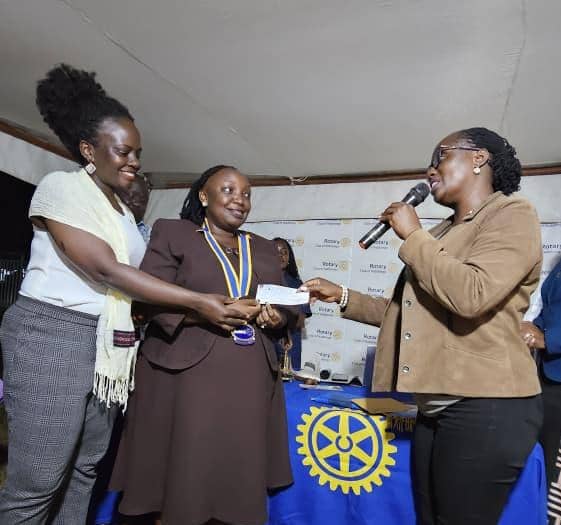
The initiative was officially unveiled over the weekend during the Rotary Club of Nabbingo’s weekly fellowship at Nabbingo Catholic Parish Gardens, where the Executive Director of Malaria Partners Uganda, Eva Kagona, handed over a cheque worth USD 750 to the club’s president, Agnes Mugoya Namiiro.
Under the partnership, Malaria Partners Uganda contributed USD 750, Watudev Initiatives provided USD 200, while the Rotary Club of Nabbingo, the implementing partner, contributed USD 300 towards the four-month project.
Speaking at the event, Kagona urged the Rotary Club to ensure proper accountability and effective implementation of the project so that it delivers lasting benefits to the targeted communities in Bukomansimbi District.
She also encouraged the club to pursue larger grants in future, ranging from USD 7,000 to USD 10,000, citing its well-designed project model. She said the initiative aims to build the capacity of pupils at Louise Junior School to become ambassadors of malaria prevention, spreading lifesaving messages not only within the school but also to their families and communities, thereby contributing to reduced malaria transmission.
The Executive Director of Watudev Initiatives, Milly Namwanje Katimba, pledged her organisation’s full support to ensure the project is implemented successfully and completed on schedule.
Child-to-Family approach
The project will use the Child-to-Family (C2F) Model, an approach that equips schoolchildren with knowledge and skills to promote malaria prevention at home and within their communities.
Through the model, learners become agents of change, influencing parents, guardians, siblings and neighbours to adopt preventive measures against malaria.
The project is expected to directly benefit 350 learners and indirectly reach about 550 families, impacting more than 1,500 people with information on malaria prevention, early detection and proper management of the disease.
Malaria remains one of Uganda’s leading public health challenges and is a major cause of illness, school absenteeism, preventable deaths and reduced productivity. Children are among the most vulnerable, with repeated infections disrupting their education and placing a significant financial burden on households through treatment costs and lost working days.
The partners say empowering children with malaria prevention knowledge will help bridge the gap between awareness and action, encouraging households to adopt practices that reduce infections and improve community health.