



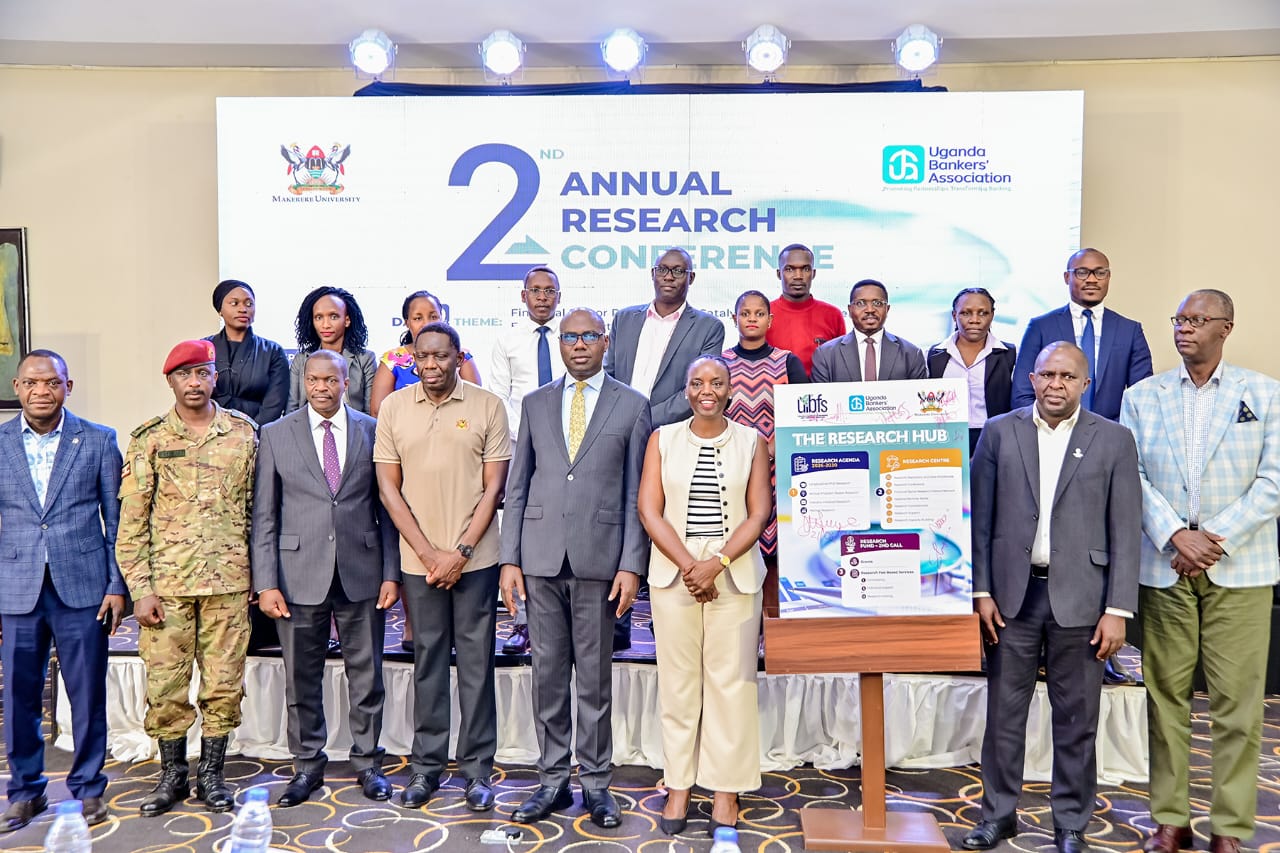
KAMPALA, UGANDA — Uganda must place financial sector research, knowledge and innovation at the centre of its economic transformation if it is to achieve its ambitious Ten-Fold Economic Growth Agenda, leaders from Government, the financial sector and academia have said.
The call was made during the second day of the 2026 Annual Research Conference held at Protea Hotel Kampala under the theme: “Financial Sector Research as a Catalyst for Uganda’s Ten-Fold Economic Growth Agenda.”
The two-day conference was organised by the Uganda Institute of Banking and Financial Services (UIBFS) in partnership with the Uganda Bankers’ Association (UBA) and Makerere University’s College of Business and Management Studies (CoBAMS).
Participants deliberated on how research can strengthen Uganda’s financial sector and contribute to inclusive and sustainable economic growth.
In his keynote address, the Secretary to the Treasury and Permanent Secretary in the Ministry of Finance, Planning and Economic Development, Ramathan Ggoobi, commended the organisers for choosing a theme he described as a matter of national importance.
He said the discussions challenged participants to think beyond the conventional role of finance as simply an intermediary between savers and borrowers.
Instead, he said Uganda must consider how knowledge, evidence, capital and innovation can come together to fundamentally transform the capacity of the economy.
“Uganda is transforming, and the question we should be asking ourselves is: How do we finance the transformation?” he said.
Ggoobi noted that financial sector research has an important role to play in helping the country understand emerging opportunities, identify financing gaps and develop evidence-based approaches to mobilising and deploying capital towards productive sectors of the economy.
The Minister of Finance, Planning and Economic Development, Hon. Henry Musasizi, who was the Chief Guest, also underscored the importance of financial sector research in supporting Uganda’s economic transformation.
He called upon academics and researchers to move beyond theory and focus on problem-solving research that addresses the real challenges facing the economy.
The Minister urged researchers and academic institutions to work closely with banks, SACCOs and insurance companies to ensure that research is informed by practical industry challenges.
He also called upon the private sector to invest in research, arguing that understanding customers and markets is one of the most valuable investments an institution can make.
“The best investment you can make is in understanding your customers and your market,” Hon. Musasizi said.
He urged regulators to remain open to evidence and innovation and to be willing to pilot, test and scale what works.
To development partners, the Minister called for greater alignment with national priorities.
“Align your support to Uganda’s research priorities, not the other way round,” he said.
Hon. Musasizi emphasised that Uganda’s Ten-Fold Economic Growth Agenda would require more than access to debt.
“Uganda’s ten-fold growth will not be delivered by debt alone, but by knowledge, innovation and capital working together,” he said.
He challenged participants to make the conference a turning point for financial sector research.
“Let this conference mark the moment when financial sector research moves from the periphery to the centre of our economic strategy.”
He further challenged stakeholders to work towards a future in which Ugandan research informs the country’s financial sector policies and products.
Speaking at the same event, the Governor of the Bank of Uganda, Dr Michael Atingi-Ego, highlighted the importance of building a financial sector that can manage risk while supporting innovation and economic growth.
A key message from his address was the need for risk mastery rather than risk aversion.
The Governor emphasised that a financial sector seeking to support businesses, innovation and economic transformation cannot simply avoid risk. Instead, it must develop the knowledge, systems and capacity to understand, assess and manage it effectively.
He also called for the deepening of Uganda’s market architecture to create a stronger and more responsive financial system.
The Governor further highlighted the importance of “a regulator that listens first”, underlining the need for dialogue and engagement between regulators and industry as the financial sector responds to changing technologies, products and market realities.
The UIBFS Board Chair, Mr Godfrey Ssebana, called for a stronger culture of evidence-based decision-making within Uganda’s financial sector.
He noted that as Uganda seeks to transform its economy, the financial sector will play an increasingly important role in mobilising savings, financing businesses, facilitating investment and supporting economic activity.
However, he said the key question is whether the financial sector is evolving in a manner capable of supporting the transformation Uganda seeks to achieve.
“To answer that question, we need evidence,” he said.
Mr Ssebana called for stronger partnerships between industry, researchers, universities, regulators and policymakers.
He said financial institutions should not only consume research but also help shape the research agenda by identifying practical challenges that require investigation.
He reaffirmed UIBFS’s commitment to strengthening its role as a connector between industry, research and professional practice, ensuring that knowledge generated through research contributes to better policies, stronger institutions and better decisions.
Relatedly, the Chief Executive Officer of UIBFS, Ms Goretti Masadde, emphasised the need to close the gap between research and practice.
She noted that the financial sector is changing rapidly, driven by technology, changing customer expectations and emerging risks, making research and continuous learning increasingly important.
Ms Masadde said research should not end with reports, academic publications or conference presentations. Instead, it must generate evidence that informs decisions, supports innovation and contributes to practical solutions.
She called for stronger collaboration between financial institutions and academic and research institutions to ensure that industry challenges are translated into relevant research questions.
Ms Masadde reaffirmed UIBFS’s commitment to providing platforms that bring together industry, academia, regulators, researchers and policymakers to share knowledge and develop evidence-based solutions.
Research as a Catalyst for Transformation
The Day Two discussions reinforced a common message: Uganda’s financial sector must become increasingly knowledge-driven, innovative and evidence-based.
The conference highlighted the importance of investing in research, strengthening collaboration between industry and academia, understanding customers and markets, mastering emerging risks, and ensuring that policies and regulation are informed by evidence.
The discussions built on the first day of the conference, which focused on “Navigating Credit Risk in the Digital Transformation Era to Drive Uganda’s Ten-Fold Economic Growth Agenda.”
Day One explored structural gaps that constrain lending, artificial intelligence and AI-powered credit scoring, fraud detection, and the changing nature of credit risk in a digital financial ecosystem.
The conference concluded with a renewed call for Government, the private sector, regulators, academia and development partners to work together to ensure that financial sector research moves from the margins to the centre of Uganda’s economic strategy.