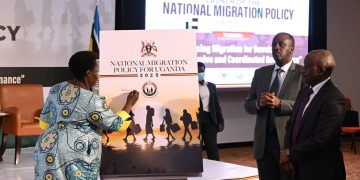



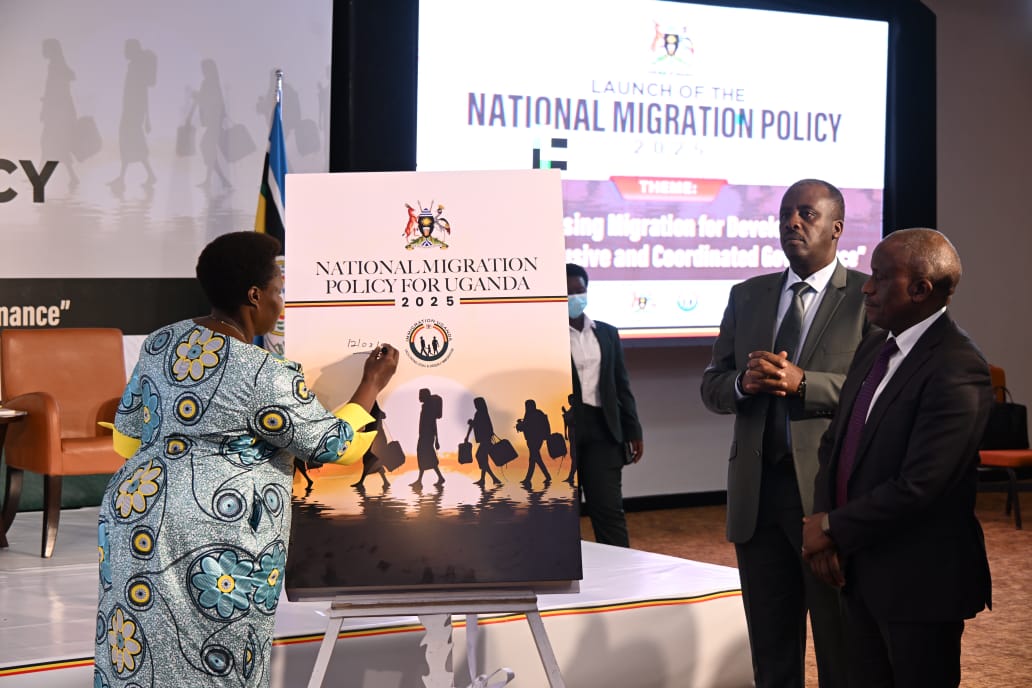
KAMPALA, Uganda : Vice President Maj. (Rtd) Jessica Alupo has launched the National Migration Policy 2025, aimed at managing Uganda’s internal, regional, and international migration flows to support poverty reduction and sustainable growth.
The multi-sectoral framework was approved by Cabinet in August 2025 to unite relevant Ministries, Departments, and Agencies (MDAs) in coordinated migration governance to support national development.
Launched under the theme “Harnessing Migration for Development through Inclusive and Coordinated Governance,” the policy aims to promote safe, orderly, and regular migration while protecting migrant rights, enhancing border management, addressing labour migration challenges, and integrating migration into broader development plans.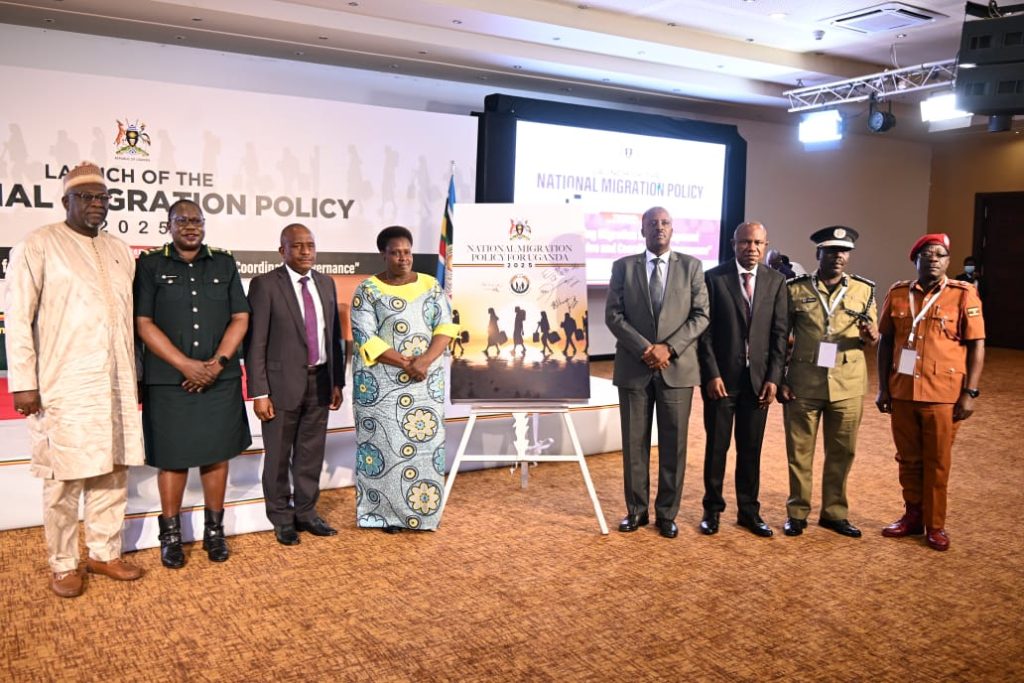 In her remarks, the Vice President said the launch was not merely the unveiling of another government document but a declaration of Uganda’s commitment to managing migration in a manner that is orderly, secure, humane, and beneficial to the country and its people.
“I therefore commend the Ministry of Internal Affairs for providing leadership in this process and congratulate all Ministries, Departments and Agencies, our technical teams, development partners, civil society, and all stakeholders whose efforts, patriotism, and dedication have made this day possible,” she said.
Alupo noted that migration is as old as humanity itself because people move in search of safety, opportunity, trade, education, family reunion, and a better future.
“In our time, migration has become one of the most important issues shaping nations, economies, and societies across the world,” she said.
The Vice President highlighted that Uganda, by virtue of its history, geography, and regional position, is deeply connected to these migration dynamics.
“We are a country of movement, exchange, hospitality, and resilience. We are a nation that hosts people in need, supports regional integration, and contributes to labour mobility, trade, and human development,” Alupo said.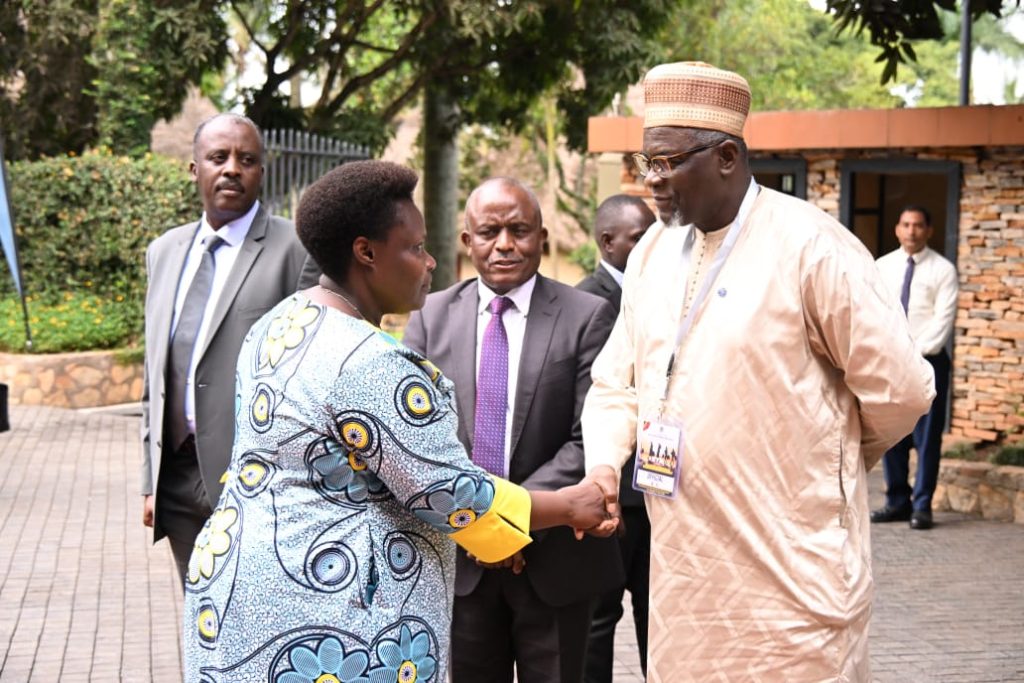 At the same time, she called upon all stakeholders to address the complex realities that accompany migration, including irregular migration, human trafficking, smuggling of migrants, transnational crime, refugee pressures, and the need for stronger systems of coordination and migration data management.
“This is why today’s launch is so significant,” she said.
The Vice President added that the National Migration Policy comes at the right time as it responds to a real national need.
“For the first time, Uganda has a comprehensive policy framework to guide how migration is governed and how its benefits can be maximized for national development, while its risks are better managed,” she said.
Alupo commended the policy for recognizing an important truth: migration is not only an immigration issue but a national issue.
She said it concerns sectors including security, labour, foreign affairs, local government, justice, health, education, planning, trade, environment, and the welfare of Ugandans both at home and abroad.
“For that reason, this policy reflects a whole-of-government and whole-of-society approach. It affirms that effective migration governance requires coordination, shared responsibility, and sustained commitment across institutions and sectors,” she said.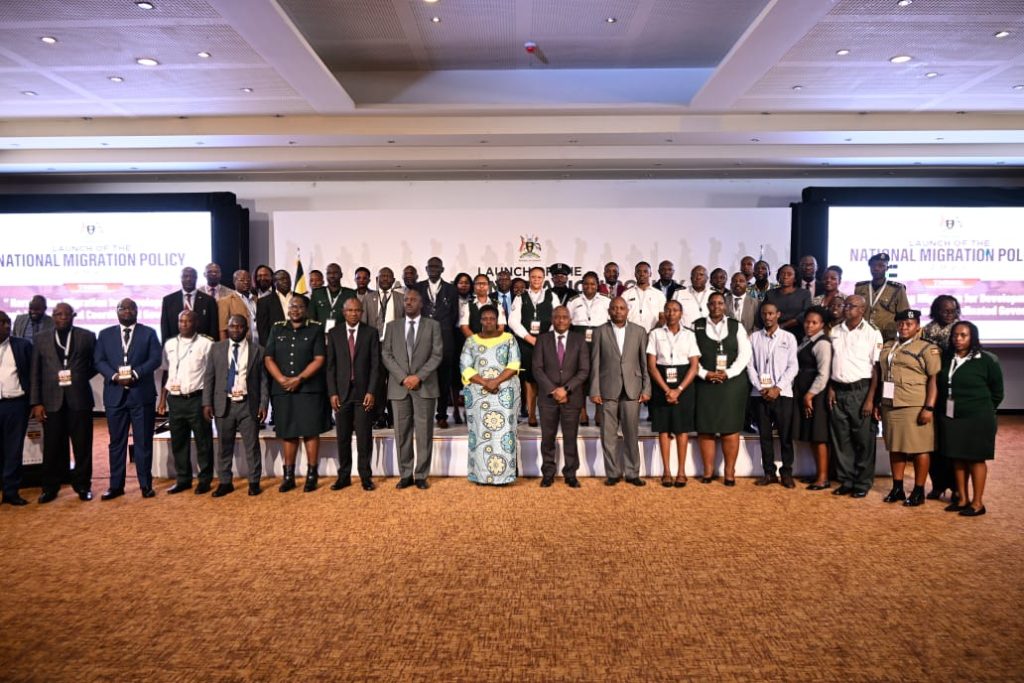 She also noted that the policy aligns with Uganda’s national priorities under the Constitution, Uganda Vision 2040, and the National Development Plan, while also responding to regional and international obligations.
“In this respect, the policy places Uganda firmly on the path of responsible, modern, and forward-looking migration governance,” Alupo said.
She stressed that when well managed, migration contributes to development through remittances, investment, innovation, labour mobility, trade linkages, tourism, knowledge exchange, and diaspora engagement.
Alupo noted that many Ugandans living and working abroad continue to support families, communities, and businesses back home.
She said their contribution to national development is significant and deserves to be recognized, supported, and organized within a clear policy framework.
The Vice President also urged stakeholders to remain vigilant about the vulnerabilities affecting migrants, especially women, children, youth, and workers who may be exposed to exploitation, deception, and abuse.
“A strong migration policy is therefore also a policy for dignity, protection, and human security,” she said.
She called upon all responsible institutions to take full ownership of the policy and translate its provisions into concrete programmes, budgets, regulations, and measurable results.
Alupo urged the Ministry of Internal Affairs to continue providing leadership in coordinating implementation of the policy.
She said the Inter-Ministerial Technical Committee on Migration must be fully empowered to serve as the engine of whole-of-government coordination by aligning sector actions, monitoring progress, strengthening accountability, and ensuring migration issues are addressed in a coherent and integrated manner across government institutions.
“This committee will be indispensable in translating policy commitments into practical and measurable results,” she stressed.
The Vice President also expressed government appreciation to development partners for their solidarity and technical support and encouraged them to continue supporting Uganda.
She acknowledged the contributions of civil society, academia, the private sector, cultural institutions, and the media in raising public awareness, conducting research, advocacy, and delivering services.
To Ugandans in the diaspora, Alupo said they remain an integral part of the nation.
“Your skills, your investment, your ideas, and your enduring love for Uganda matter greatly in our national development journey,” she said.
State Minister for Internal Affairs Gen. David Muhoozi explained that the policy is a multi-sectoral framework uniting relevant Ministries, Departments, and Agencies through coordinated migration governance aimed at national development.
He noted that Uganda, renowned for hosting nearly two million refugees and for its progressive refugee policies, will use the framework to leverage migration’s positive contributions—such as remittances, skills transfer, and economic opportunities—while mitigating risks like irregular migration, trafficking, and exploitation.
Muhoozi added that the launch comes amid ongoing efforts to strengthen migrant protections, including recent mechanisms introduced for Ugandan workers abroad.
He emphasized inclusive governance to engage the diaspora and ensure effective implementation nationwide.
The Army General said the milestone underscores Uganda’s commitment to aligning migration management with national priorities and regional frameworks such as the Global Compact for Migration.