


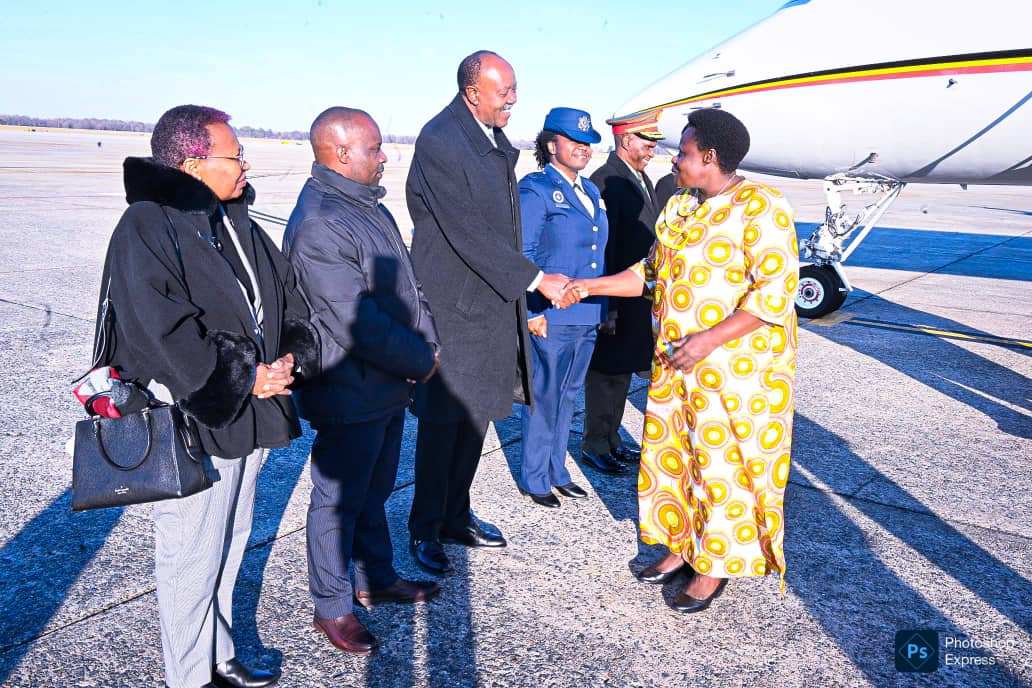
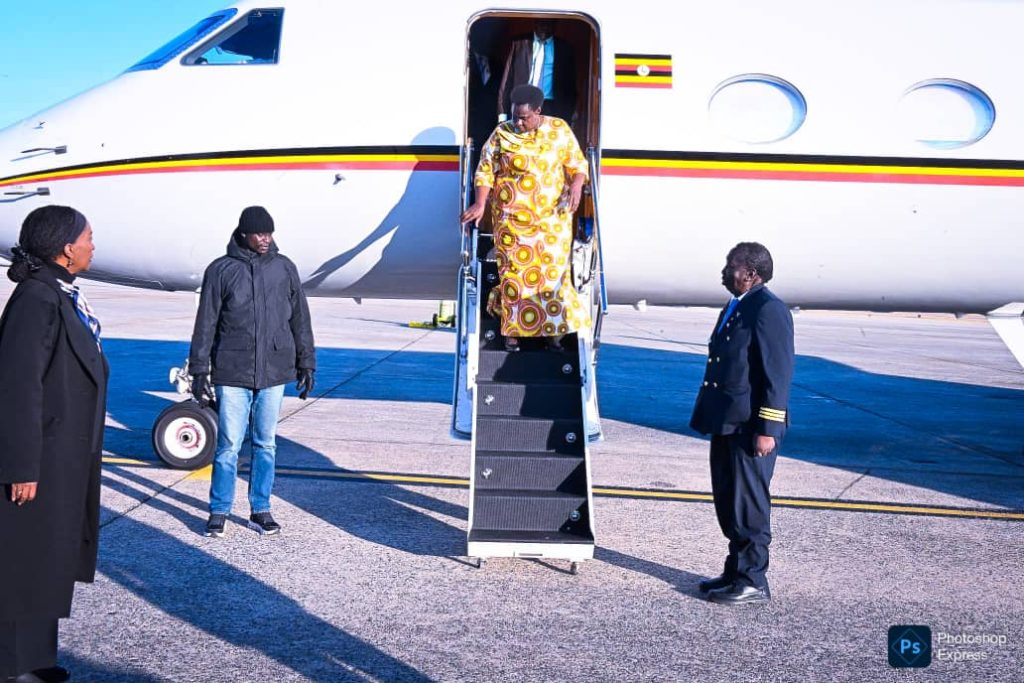
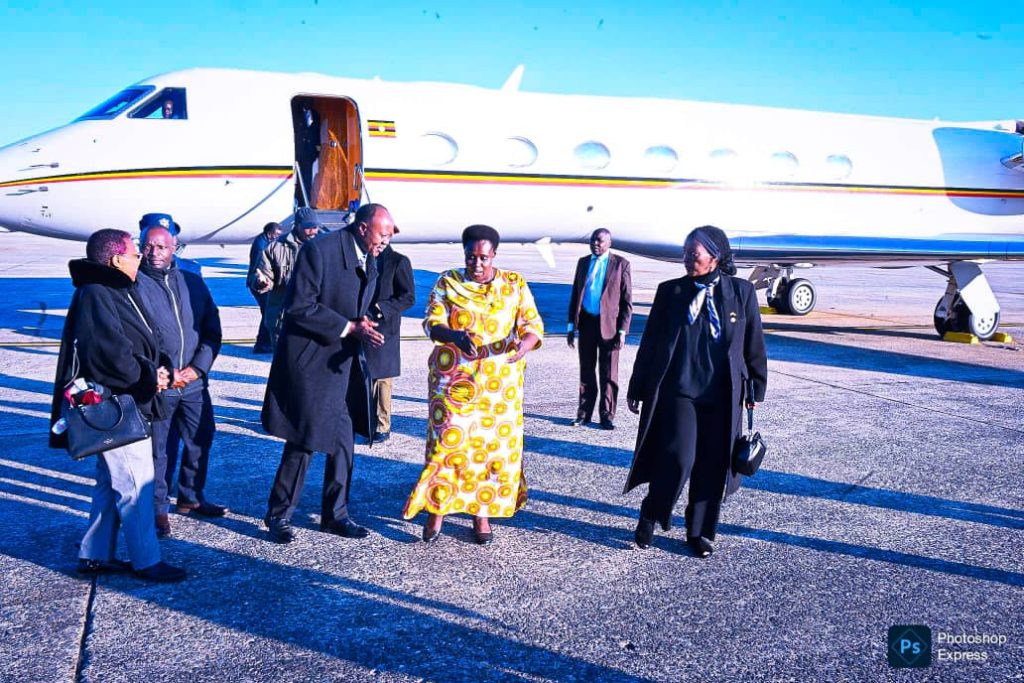
WASHINGTON, D.C. — Uganda’s Vice President Jessica Alupo has arrived in Washington, D.C. to represent President Yoweri Museveni at the signing of the peace agreement between Democratic Republic of Congo President Félix Tshisekedi and Rwanda’s President Paul Kagame.
Alupo was received by Elise K. McSwain, Deputy Director of Flightline Protocol, 89th Airlift Wing of Joint Base Andrews; Ambassador Robinah Kakonge, Head of Mission; Ambassador Tayebwa Katureebe, Deputy Head of Mission; and George Tebagana, First Secretary, among other dignitaries, upon her arrival at Joint Base Andrews, a United States military installation.
 The Vice President’s presence in Washington on behalf of President Museveni is widely viewed as a strong acknowledgment of Uganda’s consistent and constructive role in fostering peace and stability across the Great Lakes region.
Under President Museveni, Uganda has earned a long-standing reputation as a champion of dialogue, military professionalism, and regional cooperation. For years, President Museveni has been at the forefront of efforts to de-escalate tensions among regional governments and support mechanisms that address cross-border insecurity.
Uganda’s principled approach—emphasizing diplomatic engagement, intelligence coordination, and economic integration—has positioned the country as a dependable partner in resolving complex regional disputes.
On this historic occasion, Vice President Alupo reinforces Uganda’s commitment to peaceful coexistence, responsible neighborliness, and the pursuit of a stable, economically interconnected Great Lakes region.
 Eastern DRC has endured decades of conflict involving more than 100 armed groups. Among the most prominent is the M23 rebel movement, rooted in the post-1994 Rwandan genocide landscape and composed largely of ethnic Tutsi fighters.
After resurfacing in 2021, M23 seized key towns in North Kivu, heightening tensions as Kinshasa accused Kigali of supporting the insurgents—allegations Rwanda has consistently denied.
The violence has displaced millions, destabilized communities, and prompted urgent international concern. Regional governments, including Uganda, have repeatedly emphasized the need for a political settlement that prioritizes security, humanitarian protection, and long-term reconstruction.
Although sporadic clashes persist, recent diplomatic engagements have yielded encouraging progress. The upcoming White House signing is expected to establish clear security guarantees, a framework for demobilization, and enhanced joint economic cooperation between the DRC and Rwanda.
Today’s (November 4, 2025) signing ceremony of the Washington Accords was organized by the U.S. Administration following years of mediation by Angola regarding the situation in Eastern DRC.
President Trump and the presidents of the DRC and Rwanda will deliver remarks before signing the peace agreement.
Following the signing of the Washington Peace Accords for peace and stability between the DRC and Rwanda, the U.S. Chamber of Commerce’s U.S.–Africa Business Center and the U.S. Department of State’s Africa Bureau will co-host a high-level fireside chat and private-sector dialogue to launch the Regional Economic Integration Framework (REIF).