



The strength of a democracy is often measured not by how loudly those in power speak, but by how freely those who question power are allowed to speak.
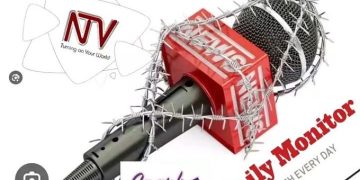
On the morning of Sunday, June 28, 2026, Uganda awoke to reports that several platforms under the Nation Media Group (NMG) umbrellas including Daily Monitor, NTV Uganda, Spark TV, KFM, Dembe FM, The EastAfrican and Ennyanda, had ceased broadcasting or publishing. The development immediately sparked debate over the future of media freedom, constitutional rights and democratic accountability in Uganda.
The Uganda Journalists Association (UJA), in a statement described the shutdown as deeply concerning.
The association said information circulating publicly suggested the action had been taken following directives attributed to the Chief of Defence Forces, Gen. Muhoozi Kainerugaba, through posts on his X account. As with any matter of significant public interest, such claims require careful verification and should be considered alongside any official explanations from the relevant authorities.
Whatever the legal or administrative justification may ultimately prove to be, the immediate impact was unmistakable: journalists were silenced, newsrooms were disrupted, audiences lost access to trusted sources of information, and hundreds of media workers faced uncertainty over their livelihoods.
The closure of a major media house is never merely a corporate story. It reverberates far beyond newsroom walls.
Nation Media Group is one of East Africa’s most influential independent media organizations.
Its Ugandan outlets have, for decades, shaped public discourse, investigated corruption, amplified community voices and provided platforms for diverse political opinions.
When such institutions are forced offline, the consequences extend beyond journalists. Citizens lose avenues through which they receive verified information, scrutinize public institutions and participate meaningfully in national debates.
In every democratic society, independent journalism functions as a public service. It informs voters, questions authority and documents history in real time. Weakening that institution affects not only the press but every citizen who depends on access to information.
Constitutional Questions
Uganda’s Constitution recognizes freedom of expression and freedom of the press under Article 29(1)(a), while Article 41 guarantees citizens the right to access information held by the state, subject to lawful limitations.
UJA argues that the reported shutdown undermines these constitutional protections. Such concerns raise broader questions that deserve public examination: Under what legal authority can a media organization be suspended? Were due process requirements followed? Were less restrictive alternatives available? And how should national security concerns, if any are invoked, be balanced against constitutional guarantees?
These are questions that go beyond one media house. They touch the foundation of constitutional governance itself.
Democracy thrives in the light
Throughout history, societies with vibrant and independent media have generally been better positioned to expose corruption, uncover abuse of power and encourage informed public participation.
Conversely, restrictions on the press often create environments where misinformation flourishes, accountability weakens and public trust declines.
The closure of major media platforms therefore becomes more than an isolated event. It serves as a test of a country’s commitment to democratic principles, institutional independence and the rule of law.
For Uganda, whose political history has included long struggles over civil liberties and constitutional governance, developments affecting the press inevitably attract national and international attention.
The human cost
Behind every newsroom are hundreds of professionals whose work sustains families and communities.
Editors, reporters, camera operators, technicians, photographers, presenters, producers, drivers, printers, IT specialists and support staff all depend on the continued operation of media institutions.
The UJA expressed concern that the shutdown could jeopardize the employment of numerous journalists and media practitioners, many of whom are members of the association.
For these professionals, the issue is not only about constitutional principles, it is also about economic survival and professional dignity.
Call for dialogue
Rather than escalating tensions, the Uganda Journalists Association has indicated that it intends to pursue engagement with key government leaders and institutions, including the Speaker of Parliament, the Deputy Speaker, the Minister for ICT, the Minister of Justice and Constitutional Affairs, the Executive Director of the Uganda Communications Commission and Gen. Muhoozi Kainerugaba.
The association also announced plans to coordinate with other media advocacy organizations in search of constructive and lawful solutions.
Dialogue remains an important avenue in resolving disputes involving constitutional rights, media regulation and public accountability.
Press freedom is not solely a concern for journalists. It is a concern for every citizen who values transparency, accountability and informed public debate.
A nation’s media will inevitably make mistakes and should be held to professional and legal standards. However, accountability for the press is most durable when pursued through lawful and transparent processes that respect constitutional safeguards.
As Uganda reflects on these events, one question remains at the center of the national conversation:
When the institutions entrusted with telling the nation’s story fall silent, who remains to tell the people’s story?