

Uganda has strengthened its capacity to police its vast inland waterways after Inspector General of Police Abas Byakagaba commissioned a fleet of newly acquired state-of-the-art marine patrol vessels, a move authorities say will enhance security, emergency response and search and rescue operations across the country’s lakes and rivers.
The vessels were unveiled during a commissioning ceremony at the Uganda Police Marine Unit Headquarters in Kigo, on the shores of Lake Victoria, where senior police commanders said the investment marks a significant step toward improving maritime safety and protecting the millions of Ugandans whose livelihoods depend on inland water transport and fishing.
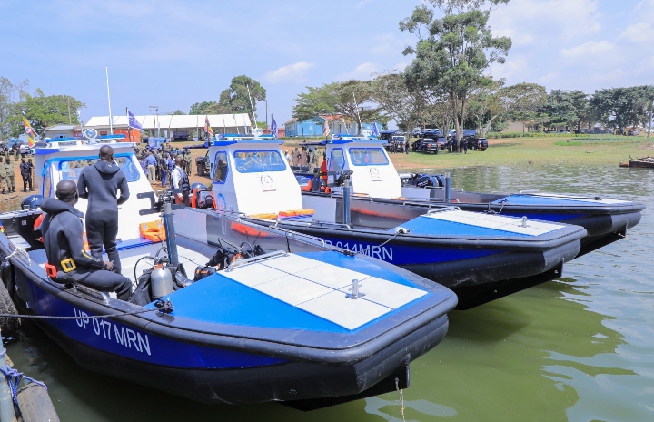
Police said the new fleet will significantly improve the Marine Unit’s operational capability by enabling faster patrols, quicker responses to emergencies, expanded search-and-rescue missions, and stronger enforcement of maritime safety regulations.
The vessels are also expected to strengthen surveillance against criminal activities on Uganda’s waterways, including smuggling, illegal fishing and other cross-border offences.
Uganda’s Marine Police play a critical role in securing the country’s extensive network of lakes and rivers, particularly Lake Victoria, the world’s second-largest freshwater lake by surface is shared with Kenya and Tanzania.
The unit is responsible for enforcing maritime laws, conducting rescue operations, investigating water-related crimes, protecting strategic infrastructure, and ensuring the safety of passenger and commercial vessels operating on inland waters.
The force has become increasingly important as Uganda’s water transport sector expands.
Thousands of people rely daily on ferries, fishing boats and cargo vessels for transport, trade and employment, making effective marine policing essential for public safety, economic activity and national security.
Despite its strategic importance, the Marine Police has faced persistent operational challenges over the years. These include limited patrol vessels, ageing equipment, inadequate funding, the vast size of Uganda’s water bodies, difficult weather conditions, fuel constraints and the complexities of policing remote island communities.
The unit has also been under pressure to respond to frequent boating accidents, many linked to overcrowded vessels, poor enforcement of safety regulations, the absence of life jackets and hazardous weather.
Authorities say modernising the Marine Unit is expected to improve rapid deployment during emergencies, reduce response times and enhance coordination with other security agencies responsible for safeguarding Uganda’s inland waters.