


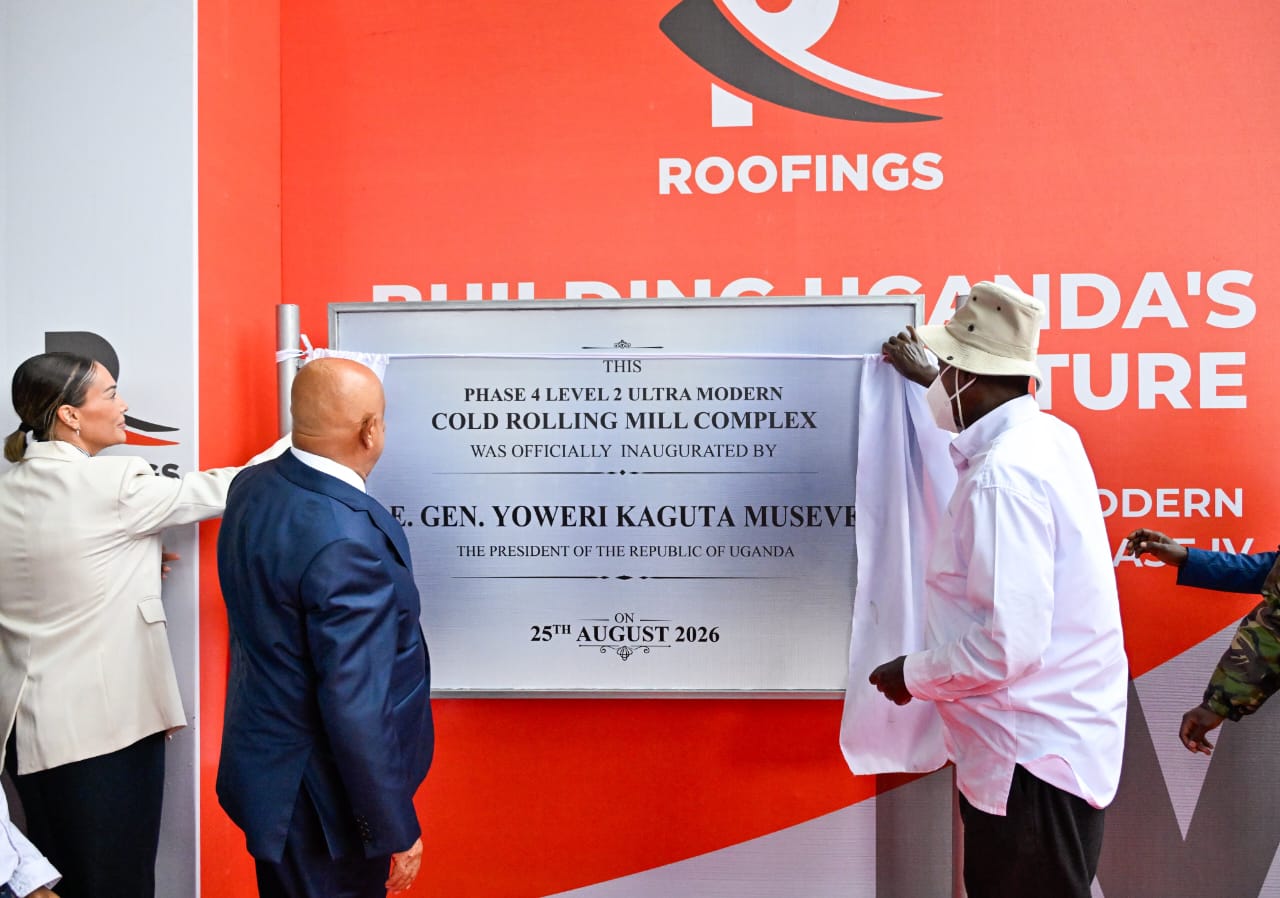
KAMPALA, UGANDA — President Yoweri Kaguta Museveni has commissioned Roofings Group’s $125 million Phase IV Ultra-Modern Cold Rolling Mill Complex at the Kampala Industrial and Business Park in Namanve, describing the investment as a major milestone in Uganda’s industrialisation, value addition and import substitution drive.
The new facility, commissioned on Tuesday, is expected to strengthen Uganda’s capacity to produce high-value steel products locally, create employment and expand the country’s manufacturing and export potential.
The complex has an annual cold-rolled steel production capacity of 150,000 metric tonnes, bringing Roofings Group’s total cold-rolled capacity to 300,000 tonnes. The company said the facility is equipped with advanced Level 2 automation and will produce cold-rolled, galvanised and colour-coated steel products.
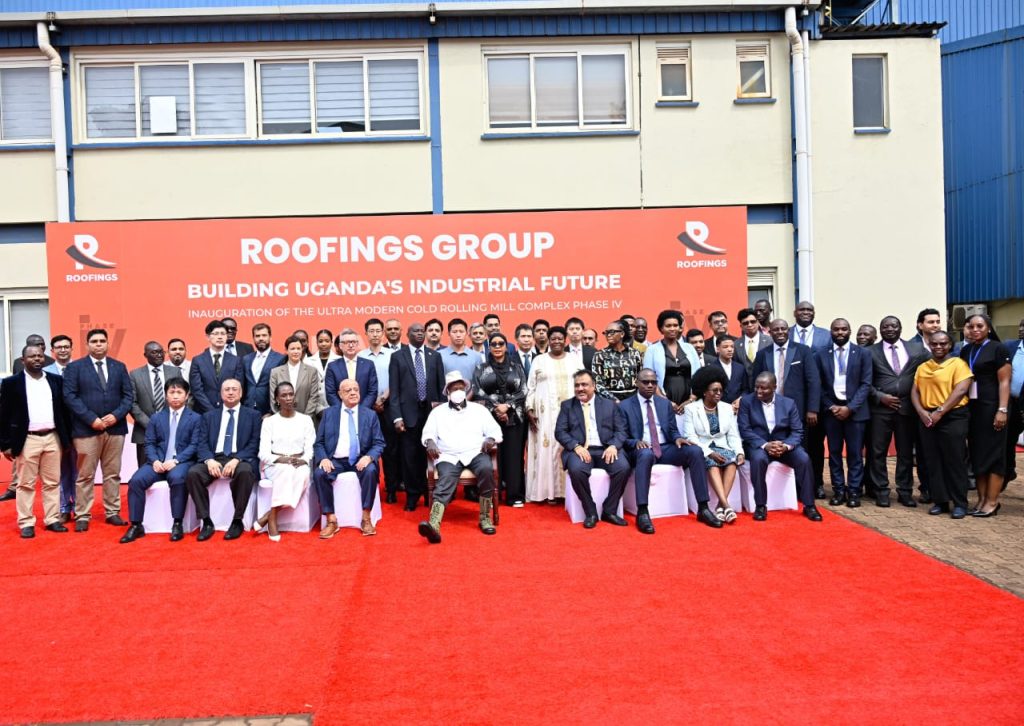
Museveni congratulated Roofings Group Chairman and Managing Director Dr Sikander Lalani and the company’s entire team for investing in local manufacturing and contributing to Uganda’s industrialisation agenda.
He said Roofings’ growth demonstrates the importance of developing an independent, integrated and self-sustaining economy, one of the objectives contained in the National Resistance Movement’s Ten-Point Programme introduced when the NRM came to power in 1986.
Museveni Links Roofings Investment to Uganda’s Industrialisation Agenda
Museveni said Uganda’s economic transformation requires the country to move away from exporting raw materials and instead process them locally to create more value, employment and wealth.
He recalled that at independence, Uganda’s economy was largely based on the production of cotton, coffee, copper, tobacco and tea, with much of the production either unprocessed or only partially processed.
According to the President, the failure to process raw materials locally resulted in Uganda losing potential value while its manufacturers were forced to import finished or highly processed products.
He cited Uganda’s historical copper industry as an example, saying copper could be partially processed in Uganda before being exported, while local manufacturers later imported highly refined copper for use in their factories.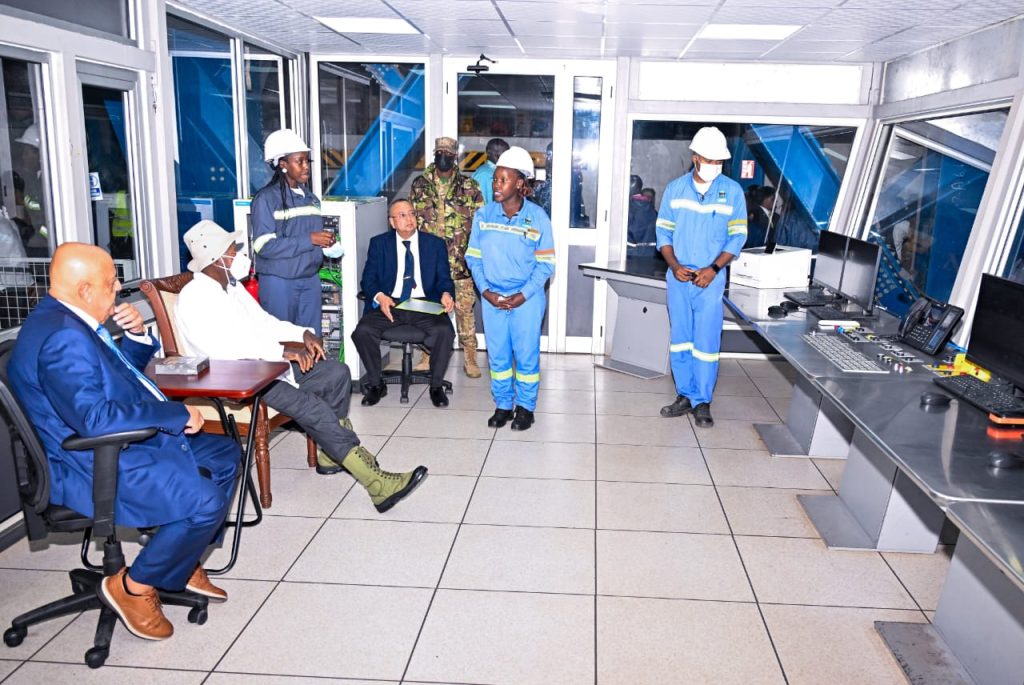 Museveni said this demonstrated the need for both vertical and horizontal integration so that raw materials can be processed locally and the resulting products supplied to other industries within Uganda.
He said the development of Roofings Group was consistent with this vision because the company has progressively moved from importing intermediate steel products to undertaking more sophisticated processing locally.
Roofings Employs More Than 2,200 Ugandans
Museveni said Roofings Group currently has a turnover of about UGX 1.2 trillion, equivalent to approximately $400 million, with about $70 million generated from exports.
He said the company employs 2,244 people, noting that many of these jobs would not exist in Uganda if the steel processing activities were undertaken outside the country.
The President said the local fabrication, coating and galvanising of steel had also enabled Uganda to retain more value within the economy.
He said Roofings currently adds about 54 percent value to the hot-rolled coils it processes, helping to reduce the cost of importing finished steel products.
Museveni said the investment was therefore not only about producing steel but also about creating employment, saving foreign exchange, increasing tax revenues and strengthening Uganda’s industrial base.
President Calls for Use of Uganda’s Iron Ore
Museveni said Uganda should now take the next step by using its abundant iron ore resources to develop a competitive domestic steel industry.
He said Uganda has high-grade iron ore deposits and should take advantage of these resources to produce steel locally rather than continuing to rely heavily on imported intermediate products.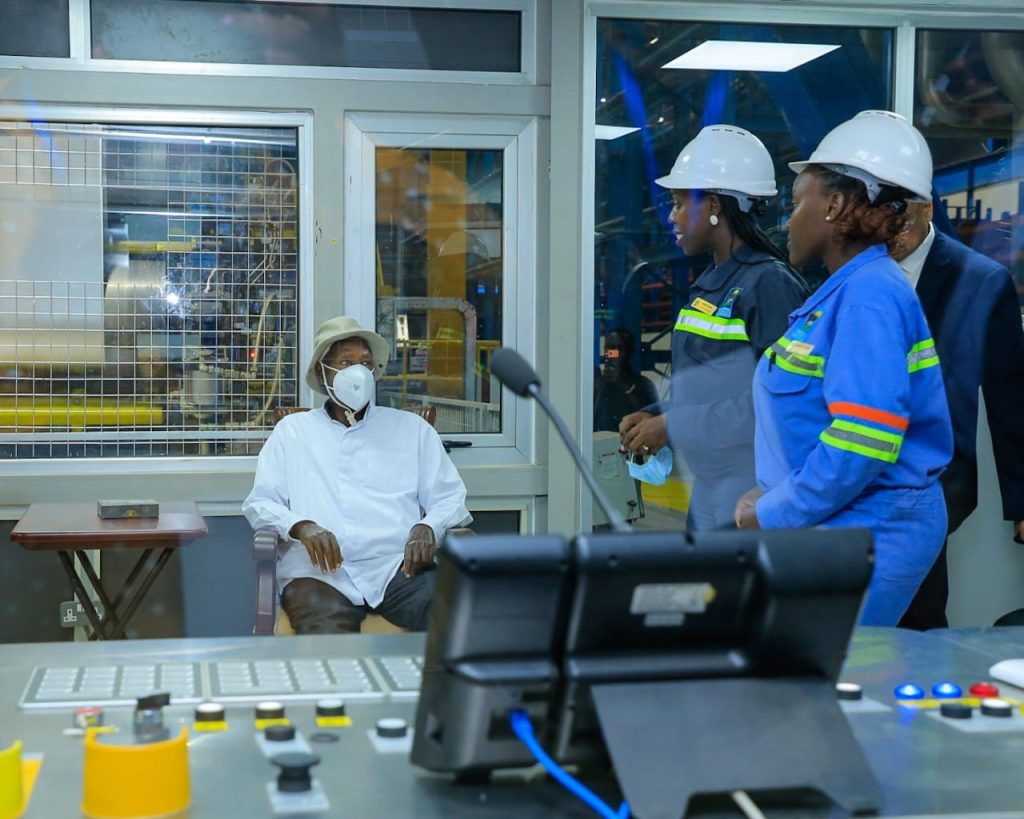 The President said the latest Roofings investment demonstrated that Uganda is capable of adopting advanced technologies and producing sophisticated steel products locally.
He said the country should continue moving towards deeper industrial integration so that more stages of production are undertaken within Uganda.
Museveni Pledges to Address EAC Trade Barriers
The President also pledged to continue engaging his counterparts within the East African Community to remove tariff and non-tariff barriers that hinder the free movement of goods and businesses across the region.
He argued that Uganda and other East African countries need a large and strong regional market to allow manufacturers, farmers and other wealth creators to expand their businesses.
Museveni used agricultural trade to explain his position, saying governments should not protect inefficient producers at the expense of consumers and regional trade.
He said restrictions on cheaper products from neighbouring countries could result in higher prices for consumers, discourage local producers from improving their competitiveness and provoke retaliatory measures from trading partners.
“If you can’t compete, get out of the market,” Museveni said, urging Ugandan producers to improve efficiency and take advantage of larger regional and international markets.
He said regional integration should be viewed as a way of creating a win-win situation in which businesses across East Africa can invest, trade and expand together.
President Highlights Africa’s Growing Demand for Steel
Museveni said Africa’s industrialisation presents enormous opportunities for steel manufacturers.
He noted that the continent requires large quantities of steel to develop infrastructure such as railways, power stations, roads and manufacturing facilities.
He said Africa’s per capita steel consumption remains below the global average, meaning demand is likely to increase as more African countries industrialise.
Museveni said the development of major transport infrastructure linking East and Central Africa would create a significant market for locally produced steel.
He argued that stronger regional integration, improved infrastructure and increased industrial production would enable African countries to build a much larger market for their manufacturers.
Roofings’ Capacity Reaches 625,000 Tonnes
Roofings Group Group Chief Executive Officer Sheikh Arif said the company’s latest investment is a state-of-the-art, technology-driven Cold Mill Complex with an annual production capacity of 150,000 metric tonnes.
He said the new facility brings Roofings’ total cold-rolled capacity to 300,000 tonnes annually, making the company one of the leading steel manufacturers in East and Central Africa.
The complex comprises four major production lines: the 4-Hi Cold Rolling Mill, Edge Trimming Line, Hot-Dip Galvanising Line and Colour Coating Line.
The 4-Hi Cold Rolling Mill gives steel precise thickness, flatness and surface finish. It operates with an eight-megawatt mill stand as part of a total connected load of 40 megawatts across the facility.
The plant uses Danieli’s Level 2 automation technology, with electrical and automation systems supplied by Danieli, Siemens and ABB.
The Edge Trimming Line ensures that steel strips are cut to precise and consistent widths, with an accuracy of approximately one millimetre.
The Hot-Dip Galvanising Line coats steel with aluminium and zinc to improve corrosion resistance and extend its service life. It uses 99.99 percent pure hydrogen generated on site through electrolysis.
The Colour Coating Line, supplied by DanieliFATA HUNTER, produces pre-painted steel and includes environmental controls designed to treat exhaust gases.
Sheikh Arif said the facility represents a significant technological advancement and is intended to position Uganda as a centre of excellence for steel manufacturing and exports.
Roofings Invests More Than $500 Million
Sheikh Arif said Roofings Group has invested more than $500 million over the past 32 years and directly employs 2,224 people.
He said the company honoured a commitment made to President Museveni in 2023 to double its capacity following completion of the new facility.
Roofings’ overall production capacity has grown from 382,000 tonnes per year to 625,000 tonnes by the end of 2025.
The company now has the capacity to produce approximately 4.2 million iron sheets every month, translating into more than 50 million sheets annually.
Sheikh Arif said this was enough to roof more than 1.6 million homes each year and represented the largest Mabati production capacity in East Africa.
He said the company adds approximately 54 percent value to every hot-rolled coil, representing more than UGX 400 billion in value addition.
Lalani Calls for Deeper Integration
Roofings Group Chairman and Managing Director Dr Sikander Lalani said the commissioning of the facility marked a significant milestone for the company and Uganda.
Lalani traced Roofings’ history back almost half a century to a modest sheet-to-sheet galvanising operation in Rwanda.
He said the company later established a sheet-forming operation in Lubowa before developing into a major steel manufacturer serving markets across East and Central Africa.
Lalani said Roofings Group currently produces about 360,000 tonnes of steel products annually and is committed to retaining more economic value within Africa.
He said the company’s vision is to be “an accelerator for a sustainable Africa”, with sustainability including long-term employment, ethical business practices, quality manufacturing and local value retention.
Lalani thanked President Museveni for supporting industrialisation, regional integration, infrastructure development and mineral value addition.
He recalled that nearly two decades ago, Museveni encouraged him to invest in the Namanve industrial park and assured him that Government would provide the infrastructure necessary to support the investment.
According to Lalani, the Government fulfilled that commitment as the industrial park developed and expanded.
Lalani said Roofings intends to deepen its partnership with Government and invest further in backward integration to bring more stages of the steel value chain into Uganda.
He said the region could benefit from combining Tanzania’s coal and gas resources, Uganda’s iron ore and renewable energy potential, and Kenya’s markets and infrastructure.
Lalani revealed that Roofings had already established a dedicated entity to begin exploration work in Uganda as part of its plans to develop local iron and steel production at significant scale.
He said the company’s long-term objective is to reduce dependence on imported raw materials and produce quality steel from locally available resources.
Lalani Seeks Regional Natural Gas Network
Lalani also asked President Museveni to consider supporting the development of a regional or sub-Saharan natural gas infrastructure network.
He said such a network could bring together gas resources from Uganda, Tanzania and other African countries and help make industries more competitive while supporting cleaner production.
He linked the proposal to Africa’s broader commitments to regional resource integration, including the Abuja Treaty, the African Union Commodities Strategy and Agenda 2063.
Government Praises Roofings Investment
Minister for Trade Sanjay Tanna described the commissioning as another major milestone in Uganda’s industrialisation journey and a vote of confidence in the country’s economic policies.
Tanna said Uganda’s development agenda under the National Development Plan IV and the Tenfold Growth Strategy focuses on four key areas: agro-industrialisation, mining, tourism, and science, technology and innovation.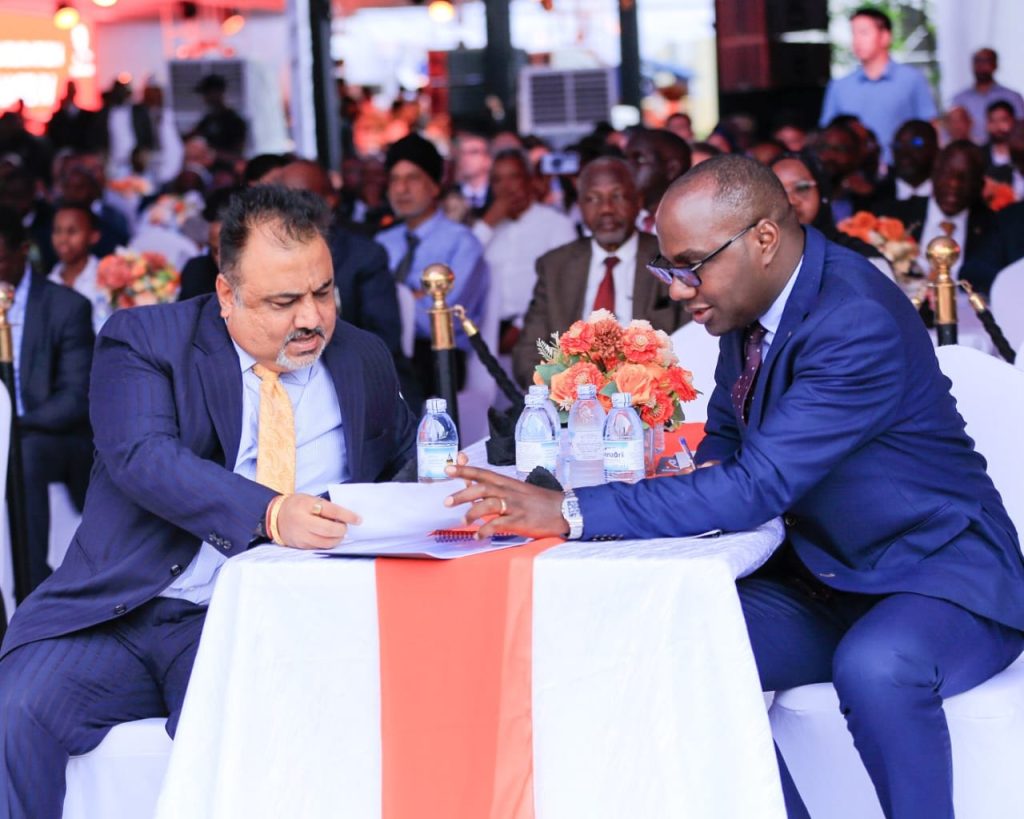 He said the Roofings plant demonstrates how advanced international technology can be transferred to Uganda to support local manufacturing.
Tanna commended Dr Lalani and Roofings for attracting technology partners such as Danieli and Nippon, saying international companies are normally cautious about transferring advanced technologies.
He said their decision to invest and transfer technology to Uganda reflected confidence in the country’s economic environment.
Affordable Power Driving Manufacturing
Tanna attributed part of Roofings’ growth to the Government’s investment in electricity and other infrastructure.
He said Uganda’s electricity cost of about 5.5 US cents per kilowatt-hour is among the lowest in the region and gives local manufacturers an advantage.
The Minister said the Government’s role in providing peace, security, roads, electricity, education and other infrastructure had helped create an environment in which industries could expand.
He said Uganda had moved from the challenge of simply producing enough goods for the domestic market to a new challenge of finding larger regional and global markets for its products.
Tanna pledged continued support from the Ministry of Trade and other Government agencies to help industries address barriers to expansion and exports.
Government Targets Bigger Export Markets
Tanna said Uganda’s industrialisation strategy is increasingly focused on expanding the country’s export capacity.
He highlighted investments in roads, railways, aviation and industrial parks as part of the Government’s strategy to connect producers to markets.
He said Uganda is improving its metre-gauge railway network and preparing for the development of the Standard Gauge Railway, which is expected to further strengthen the movement of goods.
Tanna also said Government has invested in 10 new aircraft, including two cargo planes, to strengthen Uganda’s aviation and export capacity.
He added that more industrial parks, special economic zones and export promotion zones are being developed across the country.
Roofings Commits to Community Development
Beyond steel manufacturing, Lalani highlighted Roofings Group’s investment in social development.
He said the company committed to reconstruct Kasubi Family Primary School after its facilities deteriorated.
The reconstruction is estimated to cost UGX 3.7 billion, with construction being undertaken by CCCC in collaboration with Kampala Capital City Authority.
Lalani said the project forms part of Roofings Group’s wider contributions to healthcare, education and environmental initiatives.
He also acknowledged his daughters, Nashila and Ariana, for their interest in philanthropy and their involvement in the company’s social initiatives.
A New Phase for Uganda’s Steel Industry
The commissioning of Roofings Group’s Phase IV Ultra-Modern Cold Rolling Mill Complex marks a significant expansion of Uganda’s capacity to manufacture high-value steel products.
The investment combines advanced technology from international partners with Uganda’s growing industrial infrastructure, skilled workforce and access to regional markets.
For Government, the facility is expected to contribute to import substitution, value addition, employment, technology transfer and export growth.
For Roofings Group, it represents another step towards deeper integration of the steel value chain and the eventual use of Uganda’s own iron ore resources in large-scale steel production.
Museveni said the country must continue pursuing a strong manufacturing and export-oriented economy while working with its regional partners to remove barriers to trade.
The President said a larger East African market would give Ugandan manufacturers greater opportunities to expand production, create jobs, pay taxes and contribute to the country’s long-term economic transformation.