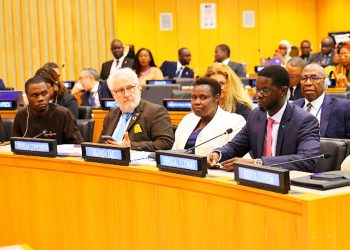


Uganda has launched its Fifth Extractive Industries Transparency Initiative (EITI) Report, highlighting a significant rise in revenues from the mining, oil and gas sectors while calling for stronger transparency, accountability and value addition.
The report, covering the financial year 2023/24, was launched in Kampala as government officials, private-sector players, civil society organisations and development partners reviewed Uganda’s progress in managing revenues from the extractive sector.
State Minister for Finance, Amos Lugolobi said the country must ensure that revenues generated from its natural resources are invested in ways that create lasting benefits for future generations.
He said stakeholders must focus on mobilising domestic resources and making strategic investments that support infrastructure development, investment, foreign exchange earnings and value addition.
“Whatever we do, we need to learn to mobilize resources. The extractive sector has a particular role to play because, if properly managed, it can generate revenue that can help us put in place the necessary infrastructure to stimulate investment, foreign exchange earnings and value addition,” he said.
He added that transparency would remain critical in ensuring that Uganda’s extractive resources are properly managed and converted into investments that support economic transformation.
Extractive revenues rise to UGX663 billion
According to the Fifth EITI Report, total revenues from Uganda’s extractive sector increased by 25.1 per cent, from UGX530.17 billion in FY2022/23 to UGX663.24 billion in FY2023/24.
Direct government revenues rose from UGX481.27 billion to UGX606.36 billion during the period.
Oil and gas revenues increased by 41.7 per cent, from UGX230.23 billion to UGX326.27 billion, while mining revenues rose from UGX299.95 billion to UGX336.97 billion.
The report also shows that the mining and quarrying sector contributed UGX2.59 trillion, equivalent to 1.28 per cent of Uganda’s GDP, during the reporting period.
The extractive sector contributed UGX606.35 billion in direct government revenues, representing about 2.18 per cent of total government revenues.
UCEM calls for data-driven decisions
Humphrey Asiimwe, Chief Executive Officer of the Uganda Chamber of Energy and Minerals (UCEM), said the report provides an important reference for government, businesses, civil society and communities seeking to understand developments in Uganda’s extractive sector.
He said communities in mining areas have a right to know what resources are being extracted, what payments are being made and how the resulting revenues are managed.
“The EITI report is a document that government, stakeholders and civil society can look at. Communities also want to know what is happening in their backyard. Government needs data to make policies, while citizens want to know whether the money generated from these resources is being put to proper use,” Asiimwe said.
He said the mining sector should not be viewed in isolation because it is linked to other areas of the economy, including manufacturing, infrastructure, finance and employment.
The report indicates that Uganda’s mineral production value increased by 87 per cent, from UGX248.5 billion in FY2022/23 to UGX464.7 billion in FY2023/24.
Iron ore was the main driver of the increase, with its production value rising by 218 per cent to UGX289.3 billion.
Asiimwe also called for greater investment in geological data, mineral processing and value addition to enable Uganda to capture more economic benefits from its natural resources.
Report highlights progress, gaps
Maalej Reached, Mission Director and EITI Independent Administrator from Tunisia, said the quality and comprehensiveness of Uganda’s EITI data were among the key highlights of the report.
He said obtaining comprehensive and reliable data remains a challenge in several countries implementing EITI, making Uganda’s progress significant.
“One of the key highlights and findings is the quality and comprehensiveness of the data. This is a very challenging aspect in other countries, so this is a milestone for Uganda,” Reached said.
He also noted the growing contribution of the extractive sector to government revenues.
However, Reached said Uganda needs to strengthen reporting on environmental issues and establish a stronger legal and institutional framework for EITI transparency.
He also called for EITI reporting to become more systematic, with information integrated into government systems and databases rather than being treated only as periodic reports.
The Fifth EITI Report recommends establishing a legal and institutional basis for UGEITI reporting, improving the identification and classification of extractive revenues, strengthening beneficial ownership information and enhancing disclosure of financial statements.
It also recommends better disclosure of project-level costs, as well as stronger reporting on greenhouse gas emissions and environmental and social expenditure.
Reached further called for stronger monitoring and evaluation of EITI implementation as Uganda moves closer to oil production.
The report notes that during FY2023/24, Uganda’s oil and gas sector remained in the exploration, field-development and preparations-for-production phase, with no oil or gas production or exports recorded during the reporting period.
Revenue sharing and accountability
The discussions also focused on ensuring that revenues generated from minerals reach intended beneficiaries and contribute to local development.
Under the Mining and Minerals Act 2022, mining royalties are allocated with 70 per cent going to the Central Government, 15 per cent to local governments, 10 per cent to sub-county or town councils, and five per cent to owners, lawful or bona fide occupants of the land.
Asiimwe said access to reliable information on these revenue flows is essential for accountability and meaningful public participation.
EITI urges citizens to follow the money
Saul Ongaria, National Coordinator of Uganda EITI, said the initiative works with government, civil society, development partners and companies to improve transparency in Uganda’s mining, oil and gas sectors.
He said the EITI process provides information on revenues, taxes, licences, surface rentals and other payments in the extractive sector, allowing government and citizens to track how resources are generated and managed.
“We are all concerned about the development of the oil and gas sector, but institutions must be accountable for the revenue received and ensure that the intention of this money is achieved,” Ongaria said.
He urged citizens to pay greater attention to developments in the extractive sector, particularly as Uganda moves towards oil production and potentially higher revenues.
“Very soon oil production will start, so revenues will increase. We have to be keen on what is happening and what the money will be used for. Citizens should follow the findings of the EITI report,” he said.
The report shows that 99 per cent of reconciled revenues within the FY2023/24 reporting scope were covered through reconciliation, although outstanding issues remained around reporting and signed declarations from some companies.
Civil society welcomes report
Chris Musiime, Programme Director at the African Centre for Energy and Mineral Policy (ACEMP), welcomed the report, saying it provides information that stakeholders can use to demand accountability.
“As ACEMP, we are pleased by this report, especially its focus on transparency and accountability. We believe the report provides the data needed for all stakeholders to hold each other accountable,” Musiime said.
He said ACEMP would work with relevant stakeholders to disseminate the information in the report to policymakers and ordinary citizens.
Musiime also acknowledged the support of development partners, including Danida, in advancing transparency and accountability in Uganda’s extractive sector.
Industry pledges local participation
Manish Kalla, General Manager of Tembo Steels, said the company remains committed to local participation and Uganda’s long-term development aspirations.
Kalla said Tembo Steels sources raw materials locally, including from Kabale District, and remains committed to supporting Uganda’s development through local investment and production.
“We are 100 per cent compliant with the Buy Uganda, Build Uganda (BUBU) principle. We use raw materials from Kabale District, and we are patriotic. We also share the vision of achieving a USD500 billion economy,” Kalla said.
Focus shifts to value addition
The launch of the Fifth EITI Report comes as Uganda seeks to maximise the economic benefits of its mineral and petroleum resources.
The report shows that although extractive-sector revenues have increased, the sector’s contribution to employment remains relatively small. In FY2023/24, the extractive sector directly employed about 6,100 people, equivalent to approximately 0.027 per cent of Uganda’s working population.
Stakeholders therefore stressed the need to move beyond extraction towards value addition, industrialisation, local content, stronger revenue collection, environmental protection and transparent management of public resources.
As Uganda progresses towards oil production and expands its mineral sector, the EITI process is expected to remain an important mechanism for providing citizens with information on revenues generated from natural resources and how those resources are managed.
The Fifth EITI Report places transparency, accountability and access to reliable information at the centre of Uganda’s efforts to turn its natural-resource wealth into sustainable economic development.
Suggested headline: Uganda Launches Fifth EITI Report as Extractive Revenues Rise