



By Robert M. Kangumba
Manager, Digital Platforms, MTN Uganda
Marketing professional with over 15 years of progressive experience
Most digital campaigns don’t fail because of the budget. They fail before they even launch.
That’s not a provocative opinion. It’s a pattern I’ve seen repeatedly across businesses in Uganda—from traders in Kampala to regional brands reaching customers upcountry.
The business has a product worth advertising. The platform is ready. The budget is approved. And then the campaign goes live without a clear objective, a defined audience, or a reliable way to determine whether it worked.
Two weeks later, the money is spent—and there is little to show for it.
The good news is that this is entirely avoidable. And the solution doesn’t require more money. It requires better preparation.
What Preparation Really Means
Preparation is not just a meeting, brainstorming session or mood board. It means answering three critical questions before spending a single shilling.
1. What is the one thing I want someone to do after seeing my ad?
Not feel. Not think. Do.
Call. Fill in a form. Send a WhatsApp message. Visit a webpage. Make a purchase.
Choose one action.
If you cannot clearly identify that action, you are not ready to launch.
2. Who, specifically, am I trying to reach?
Not “everyone in Uganda.” Not simply “young people.”
Think about a real person: where they live, what they do, what they are interested in, and what they might be doing when they see your ad.
The narrower your initial audience, the faster you can learn what works.
3. How will I know if it worked?
If your answer is, “We’ll see how many people saw the ad,” you don’t yet have a measurement plan.
You need a measurable action—a click, call, form submission, WhatsApp message or purchase—that you can track from the moment your campaign goes live.
What This Looks Like in Practice
Palmy Junior School ran a campaign on MTN Ads in early 2025 with one clear objective: new student applications.
Not awareness. Not reach. Applications.
The school kept its approach simple: one clear message highlighting its educational offering and what made it worth choosing; one defined audience—parents of prospective students within its catchment area; and one tracked action—clicking through to apply.
45.34% Campaign conversion rate — Palmy Junior School, MTN Ads, February 2025
That figure is worth pausing on.
In digital advertising, conversion rates above 2–5% are generally considered strong, depending on the industry and campaign objective. Palmy Junior School achieved a 45.34% conversion rate.
The campaign was run again in June 2025 using the same disciplined approach.
The school did not necessarily have an extraordinary budget. What it had was an extraordinary level of focus: one KPI, one audience and one action.
That is the formula.
“Preparation is the single most important determinant of success. Businesses that define goals, map audiences, and align their creative before launch consistently outperform those that rely on guesswork.”
Your Pre-Launch Checklist
Before you press “go” on your first campaign, work through these six steps:
✓ Define one KPI.
Choose the single action you want someone to take after seeing your ad: a call, form submission, WhatsApp message or purchase. One—not three.
✓ Choose one primary audience.
Start narrow enough to learn. Don’t go broad simply because it feels safer. Broad audiences can spread your budget thin and make it harder to understand what is working.
✓ Run a simple A/B test.
Change one variable at a time—either the creative or the audience, not both. Run the test for 5–7 days before deciding whether to scale.
✓ Set a test budget and a stop rule.
Decide in advance when you will pause and review. For example, if your cost per result exceeds your target by 30%, stop and reassess. This protects your budget and encourages discipline.
✓ Make the landing page match the ad.
The offer, wording and tone should be consistent. If your ad promises a free consultation but your landing page takes users to a product catalogue, you risk losing the click you just paid for.
And make sure the page loads quickly on mobile. Your audience is likely to encounter your campaign on a phone.
✓ Confirm your tracking is working before spending.
Click your own ad. Complete the form. Test the call or WhatsApp action. Make sure the conversion is being recorded correctly.
Do this before launch—not after you have spent your budget.
What Not to Do
✗ Launch without a tracked CTA.
If you cannot measure the action you want people to take, you cannot effectively improve the campaign. Confirm that clicks, calls, form submissions or other desired actions are being recorded before you spend.
✗ Overcomplicate the test.
Start with one KPI and one or two variants. Testing too many variables at once makes it difficult to know what caused the result—good or bad.
✗ Scale before you have proof.
One of the fastest ways to waste a budget is to increase spending on a campaign before it has demonstrated that it works.
Learn first. Scale second.
Digital Advertising Is Not a Gamble
Digital advertising is a discipline.
And like any discipline, results improve when the fundamentals are applied consistently.
Palmy Junior School did not achieve a 45.34% conversion rate by accident. It started with clarity: what the school wanted, who it wanted to reach, and how it would measure success.
That discipline is available to businesses across Uganda—regardless of size, sector or advertising budget.
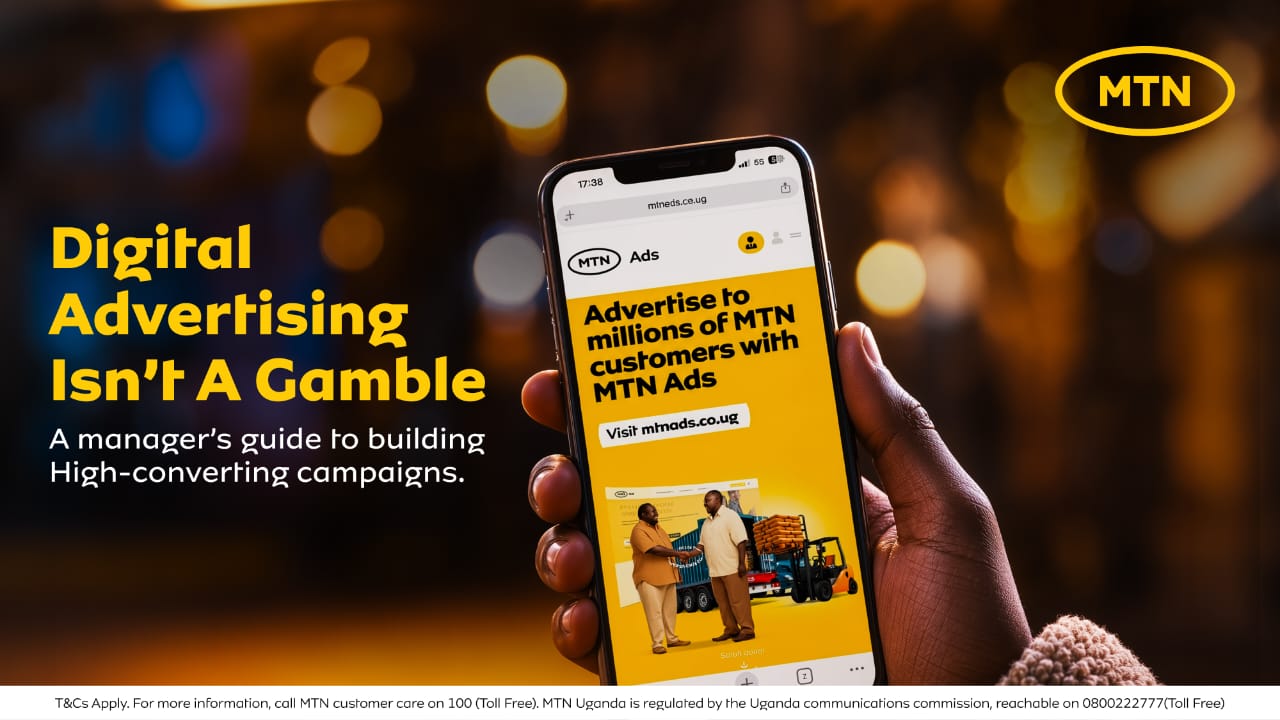
The platform is there. The audience is there. With more than 20 million verified MTN customers, businesses can reach customers directly and measurably through a network they already trust.
The difference between spending on advertising and investing in advertising often comes down to one thing:
Preparation.
Ready to launch your first campaign?
Start with the tools, insights and support built for Ugandan businesses.
www.mtnads.co.ug
About the Author
Robert M. Kangumba
Manager, Digital Platforms, MTN Uganda
Robert M. Kangumba is a seasoned marketing professional with over 15 years of progressive experience in digital platforms and advertising.