



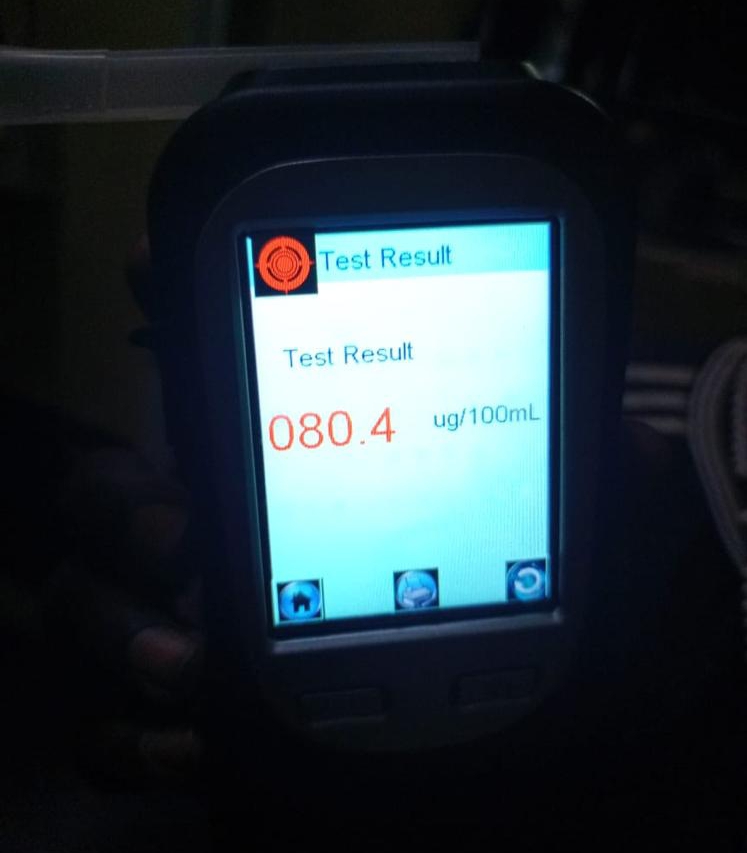
KAMPALA — A truck driver accused of driving under the influence of alcohol and without a valid licence has been arrested in Mpigi, as a string of deadly crashes renews scrutiny of road safety enforcement across Uganda.
Martin Oponya, the driver of Sino truck UA 367AM, was arrested at Maya Checkpoint after allegedly failing to stop when directed by Traffic Police officers.
According to Traffic Police spokesperson, Michael Kananura, further checks found Oponya allegedly driving under the influence of alcohol and without a valid driving licence.

“He is currently detained at Maya Police Station pending court proceedings,” Kananura said.
The owner of the truck has also been charged with allegedly allowing a person without a valid driving licence to drive the vehicle.
The arrest comes at a time when a succession of fatal crashes has placed road safety high on the national agenda.
A week of deadly crashes
On 7 August, two employees of Next Media, producer Badru Kasirye and content creator Isaac Ndamagye, were killed in a head-on collision at Namulanda along Entebbe Road. Their colleague, Brian “Makona” Ssemanda, was injured and taken to hospital.
Police said the crash happened at about 2am near the Stabex area and involved a Toyota Hilux and a Toyota Allex. Preliminary investigations indicated that the Hilux allegedly lost control and crossed into the opposite lane before colliding with the oncoming car.
Police have stressed that the exact circumstances and cause remain under investigation.
The deaths came only days after 14 people were killed in a collision between a taxi and a sand-carrying truck in Kalungu District, while four others were injured.
Police said the truck driver fled the scene and was being sought.
Another fatal crash occurred in eastern Uganda in July when a bus carrying pupils and staff of King David Junior School overturned while returning from an educational trip to Sipi Falls in Kapchorwa.
The death toll later rose to 24, including 23 pupils and the bus driver, according to Uganda Police. Investigations into the cause of that crash are continuing.
The tragedy prompted the government to suspend school trips and educational tours as authorities reviewed safety measures governing the transport of children.
New rules for school transport
The government has since proposed tougher requirements for vehicles and drivers transporting schoolchildren.
Under the measures announced by the Ministry of Education and Sports, vehicles carrying learners must have a valid Private Motor Omnibus licence and Inspection of Vehicles certification, while vehicles are expected to be roadworthy and drivers to hold the appropriate class of driving permit.
Authorities are also proposing specialised certification and defensive-driving training for school-transport drivers, regular background checks, stricter vehicle inspections and wider use of speed cameras and automatic number-plate recognition technology.
Traffic Police have said enforcement will focus on speeding, overloading, route violations and other offences involving school transport.
Earlier in the year, government also unveiled safer-school-zone measures, including a proposed 30km/h speed limit around schools, pedestrian crossings, road signs and barriers to protect children.
Kananura has repeatedly warned that human behaviour remains a major factor behind road crashes.
“Drive on the road as if every child on the road is your own child,” he said during a road-safety campaign.
He said speeding, drink-driving, negligence and overloading were among the behaviours contributing to crashes.
Enforcement under pressure
The latest arrest illustrates the challenge facing Traffic Police: stopping dangerous motorists before their behaviour results in a fatal crash.
For road users, the issue is not simply whether offenders are arrested after a crash. It is whether enforcement can identify and remove dangerous drivers before lives are lost.
The authorities’ response is increasingly combining roadside enforcement with technology, vehicle inspections and tighter requirements for commercial and school transport.
But the continuing deaths on Uganda’s roads suggest that enforcement remains only one part of a much larger problem involving driver behaviour, vehicle safety, road conditions and compliance with traffic regulations.
Police say they will continue taking action against motorists whose conduct puts other road users at risk.