


KAMPALA, Uganda — Uganda’s GROW project is entering a new phase, one that goes beyond financing to directly confront deep-rooted social norms limiting women’s economic power.
Through its latest campaign, “My Voice – My Family is Stronger for It,” the initiative is now championing women’s decision-making authority in business, while engaging men and communities as allies in shifting long-standing cultural attitudes.
From Financing to Social Transformation
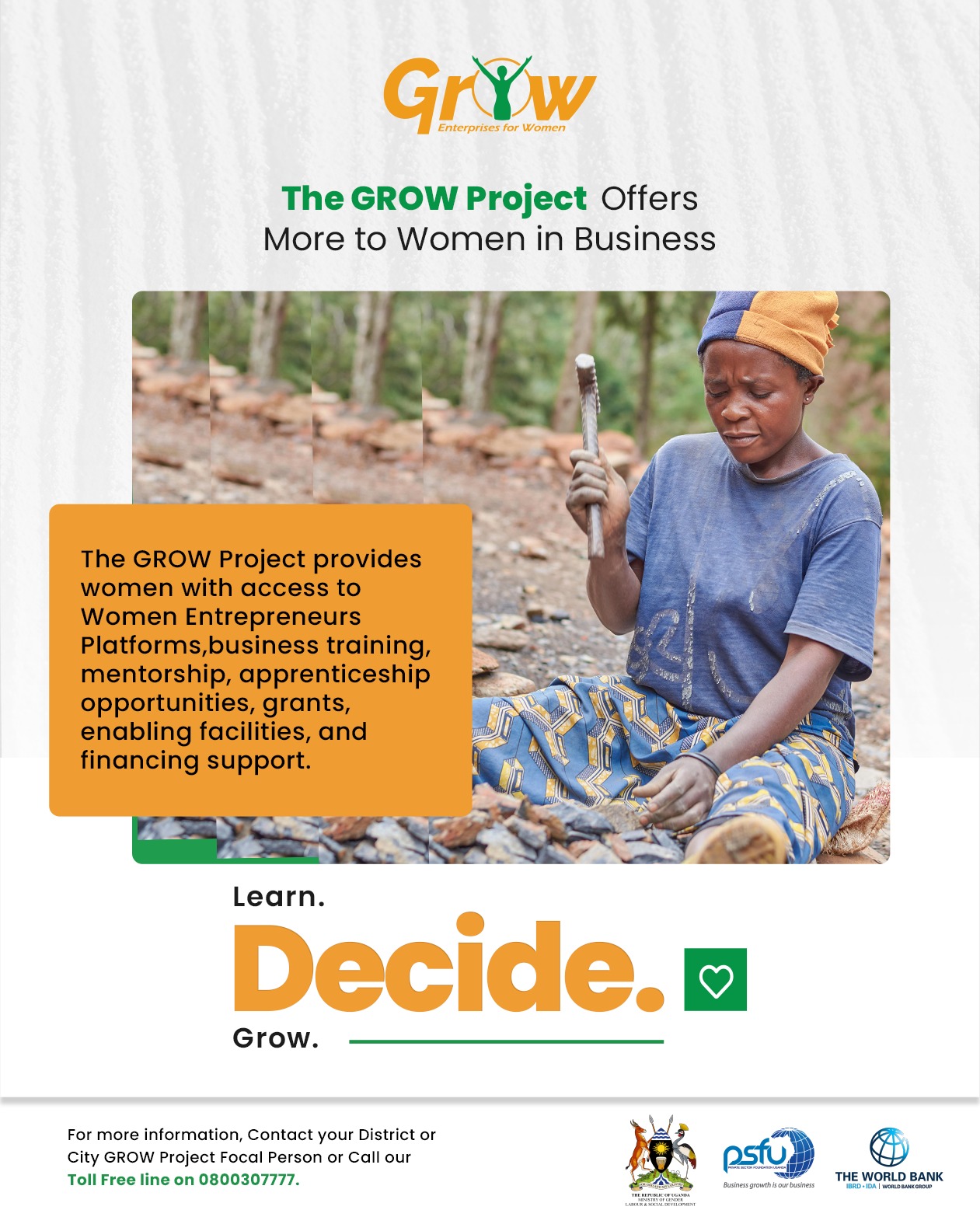
Originally designed to expand access to capital, training, mentorship, and entrepreneurial platforms, the GROW project has already transformed thousands of women-led enterprises across regions such as Kampala, Wakiso District, Mbarara City, Gulu City, and Tororo Municipality.
Now, the focus is widening: addressing patriarchal norms that have historically limited women’s voice, control over resources, and ability to scale businesses.
“Women have the skills and ambition,” notes a program official. “But without decision-making power, their businesses and families cannot fully thrive.”
Campaign Challenges Long-Held Beliefs
At the heart of the campaign is a simple but powerful message: women’s leadership strengthens—not weakens—families.
A radio message airing across the country challenges a common myth: “Women shouldn’t lead businesses—it upsets the home.” The response is clear: evidence shows households benefit when women actively participate in financial decisions.
One beneficiary featured in the campaign shares her experience: after receiving business training and support, she began making independent decisions about her enterprise.
“I used to be told to consult my husband for every decision,” she says. “Now my business has grown—and my marriage is stronger because I contribute more to our family.”
Evidence Backs the Shift
Data emerging from the GROW project supports this narrative. Households where women actively participate in decision-making are more likely to reinvest profits and manage finances effectively.
At the same time, access to finance continues to expand. Nearly 40% of beneficiaries are first-time borrowers, signaling that the project is reaching women previously excluded from formal banking systems.
Most participants fall between ages 36 and 50, while 46% have completed advanced secondary education—an indication of both readiness and untapped potential.
Small Loans Driving Big Change
The majority of loans about 75% range between Shs4 million and Shs20 million, targeting small and medium enterprises.
These funds are already reshaping businesses:
In Wakiso, a vocational trainer used Shs75 million to purchase soap-making equipment, expanding opportunities for over 600 young women, A medical practitioner in the same district invested her Shs20 million loan to improve clinic services in Kampala and surrounding areas, In Nakasero, a long-time food vendor scaled her catering business, employing 10 young women after accessing affordable financing.
Across sectors from food processing to healthcare, women are using capital not just to survive, but to expand.
Breaking Barriers Across Sectors
The impact extends into traditionally male-dominated industries. In Mbarara, an auto parts dealer has used her loan to expand operations and diversify into new business lines, proving that women can compete and succeed—in any sector.
Meanwhile, in Gulu, a restaurant owner has leveraged financing to open a guest house, employing 35 workers and boosting the local economy.
At the higher end, entrepreneurs in towns like Tororo are accessing larger loans of up to Shs200 million, enabling them to scale wholesale and construction businesses and create even more jobs.
A Broader Economic and Social Shift
Sector data shows that 37% of beneficiaries operate in trade and commerce, followed by agriculture (25%), manufacturing (11%), construction (10%), and business services (8%).
But beyond numbers, a deeper shift is underway.
By combining financing with mentorship, training, and now social norm change campaigns, GROW is redefining what economic empowerment looks like—placing women at the center of both business and household decision-making.
Officials say the next phase will intensify outreach through local GROW focal persons and a national hotline (0800307777), ensuring more women and their families benefit.
As the campaign message resonates across communities, one idea is gaining ground: when women lead, families and economies grow stronger.