



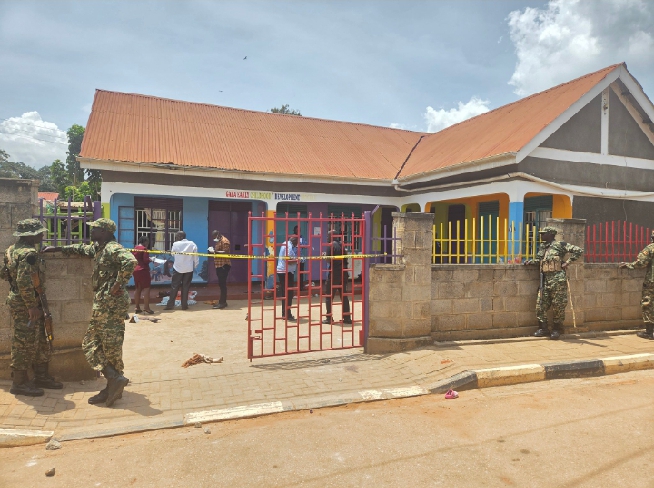
Authorities in Ugandan Capital Kampala are investigating a horrifying attack that left four young children dead at a local early childhood center, in one of the most disturbing acts of violence to hit the capital in recent years.
Police spokesperson for Kampala Metropolitan area, Rachael Kawala confirmed that the incident occurred at the Ggaba Early Childhood Development Program school in Makindye Division.
A male suspect allegedly stormed the premises and fatally stabbed four juveniles in a brutal assault that has shocked the nation.
The suspect was quickly apprehended by security forces and is currently in custody.
She said investigations are ongoing to establish the motive behind the killings.
“This is a deeply tragic incident,” Kawala stated, adding that more information will be released as inquiries progress.
Residents in the area described scenes of panic and grief as news of the attack spread, with parents and community members gathering at the school in disbelief.
While rare, attacks targeting children have a profound impact and often expose deeper societal issues.
Uganda has in recent years recorded multiple cases of extreme violence, many linked to domestic disputes, psychological distress, or community tensions.
According to police annual crime reports: homicide cases remain a persistent concern across the country.
Domestic violence also continues to account for a significant share of killings.
Many violent crimes occur in familiar environments, homes, neighborhoods, and community spaces.
Though attacks in schools are uncommon, this incident underscores a growing unpredictability in the nature of violent crime.
Mental health crisis
The tragedy comes against the backdrop of a widening mental health crisis in Uganda.
Recent health assessments estimate that around 14 million Ugandans are living with mental health conditions, ranging from depression and anxiety to more severe psychiatric disorders. Experts caution that this figure reflects untreated and often unrecognized conditions, not simply extreme illness.
Limited access to mental health care, combined with stigma and economic hardship, has left many without support. Analysts warn that in some cases, untreated psychological distress can escalate into violent behavior.
Security and public health experts increasingly point to a convergence of risk factors behind violent crimes:
Psychological distress and untreated mental illness, economic pressure and unemployment, substance abuse, and
social and family breakdown.
They stress that law enforcement alone cannot address these issues without parallel investment in mental health services and community support systems.
As investigations continue, the community in Makindye Division is left grieving the loss of four young lives in circumstances that remain difficult to comprehend.
The incident has reignited urgent calls for: stronger child protection measures in schools, increased mental health awareness and services, and early identification of individuals at risk of violent behavior.