


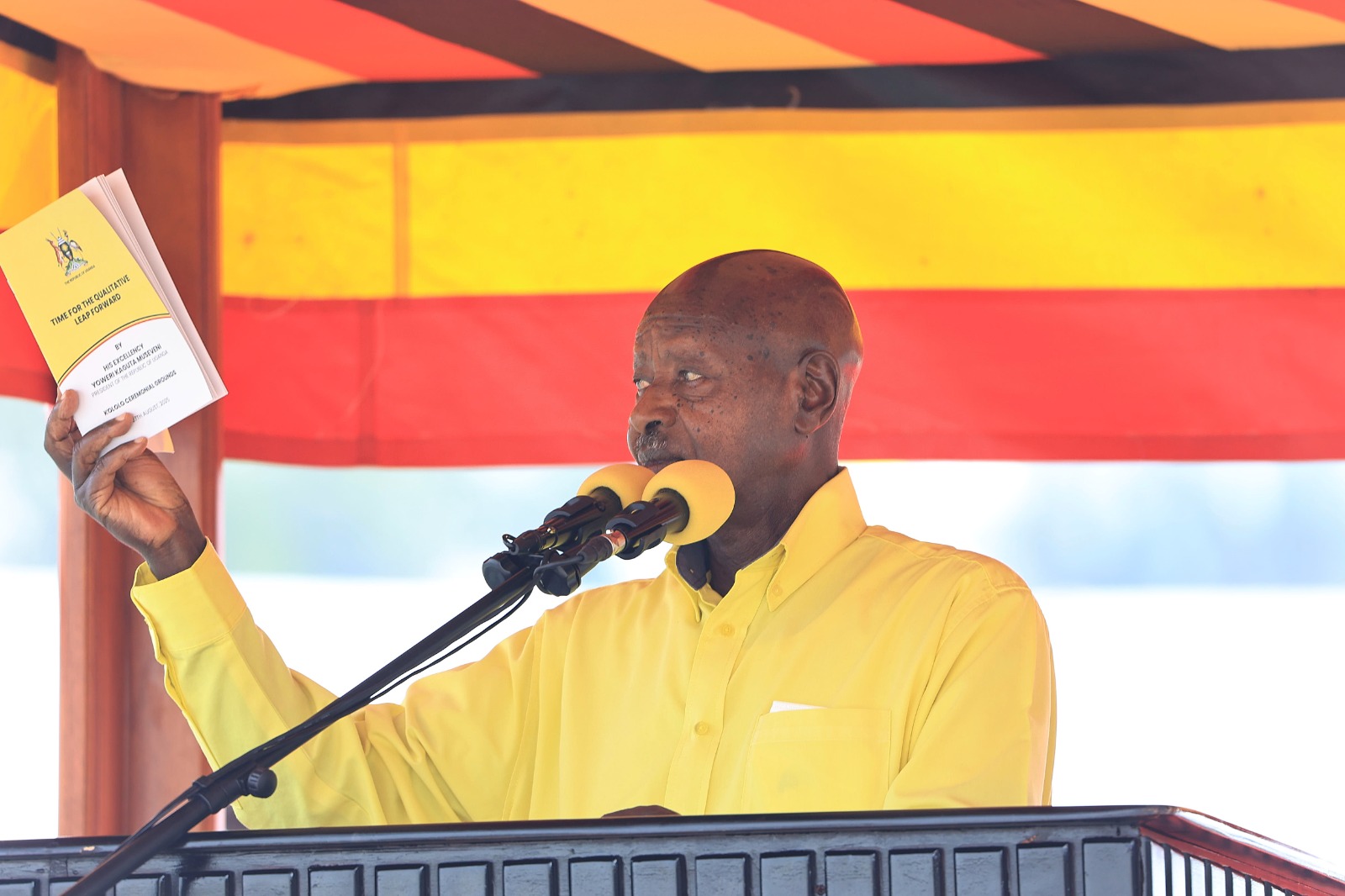
President Yoweri Museveni delivered a sweeping address on Uganda’s economic history, challenges, and future prospects, tracing the nation’s transformation over the last 1,000 years while outlining a bold roadmap for growth and development.
Reflecting on Uganda’s roots, Museveni emphasized the country’s long-standing presence, dating back over four million years, but chose to focus on the past millennium, especially since independence in 1962.
He noted that at independence, Uganda’s economy was a fragile enclave, dominated by six key commodities, cotton, coffee, copper, tobacco, tea, and tourism, surrounded by widespread poverty affecting 91% of households.
He was opening the the National Resistance Movement party national conference at Kololo Ceremonial Grounds.
The president recounted the economic collapse under Idi Amin’s regime in the 1970s, where critical sectors like cotton, copper, and tourism were devastated.
Only tobacco and coffee lingered, while everyday essentials became scarce, forcing Ugandans to rely on imported goods, including beer from neighboring countries.
NRM’s five-phase economic revival
Museveni credited the National Resistance Movement (NRM) for spearheading Uganda’s economic recovery through five distinct phases:
Minimum Economic Recovery: Reviving cotton, tea, and tourism while curbing smuggling and black-market currency speculation.
Expansion: Boosting production of coffee, tea, and tourism, and recommitting to copper mining with improved practices.
Diversification: Challenging colonial-era narrow definitions of cash crops to include bananas, maize, milk, beef, cassava, fruits, and vegetables—transforming them into viable cash products.
Value Addition: Promoting local processing industries, such as turning cotton into shirts, to increase earnings and generate employment. Museveni highlighted factories producing jeans, shoes, and vehicles, including locally made Kiira Electric vehicles.
Knowledge Economy: Focusing on skills and innovation, leveraging the brain and hand to drive modern industry.
Since independence, Uganda’s economy has grown dramatically—from $3.9 billion to $66 billion by purchasing power parity. Museveni announced the government’s ambitious new goal: leapfrogging to a $500 billion economy, elevating Uganda from a lower-middle-income to a high-middle-income country in the coming years.
Towards a modern, prosperous Uganda
The president stressed the need to modernize agriculture, infrastructure, and society, moving from manual labor to mechanization and from firewood to electricity. Peace remains paramount, with the NRM credited for maintaining 40 years of continuous stability—a rarity in the region’s turbulent history.
Museveni underscored the importance of wealth creation through commercial agriculture, manufacturing, services, and ICT as the foundation for job creation and poverty reduction.
He highlighted successful youth entrepreneurs, such as Joseph Ijara of Serere, who transformed small acreage into profitable poultry and dairy enterprises.
He also called for sustainable management of wetlands, promoting fish farming over rice cultivation to preserve water for irrigation and increase incomes.
Security, Regional Integration, and the Future
Addressing security, Museveni advocated for deeper East African political and economic integration to strengthen the region against global challenges. Drawing comparisons with the United States’ success through unified markets, he urged African leaders to build a “United States of Africa” rather than a fragmented region.
Concluding, Museveni called on new and young leaders to focus on practical problem-solving, fight corruption, and empower citizens through government programs rather than personal patronage.
“With these few words, I open the national conference,” he declared, signaling a renewed commitment to Uganda’s economic transformation and unity.