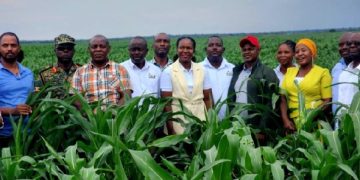



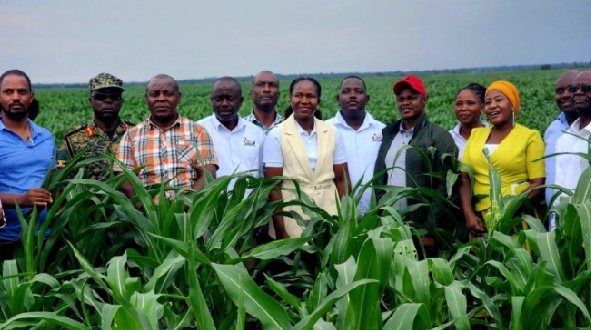
Parliament has urged the National Enterprise Corporation (NEC) to modernise its 3,000-acre maize farm in Kyankwanzi and turn it into a regional food-production hub.
The call was made when the Parliamentary Committee on Defence and Internal Affairs inspected the NEC Agro Farm as part of its nationwide tour of Ministry of Defence and Veterans Affairs (MoDVA) and Uganda Peoples’ Defence Forces (UPDF) establishments.
The five-member team, led by UPDF Commander of Reserve Forces Maj. Gen. Joseph Musoke Semwanga, toured the farm and assessed its production capacity, challenges and future plans.
The Kyankwanzi farm, established more than two years ago as one of NEC Enterprises’ production arms, grows maize primarily for the UPDF.
The farm has more than 18 blocks covering over 3,000 acres.
According to the farm’s agronomist, Agaba Didas, the crop takes about three-and-a-half months to mature and dry before harvesting. Large-scale combine harvesters are used to improve efficiency and minimise contamination and aflatoxin risks.
“This is a government farm owned by NEC Enterprises. We plant over 3,000 acres of maize and entirely it is to feed the UPDF,” Agaba said.
Floods, drought hit production
However, the farm faces major production challenges, including prolonged drought, inadequate machinery and flooding from River Mayanja.
General manager Eng. Simon Baalwa Terwane said floods from the river can submerge about 640 acres of farmland for nearly four months, while drought and limited planting and harvesting equipment also affect production.
“The challenges we face are long droughts, lack of standard machines for planting and harvesting, floods from River Mayanja and animals that destroy the maize crops,” Terwane said.
Maj. Gen. Semwanga urged NEC management to pursue modern farming methods and reduce dependence on rainfall, including investment in solar-powered irrigation systems.
He said NEC should study agricultural practices used in countries such as the Netherlands and develop the Kyankwanzi farm into a centre of excellence in large-scale agricultural production.
“In the military, we always want to have centres of excellence, so we want NEC to be a centre of excellence,” Semwanga said.
He also called for increased food production beyond military requirements, arguing that NEC farms could contribute to regional food security and potentially supply markets across East Africa.
The committee members commended the farm’s operations after a two-hour inspection and pledged to consider its needs through Parliament’s oversight and budgeting processes.
The inspection was part of a wider parliamentary assessment of MoDVA and UPDF establishments across the country.