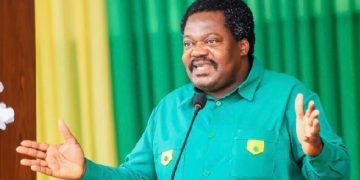



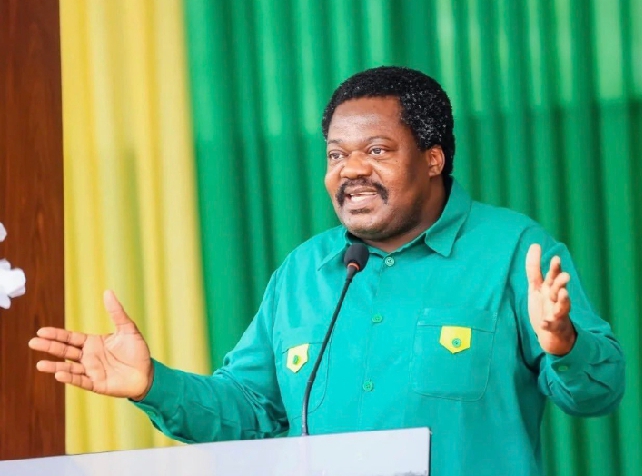
Tanzania has been plunged into fresh political uncertainty after Vice-President Emmanuel Nchimbi announced his resignation and retirement from active politics, bringing an abrupt end to a career that has taken him from party youth leadership to the country’s second-highest office.
Nchimbi said on Tuesday, August 25, that he had formally written to President Samia Suluhu Hassan informing her of his decision.
His resignation will take effect on September 4, 2026.
In announcing the move, Nchimbi referred to a commitment he said he made to Hassan in August 2025, before becoming her running mate.
He said he had promised to leave office if the President ever decided she needed a different vice-president.
Nchimbi said he was now convinced that Hassan wanted a change and that he had decided to honour his pledge.
The resignation was accepted by the President, according to a government statement. Constitutional procedures for appointing a replacement are expected to follow.
A sudden ending to a political comeback
The departure is striking because Nchimbi had only been in the vice-presidency since November 2025.
He was sworn in on November 3 after serving as Hassan’s running mate in the October 2025 general election. Before that, he had occupied one of the most influential positions in Tanzania’s ruling Chama Cha Mapinduzi (CCM) as its secretary-general.
His resignation therefore represents more than the loss of a cabinet figure.
It removes from government a politician who had spent decades building influence within the ruling party and who had only recently returned to the centre of national politics.
It also comes at a sensitive moment for Tanzania, where questions about political freedoms, constitutional reform and the government’s treatment of critical voices have intensified.
Reuters reported that Nchimbi had recently attracted criticism within CCM after calling for a new constitution at a human-rights event in Dar es Salaam.
He argued for a constitution that would promote not only economic development but also the dignity and human worth of Tanzanians.
Who is Emmanuel Nchimbi?
Born in Mbeya on December 24, 1971, Nchimbi has spent much of his adult life in public service.
His education included Oysterbay Primary School in Dar es Salaam, Uru and Sangu secondary schools and Forest Hill Secondary School. He later studied public administration at Mzumbe before pursuing further postgraduate studies, including banking and finance.
His political career began to gather momentum in the 1990s through CCM’s youth structures. He later served as a district commissioner before entering Parliament as the MP for Songea Town.
Government appointments followed rapidly.
Nchimbi served as a deputy minister in several portfolios before becoming Minister for Information, Culture, Sports and Youths and later Minister for Home Affairs.
His career then took an international turn. He served as Tanzania’s ambassador to Brazil from 2016 to 2021 and later as ambassador to Egypt from 2022 to 2023.
His return to the political frontline came in January 2024, when he was appointed CCM secretary-general, a powerful post placing him at the heart of the ruling party’s political machinery.
That appointment put him in a strong position ahead of the 2025 election.
Nchimbi’s rise to the vice-presidency was closely tied to Hassan.
In 2025, Hassan selected him as her running mate for the general election, elevating a long-serving CCM insider and former party secretary-general to the position that would put him directly alongside her at the top of government.
The two therefore entered the 2025 election as a political team before Nchimbi was sworn in as vice-president following Hassan’s victory.
Their partnership was rooted in the ruling party rather than being a new political alliance.
Nchimbi had already spent years moving through government and CCM structures, while Hassan had risen from Zanzibar politics to become vice-president under President John Pombe Magufuli before succeeding him as president in 2021. Tanzania’s Vice-President’s Office records Hassan as vice-president from 2015 until 2021.
But the relationship now ends with Nchimbi saying he believes Hassan wants another deputy.
Notably, the official government statement did not give a reason for his resignation. It simply confirmed that Hassan had accepted the resignation and that constitutional procedures would be followed to appoint another vice-president.
That difference has left considerable room for speculation over what happened behind the scenes.
Resignation and media controversy
Nchimbi’s announcement came shortly after the authorities suspended the publishing licence of the critical newspaper MwanaHALISI.
The newspaper had published reports about alleged tensions involving Nchimbi and the presidency, including claims that he was under pressure to resign.
Authorities said the publication had breached professional standards relating to accuracy, balance and verification.
The proximity of the suspension and Nchimbi’s resignation is likely to intensify scrutiny of the circumstances surrounding his departure.
However, there is no established evidence that the newspaper’s reporting caused Nchimbi’s resignation, and the official explanation remains his statement that he believed Hassan wanted a new vice-president.
Nchimbi’s departure leaves Hassan with the task of selecting a new deputy at a particularly sensitive moment.
The Tanzanian presidency has confirmed that constitutional procedures will be followed for the appointment.
For Nchimbi, meanwhile, the announcement marks a dramatic retreat from a political career spanning more than two decades.
From CCM youth leadership and Parliament to ministerial office, diplomatic postings, party leadership and ultimately the vice-presidency, he had become one of the better-known figures in Tanzania’s political establishment.
Now, before completing even a year in the country’s second-highest office, he says he is walking away from both government and active politics.
His final explanation was strikingly simple: he had promised to leave if the President wanted a different deputy, and he believed that moment had arrived.