


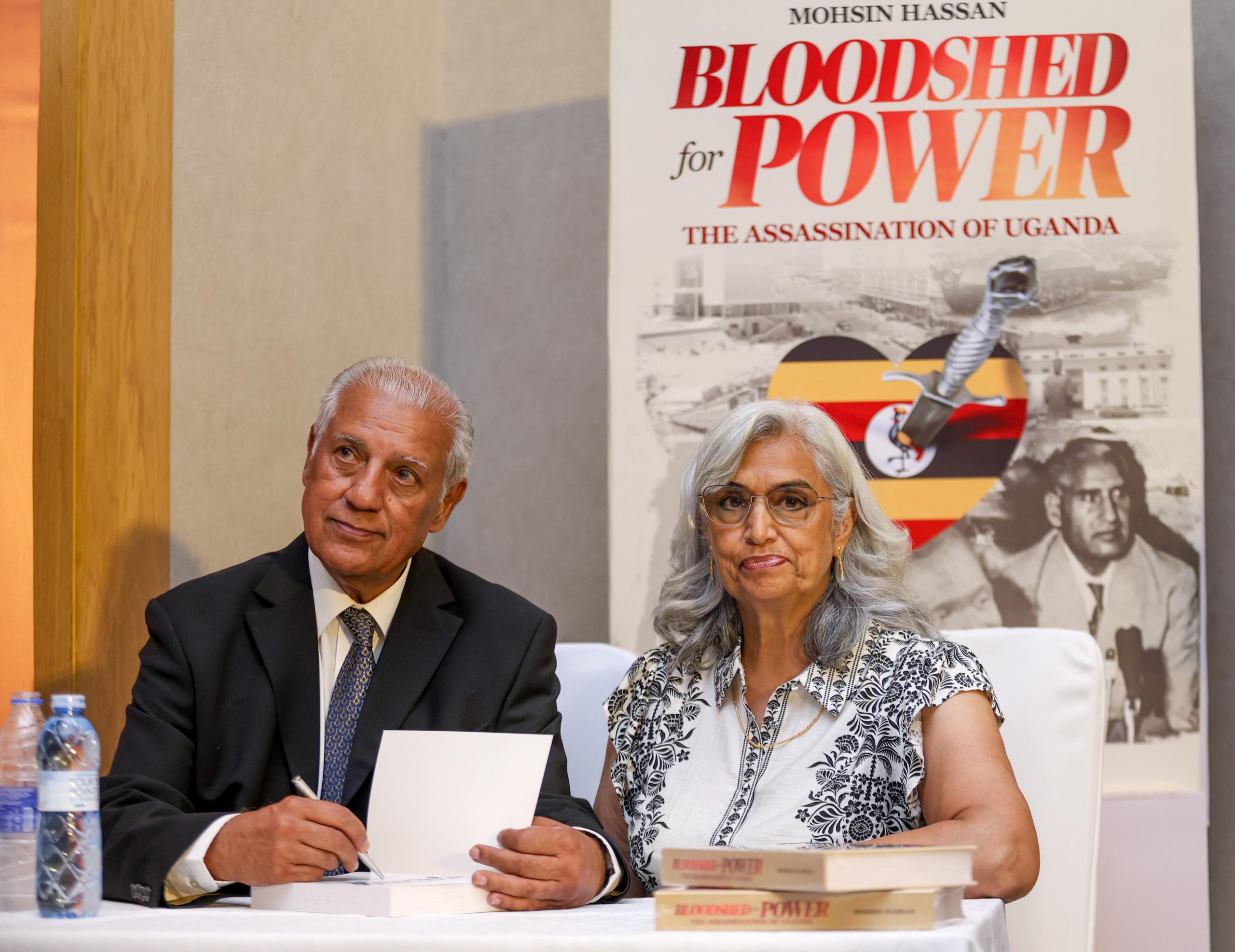
KAMPALA (UGNEWSLINE) — The memory begins with a shovel.
There was earth to move, orders to follow and work to be done.
For prisoners taken from Luzira in 1971, the digging at Mutukula initially appeared to be another grim task imposed on men whose freedom had already been taken away.
Then Prof. Charles Kwesiga understood what the digging was for.
They were preparing graves.
More than five decades later, Kwesiga returned to that memory in a Kampala hotel, telling an audience how prisoners lived with the knowledge that they could disappear at any moment.
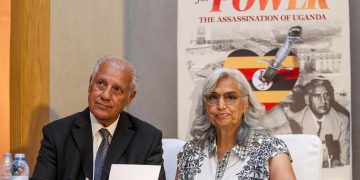
His testimony came at the launch of “Bloodshed for Power: The Assassination of Uganda”, a book by Mohsin Hassan that revisits the life and death of his father, Mohamed Hassan, a senior police officer who headed Uganda’s Criminal Investigation Department during one of the country’s most turbulent periods.
But the evening was about more than a book.
It was about what happens when people who survived history begin to speak about it again.
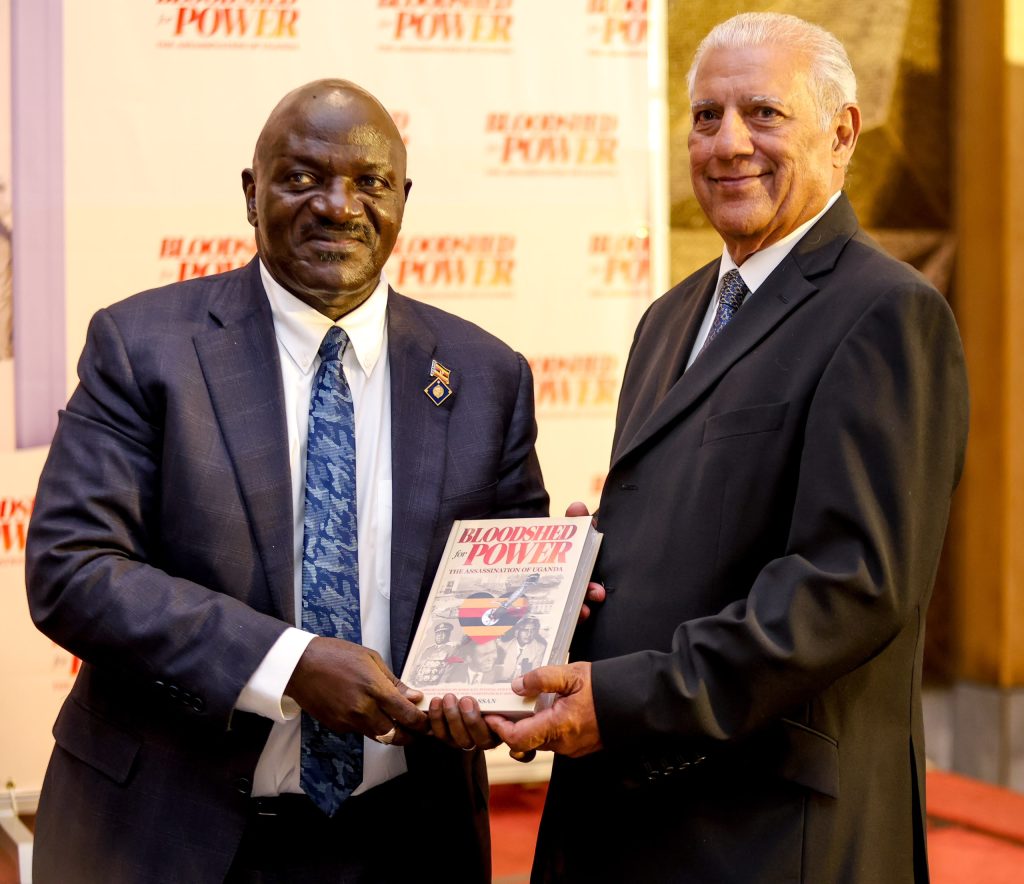 Kwesiga described being transferred from Luzira to Mutukula after his detention in 1971.
There, he said, prisoners were subjected to hard labour while living under an atmosphere of fear.
The work became particularly disturbing when the purpose of the digging became apparent.
Kwesiga recalled that detainees were made to bury other prisoners and later recounted his involvement in the recovery of Mohamed Hassan’s remains from a mass grave.
For those listening, the past suddenly acquired a human voice.
There were no statistics in his account.
There were no distant dates.
There was a man remembering what he saw.
A father’s unfinished story
Mohsin Hassan has spent years carrying another version of that history, the story of a father whose professional life placed him close to some of the most consequential investigations in Uganda before and during the political upheaval of the early 1970s.
Mohamed Hassan rose through the police service and eventually headed the Criminal Investigation Department.
His work included the investigation into the assassination of Brigadier Pierino Okoya and his wife, Anna, an episode that became part of the growing political tensions surrounding Uganda in the years before Idi Amin took power.
For his son, however, the challenge was not simply to tell the story of a police officer.
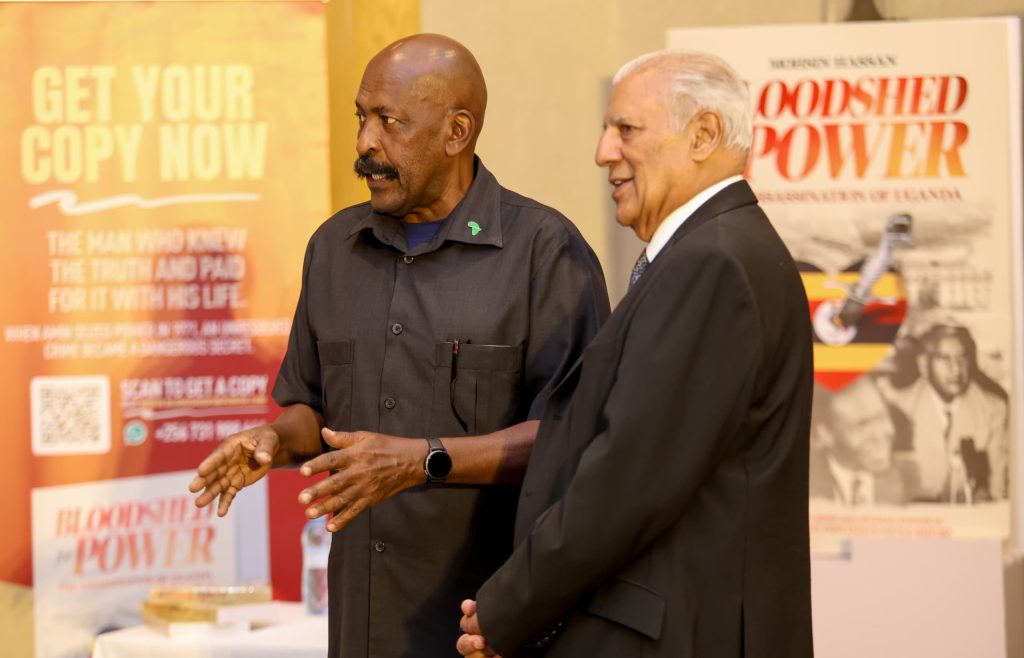
It was to recover a life from the arguments and political battles that surrounded it.
Hassan says he drew on archival material, police and court records, private papers and personal recollections while researching the book.
He also stresses a distinction that can easily disappear when history is retold: an allegation recorded during an investigation is not necessarily an allegation established in court.
That distinction sits at the heart of his attempt to reconstruct his father’s story.
He presents Mohamed Hassan as an investigator operating in an increasingly dangerous political environment, rather than as someone seeking political power for himself.
The book therefore asks readers to do something that historical controversies often make difficult: separate what is documented from what is alleged, and what is remembered from what can be independently established.
The weight of remembering
Uganda has lived through several periods in which political conflict left deep scars on families and institutions.
For many younger Ugandans, those events exist primarily in textbooks, documentaries, family conversations and the stories of parents and grandparents.
For survivors such as Kwesiga, they are memories.
And memories carry a different weight.
A prison transfer is not simply a line in an archive when you were the person being transferred.
A mass grave is not merely a historical reference when you helped recover the remains.
That is why eyewitness testimony can change the character of a historical conversation.
It brings the past closer.
At the book launch, Kwesiga’s account connected Hassan’s personal story to the wider human cost of Uganda’s political upheaval.
Why the story is resurfacing now
The passage of time has created distance from the events of the early 1970s, but it has not erased their significance.
Instead, each surviving testimony raises another question: what should a country remember, and how should it remember it?
That question is particularly important in societies whose political histories contain competing accounts of responsibility, victimhood and power.
Hassan does not ask readers to accept his narrative without scrutiny.
He encourages them to examine the evidence, challenge conclusions and debate interpretations.
In that sense, the book is less an attempt to close an argument than an invitation to reopen one.
Its central message is that history becomes stronger when evidence is questioned rather than simply accepted.
A room full of history
The launch at Four Points by Sheraton Kampala brought together figures from Uganda’s military, public service and wider society.
Retired Gen. Ivan Koreta served as chief guest, while Gen. Katumba Wamala, the Minister of Public Service, delivered the closing address.
Katumba commended the effort to document the story and urged younger Ugandans to engage with the country’s history.
His message reflected a concern that extends beyond this particular book.
As generations change, first-hand witnesses disappear.
With them can go details that official records never captured, the atmosphere of a prison, the fear of a particular night, the sound of people being moved, or the moment when an apparently ordinary task revealed something terrible.
Kwesiga’s recollection therefore matters not only because of what happened to him.
It matters because of what happens to a country’s memory when those who witnessed its darkest chapters are no longer able to speak.
History does not always arrive quietly
The launch generated discussion online under hashtags including #BloodShedForPower and #BookLaunch, extending the conversation beyond the hotel where the book was unveiled.
But the most striking image from the event remained the simplest one.
A survivor describing a shovel meeting the earth.
A task becoming a revelation.
And a memory that had travelled more than half a century before finding its way back into public conversation.
Uganda’s past cannot be changed by revisiting it.
But it can be examined more carefully.
It can be challenged, documented and debated.
And perhaps that is the real significance of Bloodshed for Power.
Not that it provides the final word on a troubled chapter of Uganda’s history, but that it gives another generation an opportunity to ask the questions that history leaves behind.
Who was responsible? What can be proved? What was forgotten? And whose voice was missing?
Those questions do not belong only to the past.
They belong to Uganda’s present, and to the generations that will inherit its history.