


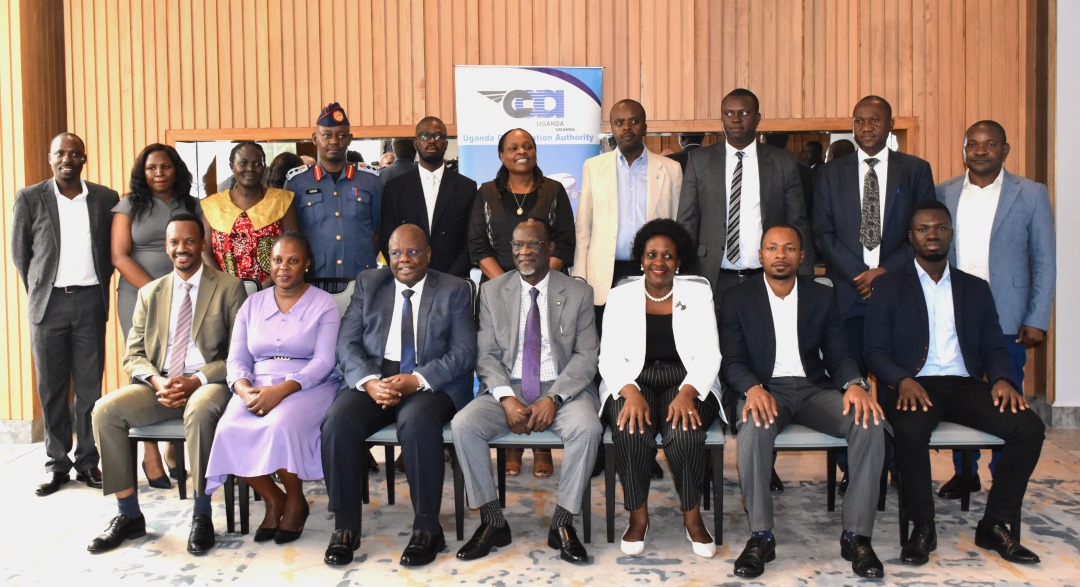
The inauguration of the National Committee on Wildlife Hazard Management marks a significant milestone in efforts to enhance aviation safety.
The Committee has been established in accordance with Regulation 273 of Statutory Instrument 94 of 2022, Civil Aviation (Aerodromes) Regulations, 2022.
Speaking during the inauguration ceremony in Kampala, Director Safety, Security and Economic Regulation, UCAA, Eng. Ronny Barongo, said that ICAO recognizes the need for a coordinated, national approach to managing the interaction between aviation operations and wildlife, to minimize the risks to aviation safety.
“The National Wildlife Committee will ensure that Uganda adheres to ICAO’s guidelines on land use practices, wildlife management and conservation, particularly with respect to wildlife hazards around airports and aviation operations,” he explained.
The committee is comprising of the technical experts from the different institutions which can shape the policy development and technical management of the wildlife around the airports.
“The committee will not only help in implementing the ICAO guidelines on wildlife management and conservation around airports in Uganda but may help the Uganda Civil Aviation Authority to close different Protocol Questions from the 2023 ICAO audit which is still open.” He emphasized.
The committee is expected to help the aviation industry in;
- Analyzing wildlife hazard problems at aerodromes.
- Share information on new research and investigation studies on wildlife hazard management.
- Acting as an interface between aerodrome operators and air operators.
- Advising aerodrome operators on wildlife hazard management.
- Reviewing the effectiveness of the wildlife hazard management program at aerodromes.
“The threat wildlife has on aviation safety is significant and can only be managed by synergies from different expert agencies. We know that this committee is very key in shaping this process of managing wildlife risk to aircraft operations,” he added
In his remarks Mr. Fred Bamwesigye, the director general of Uganda aviation authority, who is also the chairperson of this Committee said that this Committee has not been established by chance, it is a deliberate and strategic response to a pressing threats that has grown in significance over the years posed by wildlife, particularly bird strikes, to aviation safety in Uganda.
He cited an example of A KLM Airbus A330-200 on October 10th, 2010, that had a bird strike while performing flight KLM562 from Entebbe (Uganda) to Amsterdam (Netherlands), ingesting a bird into the right-hand engine, shortly after take-off.
“A bird strike is a collision between an aircraft and a bird. Besides impacting operations at the airport, this incident came with huge associated costs relating to procurement of a new aircraft engine. Each wildlife strike is a potential threat to human life, to aircraft, and to operational efficiency,” he said.
According to ICAO statistics, thousands of such incidents occur annually, with millions of dollars in damages and airport and airspace disruptions.
“Considering the growing air traffic, with increasing settlements near airports, and evolving wildlife behavior, it is imperative to adopt a national, coordinated approach in minimizing wildlife hazard around airports. Bird and wildlife strikes remain one of the most persistent operational risks facing airports globally and locally,” he stated.
He further added that the impact of such incidents goes beyond economic losses; it directly affects the safety of passengers, crew, aircraft, and airport operations.
“Entebbe being a bird sanctuary means that we inevitably must co-exist with the birds, while putting in place mitigation measures that ensure that the runways are free of birds prior to a landing or take-off. This comes at a huge cost and requires a lot of communal sensitization efforts, among others,” he noted.
This Committee will be the primary national platform for policy coordination, data sharing, and inter-agency collaboration on wildlife hazard management.
Hon. Justice Steve Kavuma, the Board Chairman of Uganda Civil Aviation Authority who represented the guest of honour, minister for transport and works Hon. Katumba Wamala said that the formation of this National Committee is both timely and necessary. “It signals a decisive step forward in the Government of Uganda’s commitment to systematically address the risks posed by wildlife around airports and in airspace. It brings together the essential minds and authorities from aviation, Makerere University, environmental science, wildlife biology, airport management and government agencies.”
He added; “As we begin this important journey, let us remember wildlife hazard management is not about exclusion, but about balance. It is about respecting the natural habitats while creating secure zones of operation for aircraft. That balance is delicate, but with science, data and dialogue, it is achievable. I urge you all to approach this with urgency. Let this Committee be known not only for its policies, but for its impact on Aviation safety, and on the future of aviation in our country.”
In conclusion, he commended the initiative taken by the Uganda Civil Aviation Authority in constituting this Committee.