


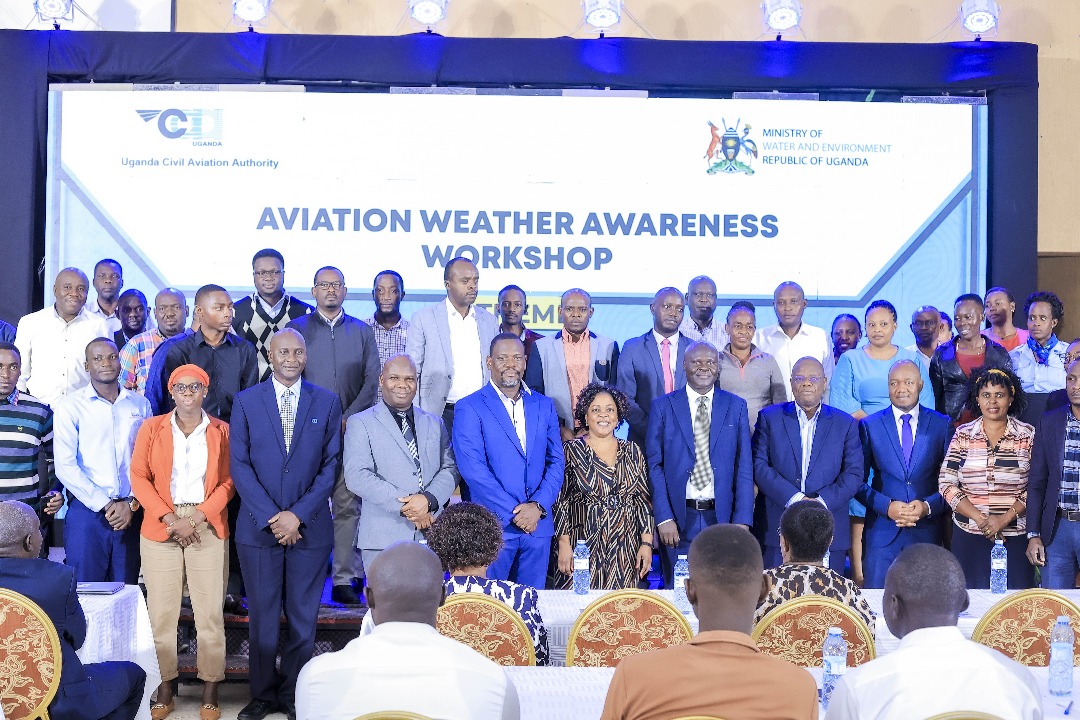
Entebbe, Uganda—The Government of Uganda has reaffirmed its commitment to aviation safety at a national Aviation Weather Information Workshop focused on enhancing the role of meteorology in flight operations. The two-day event, held at the Imperial Golf View Hotel in Entebbe, has brought together key stakeholders from the aviation and meteorological sectors to strengthen coordination, information sharing, and operational readiness.
Organized jointly by the Uganda Civil Aviation Authority (UCAA) and the Department of Meteorological Services under the Ministry of Water and Environment, the workshop focuses on enhancing coordination, technology use, and risk preparedness in response to weather-related aviation challenges.
Speaking at the opening ceremony, the Commissioner for Meteorology, representing the Permanent Secretary Dr. Alfred Okot Okidi, emphasized the vital importance of accurate and timely weather information in aviation.

“Weather is one of the most critical factors influencing aviation safety, regularity, and efficiency,” the Commissioner noted.
“Our role as meteorologists is not only to forecast but to ensure the information is precise, actionable, and seamlessly integrated into decision-making processes,” he added.
He also acknowledged Uganda’s recent strides in upgrading its meteorological infrastructure, including the installation of wind-shear detection systems (LLWAS), weather radar improvements, upper-air systems under the SOFF project, and the deployment of forecasting tools like the PUMA system.
“These investments reflect the government’s commitment to aligning with international aviation standards,” he said, while calling for continued vigilance amid rising severe weather risks fueled by climate change.
UCAA Director General Calls for Stronger Collaboration
In his remarks, the UCAA Director General reinforced the agency’s core principle, “Safety, Safety & Safety” and called for tighter collaboration between meteorologists and aviation professionals.
“Aviation is uniquely sensitive to weather from takeoff to landing. Accidents and delays linked to weather remain a global concern. Accurate forecasts and clear communication are non-negotiable,” he said.
Highlighting a sharp rise in aircraft movements at Entebbe International Airport from 21,584 in 2021 to 32,552 in 2024, the Director General urged stakeholders to match this growth with improved meteorological capacity and awareness.
“As air traffic increases, it is our responsibility to enhance aviation safety through better use of weather information,” he added.
He emphasized the importance of not only investing in modern technology like satellite imagery and predictive modelling but also ensuring professionals are trained to interpret and apply such data effectively.
Strategic Workshop Objectives
Under the theme “Fostering Coordination & Collaboration between Meteorologists and Aviation Professionals,” the workshop aims to:
Enhance early warning systems and real-time threat communication;
- Integrate new technologies, including AI, to improve forecast accuracy.
- Clarify institutional roles and strengthen inter-agency collaboration.
- Promote operational decision-making based on weather intelligence.
- Build capacity in weather-related risk management.
The workshop has attracted participants from across the aviation ecosystem including pilots, airline operators, airport management, meteorologists, air traffic controllers, customs, immigration, and emergency response teams.
A Whole-of-Sector Approach
Representing Entebbe International Airport, the General Manager of the Directorate of Airports and Aviation Security welcomed delegates and stressed that addressing weather-related challenges requires a whole-of-sector approach.
“This workshop is not just timely—it is essential,” he said. “Weather is a defining factor for flight safety, and our collaboration must reflect that reality.”
Looking to the Future
Over the next two days, technical sessions will cover best practices in aerodrome weather management, integration of meteorological data in airport operations, and collaborative strategies for safeguarding Uganda’s airspace.
“Let us use this workshop to share knowledge, close gaps, and develop practical solutions that will safeguard our skies. The lives of passengers, crew, and the integrity of our aviation infrastructure depend on the work we do.” Commissioner for Meteorology concluded.