




KAMPALA, Uganda — Uganda’s newly launched monthly National Cleaning Day campaign has encountered its first major challenge after the Seventh-day Adventist (SDA) Church objected to the government’s decision to hold the exercise on the last Saturday of every month, saying the schedule conflicts with one of the faith’s most sacred religious observances.
The disagreement has opened a wider debate about the balance between civic obligations and constitutional guarantees of religious freedom, just as President Yoweri Museveni prepares to lead the inaugural nationwide clean-up exercise in Kampala’s Nakasero area.
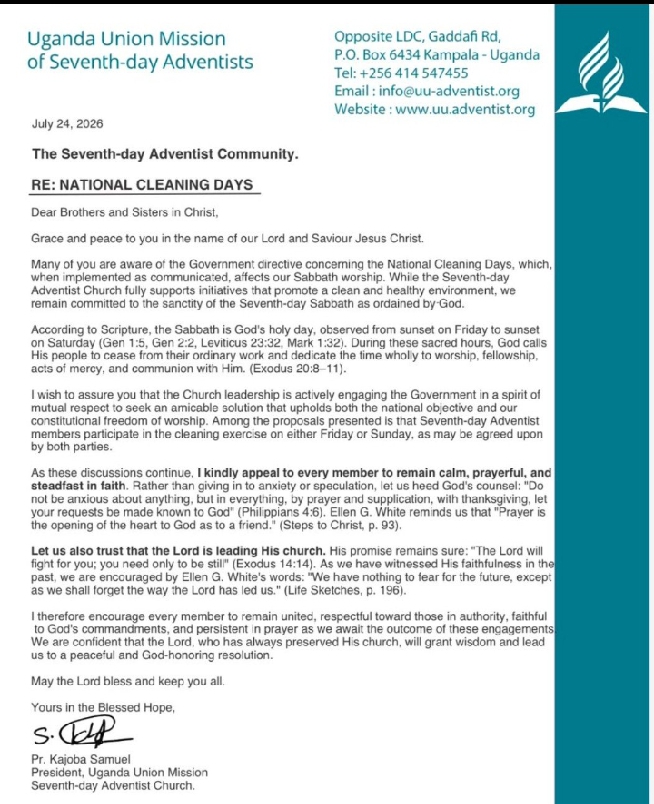
In a statement released on Friday, the Uganda Union Mission of the Seventh-day Adventist Church said it strongly supports government efforts to improve sanitation, public health and environmental protection.
However, church leaders said designating Saturday as the official day for the monthly exercise creates a direct conflict with the Sabbath, which Adventists observe as a holy day dedicated entirely to worship.

“Our commitment to a clean and healthy environment remains unwavering, but so does our commitment to the sanctity of the Seventh-day Sabbath as ordained by God,” Uganda Union Mission President Pastor Samuel Kajjoba said in a statement.
The church disclosed that it has begun consultations with government authorities in search of a practical solution that would enable Adventists to participate in the national campaign without compromising their faith.
Church leaders have proposed allowing members to join community cleaning activities on Fridays or Sundays instead.
Kajjoba urged Adventists across Uganda to remain peaceful, respect government institutions and avoid confrontation as discussions continue.
The Seventh-day Adventist Church is a global Protestant Christian denomination with more than 23 million baptized members worldwide and a significant presence across Africa, including Uganda.
The church traces its origins to the United States in the nineteenth century and is distinguished by its observance of the seventh-day Sabbath, from Friday sunset to Saturday sunset, in accordance with the Fourth Commandment.
Unlike most Christian denominations, which gather for worship on Sunday, Seventh-day Adventists believe Saturday is the biblical day of rest established at Creation and reaffirmed in the Ten Commandments.
During the Sabbath, members refrain from ordinary work, commercial activities and secular engagements, devoting the time to worship services, prayer, Bible study, family fellowship and community ministry.
The denomination also emphasizes healthy living, education, humanitarian service and preparation for the second coming of Jesus Christ.
Around the world, the church operates thousands of schools, universities, hospitals and health facilities alongside one of the world’s largest Protestant humanitarian organizations.
The current dispute arose after Uganda’s Cabinet approved the National Cleaning Day initiative in 2025, designating the last Saturday of every month for nationwide community clean-up exercises.
The programme is intended to encourage citizens to take greater responsibility for sanitation in neighbourhoods, markets and public spaces as part of a broader effort to improve environmental health.
Following concerns raised by the Adventist Church, the ruling National Resistance Movement (NRM) indicated that discussions with the Office of the Prime Minister had produced an interim understanding.
NRM Deputy Secretary General Rose Namayanja said in a post on X that Seventh-day Adventists would be free to attend Sabbath worship without interference while consultations continue over arrangements that could allow them to participate in the clean-up campaign on Fridays or Sundays.
“We will communicate the outcome as soon as the consultations are concluded,” she wrote.
The discussions underscore the challenges governments can face when implementing nationwide civic programmes in religiously diverse societies.
While both state officials and Adventist leaders say they share the goal of promoting cleaner communities, the negotiations now focus on whether the initiative can accommodate religious observance while maintaining broad public participation.
Other public members on social media also argued that government needed to sensitize people about the new initiative.