


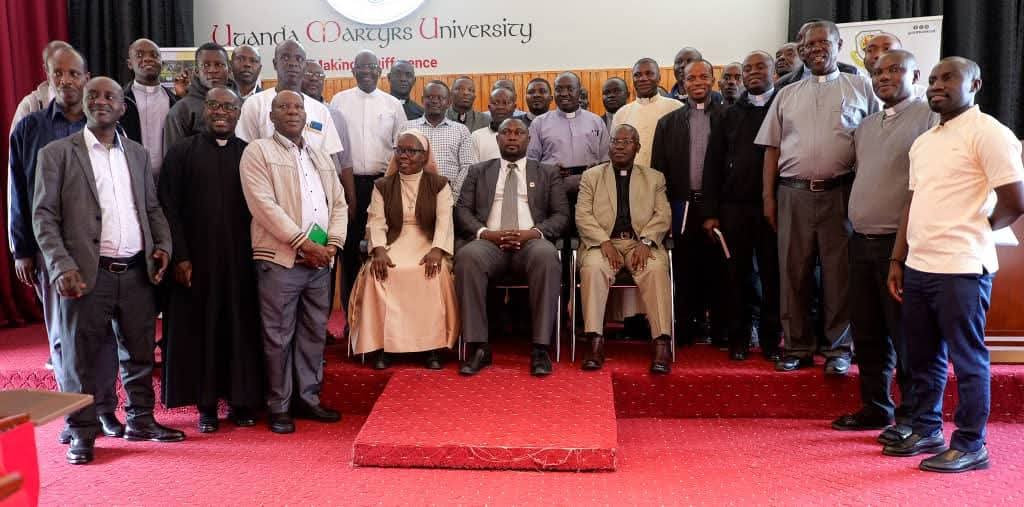
EDUCATION : Uganda Martyrs University has officially opened its 2026 Chaplaincy Short Course, bringing together participants from three different cohorts for advanced training in spiritual care, counselling, and community service.
The programme aims to equip chaplains with modern skills needed to address emerging social and spiritual challenges affecting communities, schools, hospitals, and other institutions.
Speaking during the opening ceremony, the Deputy Vice Chancellor of Uganda Martyrs University, Rev. Dr. Christopher Mukiidi, said the role of chaplains has become increasingly demanding due to rapid social transformation, technological advancement, and growing spiritual challenges in society.
“We live in a rapidly changing world marked by social transformation, technological advancement, cultural shifts, and many spiritual challenges. The ministry of chaplains today requires much more than goodwill,” Rev. Dr. Mukiidi said.
The ceremony was also attended by the Guest of Honour, Vicent Mutahunga, who encouraged participants to lead with empathy, presence, and genuine relationships in the communities they serve.
Mutahunga urged chaplains to “go where people are,” build trust through accompaniment, and carry hope as the foundation of their ministry.
According to university officials, the current intake combines participants from Levels One, Two, and Three of the programme. Rev. Dr. Mukiidi revealed that the university has so far conducted three cohorts since the programme was introduced about two years ago.
“So far we have had three cohorts. We had the first cohort about two years ago, then the second cohort, and now we are having the third cohort,” he said.
He added that the university is working towards transforming the short course into a fully accredited academic and professional programme that could eventually lead to a postgraduate diploma in chaplaincy and pastoral ministries.
“Plans are underway to ensure that these short sessions are eventually developed into an academic programme or professional programme where participants can receive a postgraduate diploma in chaplaincy ministries or related professional qualifications,” he noted.
The university reported that about 48 participants had registered for the training, with more expected to join during the course.
The programme focuses on three key areas, including care and counselling skills, crisis response and trauma support, as well as community engagement and personal resilience.
Rev. Dr. Mukiidi emphasized that the training is designed to bridge practical knowledge gaps among chaplains by exposing them to areas such as ICT, artificial intelligence, financial management, budgeting, project writing, and mental health support.
He explained that many chaplains are now facing modern-day challenges in schools and communities, including drug abuse, suicide cases, cohabitation, and mental health struggles among young people.
“When these issues are not addressed early, they can easily escalate into bigger problems affecting students, institutions, and even the church,” he said.
He further stressed that chaplaincy should go beyond conducting religious activities, describing it as “a ministry of presence and accompaniment.”
“The chaplain must be present when students are in sports, during difficult moments, and when handling challenges affecting them. It is not enough to only appear for prayers or Mass and then leave,” he added.