


The Ugandan government has returned to Parliament seeking approval to borrow €207.77 million (about Shs893 billion) to finance the long-delayed upgrading of the Jinja–Mbulamuti–Kamuli–Bukungu road, reviving a project that has been promised for more than two decades.
Finance Minister Henry Musasizi tabled the revised financing proposal on August 6, 2026, after the government renegotiated an earlier €230.45 million loan approved by Parliament in October 2025.
The new package is €22.68 million, or about Shs97.4 billion, lower than the original financing requirement.
Musasizi said the reduction followed negotiations between the Ministry of Finance, the Ministry of Works and Transport, Citibank and the African Trade Investment Development Insurance (ATIDI), which now provides insurance cover for the transaction.
The restructuring was also prompted by a change in policy by Sinosure, the Chinese export credit agency that had been expected to support the original financing.
According to Musasizi, Sinosure introduced a €100 million ceiling for financing non-revenue-generating or non-self-financing projects, making the earlier arrangement unsuitable for the road project.
The revised financing will comprise an estimated €179.26 million Citibank facility, including insurance, for the road works, and a further €28.51 million commercial facility to cover land compensation, supervision and the owner’s engineer.
A road long promised
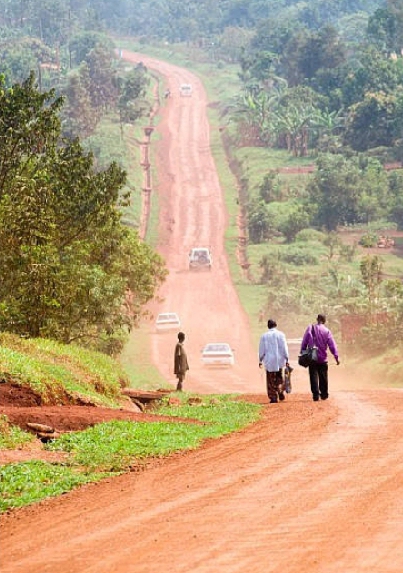
The project involves upgrading 127 kilometres of the existing Jinja–Mbulamuti–Kamuli–Bukungu road from gravel to paved Class II standard, as well as 10 kilometres of roads in Jinja City.
The corridor is regarded as strategically important to eastern Uganda, linking Jinja and Kamuli and extending towards Bukungu in Buyende.
Government says it could provide an alternative north-south transport route towards areas including Amolatar, Kaberamaido, Soroti, Nakasongola and Kayunga.
It also serves farming and trading communities whose access to markets depends heavily on the road network.
But the project has become a symbol of Uganda’s long-running struggle to turn infrastructure promises into completed projects.
The government has pledged to pave the road for more than 20 years, raising questions over why construction has yet to advance substantially despite the signing of a civil works contract in 2023.
Parliamentary documents show that the government signed a contract worth about Shs649.57 billion with PowerChina International Group Limited on March 15, 2023, covering the design and construction of the road and the Jinja City roads.
That timeline is likely to come under renewed scrutiny as Parliament considers the latest borrowing request.
Parliament faces a bigger test
Lawmakers have already raised questions about the government’s borrowing priorities and the pace of implementation.
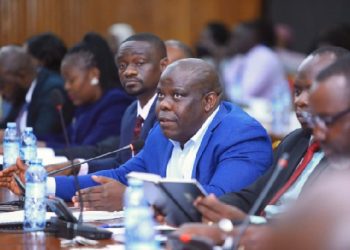
MP Patrick Nsamba Oshabe welcomed the project but questioned how government determines which roads receive financing, while Joseph Gonzaga Ssewungu asked whether newly created districts had been given priority in road development.
Deputy Speaker Thomas Tayebwa urged MPs to reserve the substantive debate for the committee stage, reminding them that Parliament has the power to reject the loan.
Tayebwa directed the relevant committees to examine whether the project is included in approved government work plans and report back to the House within 45 days.
The scrutiny comes as Uganda faces mounting pressure over public debt and debt-service costs.
Ministry of Finance figures show public debt reached about $32.3 billion in the 2024/25 financial year, with the debt-to-GDP ratio rising to 51.3%, largely as a result of increased domestic borrowing.
The government argues that borrowing for productive infrastructure can stimulate economic growth by reducing transport costs, improving market access and connecting production areas to major commercial centres.
For the Jinja–Kamuli corridor, that economic argument is central to the case for the loan.
But Parliament will also have to determine whether the project is ready for implementation and whether the revised financing offers value for money.
Key questions include the status of land acquisition and compensation, the contractor’s preparedness, financing conditions, project supervision and the timetable for construction.
The existence of a civil works contract signed in 2023, followed by financing approval in 2025 and another financing request in 2026, is likely to heighten concerns about delays.
From promise to pavement
The €22.68 million reduction in the proposed borrowing gives government a stronger financial case than the previous arrangement, but the central issue for Parliament is whether the new deal can finally deliver the road.
A completed highway could reduce travel times and transport costs, strengthen agricultural trade and improve connectivity between eastern Uganda and other parts of the country.