


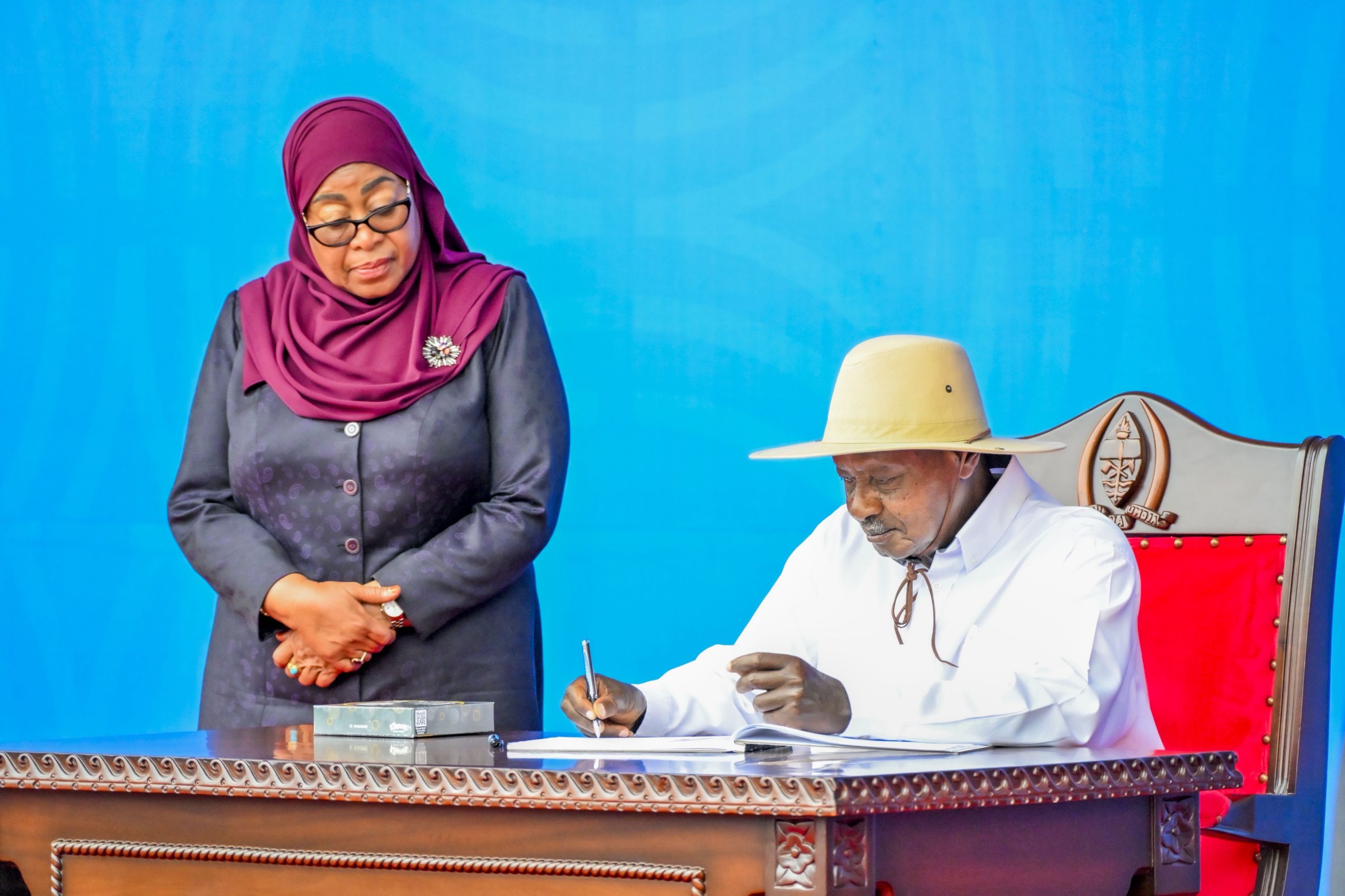
The renewed partnership was announced in Dar es Salaam after high-level talks between President Yoweri Kaguta Museveni and President Samia Suluhu Hassan, with both leaders framing the agreements as a strategic push to deepen regional integration and unlock cross-border value chains.
Energy cooperation dominated the discussions.
President Samia confirmed that the East African Crude Oil Pipeline (EACOP) project is progressing as planned, with oil transportation expected to begin in July, marking a major milestone for Uganda’s oil sector and cementing Tanzania’s role as a critical energy transit hub.
Beyond EACOP, the two countries agreed to advance plans for a gas pipeline from Tanzania to Uganda and a refined oil pipeline from Uganda to the port of Tanga, further positioning Tanzania as Uganda’s primary export corridor for petroleum products.
Trade facilitation and infrastructure were the other major pillars of the talks. Uganda is seeking expanded access to Tanzanian ports, particularly Tanga and Dar es Salaam, to reduce costs and speed up cargo movement.
Discussions also covered extending railway connectivity deeper into Uganda, a move seen as key to lowering logistics costs and boosting the competitiveness of regional trade.
President Samia acknowledged that non-tariff barriers have continued to undermine cross-border commerce, despite strong bilateral ties.
She said both governments committed to dismantling these obstacles, arguing that smoother trade flows are essential for accelerating growth and strengthening the East African regional market.
The talks also reinforced joint energy production efforts aimed not only at meeting domestic demand but also at supplying regional and international markets, signaling East Africa’s ambition to become a more significant player in global energy value chains.
Beyond economics, the two leaders addressed peace and security in the Great Lakes Region, agreeing to support dialogue initiatives to resolve ongoing conflicts.
Both sides emphasized that economic integration and regional stability are mutually reinforcing.
President Museveni used the meeting to link economic cooperation to Africa’s broader liberation narrative, arguing that modern independence depends on productive economies capable of generating income through competitive industries.
He also highlighted emerging plans for industrial specialization, with Tanzania focusing on locomotive manufacturing while Uganda develops its textile sector, an approach aimed at reducing duplication and building complementary strengths.