



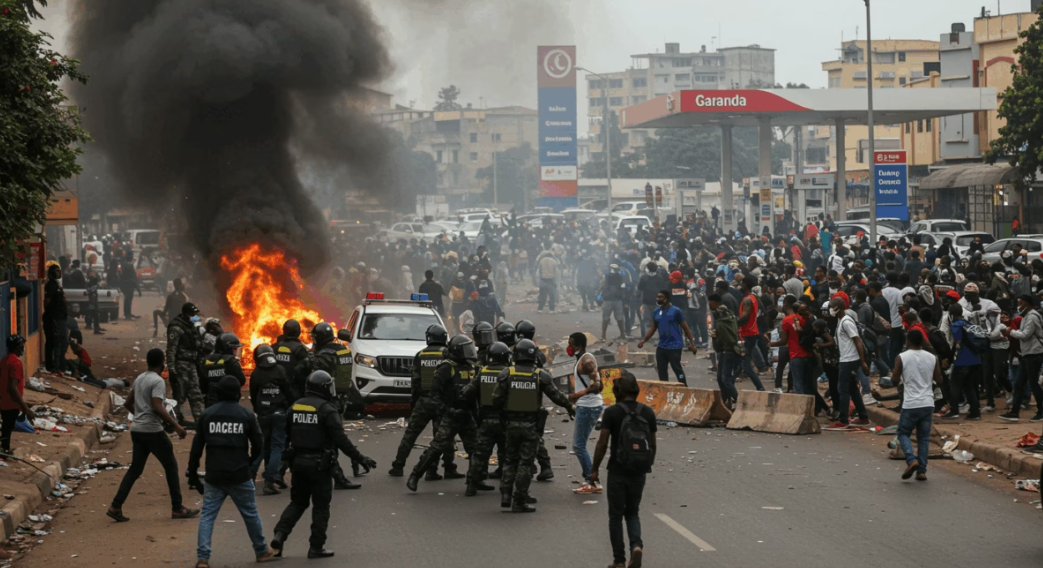
Public outrage over a steep increase in fuel prices sparked three days of violent unrest across Angola, with much of the anger directed at the country’s sizable Chinese community. The violence resulted in the looting and destruction of businesses, the shutdown of several factories, and the departure of thousands of Chinese nationals.
The unrest began after the Angolan government announced a reduction in gasoline subsidies, triggering widespread protests. Tensions were already high following the government’s decision in August to shut down 25 illegal Chinese-run cryptocurrency mining sites and deport 60 Chinese nationals allegedly involved.
Cryptocurrency mining, banned in Angola due to its heavy energy consumption, requires specialized hardware to solve complex algorithms in exchange for digital currency. The miners apprehended in the crackdown were ordered to leave Angola within 24 hours.
Footage broadcast by BBC Zimbabwe and other media outlets showed crowds of Chinese nationals at Luanda’s international airport, many rolling suitcases behind them. In one clip, a man is heard saying “bye-bye” to the departing Chinese residents while speaking Portuguese.
Angola hosts an estimated 300,000 Chinese citizens, one of the largest Chinese communities in Africa. Chinese-owned enterprises are active across multiple sectors including construction, mining, and retail. During the July riots, nearly 100 Chinese-owned shops in Luanda were vandalized or destroyed.
Analysts say the violence reflects deepening public frustration over what many Angolans see as years of exploitation by Chinese businesses and workers. Recent incidents have added fuel to the fire. In 2024, Angolan authorities shut down two Chinese factories, one metals facility accused of polluting a river while operating without a license, and a plastics plant reportedly keeping more than 100 Angolan workers confined in substandard living conditions.
Local fishermen have also raised concerns about Chinese trawlers depleting coastal fish stocks that sustain traditional livelihoods.
Although Chinese investment has powered Angola’s economic expansion over the past two decades, critics argue that the benefits have been uneven. The wealthiest 20% of Angolans have reaped most of the rewards, while the poorest 20% have seen few tangible improvements in their lives.
Angola has received more funding from China’s Belt and Road Initiative than any other African nation, approximately $68.6 billion in loans from 2000 to 2021, according to AidData. These funds have supported major infrastructure projects, including the new Dr. Antonio Agostinho Neto International Airport, completed in 2024. With the capacity to serve 15 million passengers and 600,000 tons of cargo annually, it is the largest airport China has financed outside its borders.
Angola committed to repaying much of this debt with oil, but in recent years, as China has shifted its oil imports to Russia and the Middle East, repayment has become increasingly difficult.
Adding to public discontent is the perception that Chinese companies have marginalized Angolan workers on Belt and Road projects, often reserving skilled positions for Chinese nationals and relegating locals to low-wage manual labor.
Quality concerns have also plagued some Chinese-built infrastructure. In one high-profile case, the $8 billion Luanda General Hospital, constructed with Chinese funds, was forced to shut down shortly after opening in 2010 due to structural issues. It only reopened two years later after extensive repairs.
“Chinese investments did not fulfill the expectations of improving Angola’s technological capacity and infrastructure,” wrote analyst Sumie Yoshikawa in a 2025 article for the Eurasian Review. “Moreover, many of the roads, houses, and buildings constructed by Chinese companies were of remarkably low quality.”