




Ugandan authorities have today (June 30, 2026) charged former cabinet minister and prominent women’s rights advocate Dr. Miria Matembe with promoting sectarianism, in a case that has intensified concerns among opposition figures and rights organizations over freedom of expression and the treatment of government critics.
Matembe, 73 appeared before the Grade One Magistrate’s Court in Luzira days after her arrest by security personnel.
Her appearance ends a period of uncertainty during which supporters, lawyers and civil society groups had demanded that authorities disclose her whereabouts and either release her or bring her before a court.
The veteran politician, who previously served as Uganda’s Minister of Ethics and Integrity, Member of Parliament and a member of the Constitutional Commission that helped draft the country’s 1995 Constitution, appeared visibly frail and was being aided into court.
Prosecutors accuse Matembe of promoting sectarianism, an offence under Ugandan law that authorities say is intended to prevent speech capable of inciting discrimination or threatening national unity.
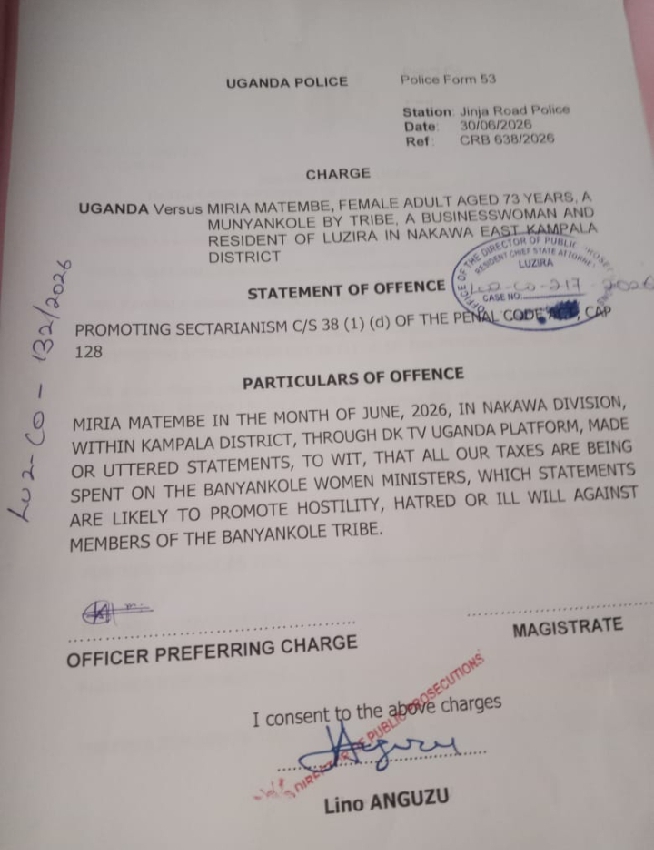 Her prosecution followed public remarks in which she criticized the conduct of Chief of Defence Forces Gen. Muhoozi Kainerugaba and expressed concern about what she described as the military’s growing role in civilian affairs. Government officials have consistently maintained that all suspects are investigated and prosecuted in accordance with the law and that no individual is above legal accountability.
Outside the courtroom, supporters and opposition leaders gathered in solidarity with Matembe.
David Lewis Rubongoya, secretary general of the opposition National Unity Platform, said after the hearing that the former minister appeared physically weak but remained composed throughout the proceedings.
The case has drawn criticism from domestic and international rights organizations, which argue that criminal prosecutions should not be used to restrict peaceful political expression. Amnesty International has previously called on Ugandan authorities to end what it describes as the harassment of activists and government critics, while urging respect for freedoms of expression and association.
The Uganda Law Society has also raised concerns about what it says is an increasing number of arrests involving lawyers, journalists and civil society activists.
Matembe has long been one of Uganda’s most prominent advocates for constitutional reform, women’s rights and anti-corruption initiatives.
Once part of the ruling establishment, she later emerged as an outspoken critic of the government, frequently speaking on governance, accountability and democratic freedoms.
Her prosecution comes amid heightened political tensions in Uganda, where opposition leaders have accused authorities of using criminal investigations to silence dissent ahead of a politically significant period.
The government rejects those allegations, saying law enforcement agencies act independently and within the framework of the Constitution.
The offence of promoting sectarianism has been the subject of recurring legal and political debate in Uganda. Critics argue that its broad wording risks limiting legitimate political speech, while government officials maintain that the law remains an important safeguard against rhetoric that could inflame ethnic, religious or regional divisions.
The court adjourned the matter to a later date as the case proceeds through Uganda’s criminal justice system. Legal representatives for Matembe are expected to challenge aspects of the prosecution, while rights groups say they will continue monitoring the proceedings as a test of judicial independence and freedom of expression in the East African nation.