


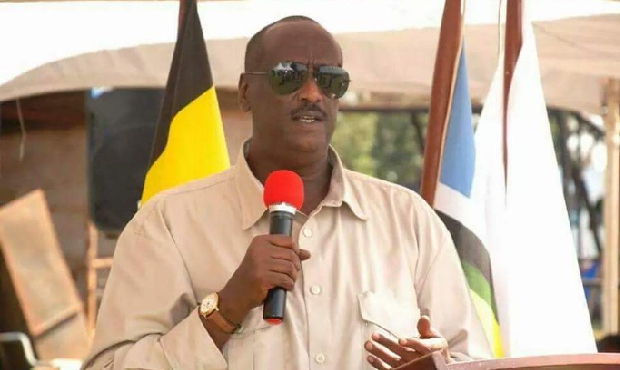
A rare intervention by Gen. Caleb Akandwanaho commonly known as Salim Saleh, one of Uganda’s most influential military figures and the younger brother of President Yoweri Museveni, has added a new political dimension to the high-profile prosecution of opposition leader Col. Dr. Kizza Besigye and veteran lawyer Erias Lukwago, highlighting growing concerns over government messaging and the military’s role in politically sensitive legal proceedings.
In handwritten letter allegedly by Gen. Saleh addressed to Chief of Defence Forces Gen. Muhoozi Kainerugaba, he (Saleh) urged the army chief to brief Justice and Constitutional Affairs Minister Norbert Mao on developments surrounding the case, arguing that the government needed a coordinated and constitutionally grounded response to mounting public scrutiny.
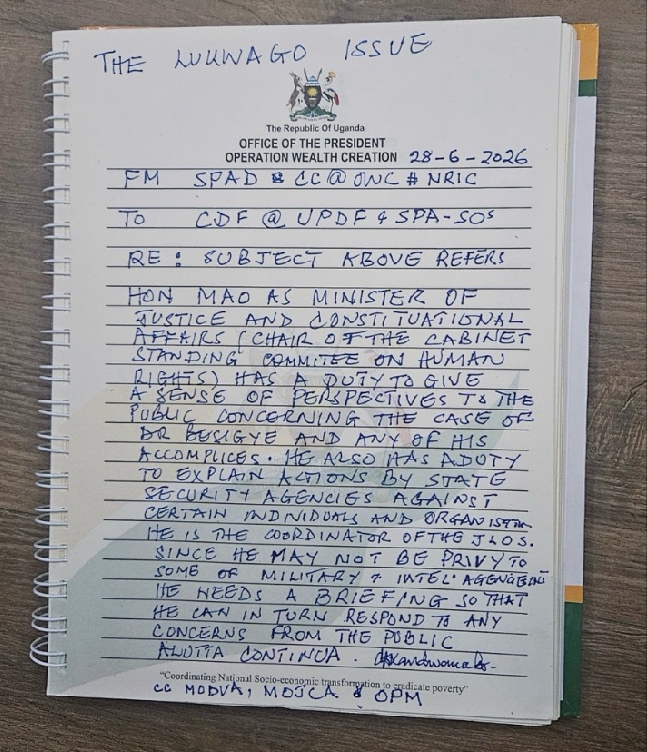
The letter, titled “The Lukwago Issue”, comes just ahead of another closely watched court appearance by Besigye and Lukwago, who face treason-related charges that they have consistently denied.
Their prosecution has become one of Uganda’s most politically contentious legal battles, attracting attention from civil society groups, diplomats and international observers concerned about the country’s democratic trajectory.
Saleh’s intervention appears aimed at placing Justice Minister Mao at the forefront of public communication, emphasizing that, as the political head of the Justice Ministry, he should be fully informed and prepared to explain the government’s position to Ugandans.
The move is widely interpreted as an effort to present a more disciplined institutional response amid escalating political debate.
The timing is significant. In recent weeks, Gen. Muhoozi has drawn criticism after making public statements suggesting that Besigye and Lukwago should face the death penalty over allegations that they plotted to assassinate President Museveni.
Those remarks sparked concern among legal observers, who questioned whether such comments from the country’s top military commander risk undermining confidence in judicial independence before the courts have ruled on the case.
Saleh’s letter reportedly goes beyond recommending improved communication.
It also advises that Minister Mao seek an audience with President Museveni to discuss what it describes as the need to restrain Muhoozi’s public commentary on ongoing legal matters, reflecting apparent unease within sections of the political establishment over increasingly outspoken military involvement in politically charged cases.
The developments coincide with another controversy that has intensified debate over governance and civil liberties in Uganda: the recent shutdown of several major media outlets operated by Nation Media Group Uganda, including NTV Uganda, Daily Monitor, KFM, Dembe FM and Spark TV.
Former government spokesman Ofwono Opondo has publicly questioned the legal authority behind the closures, asking whether the decision originated from the government or from the Patriotic League of Uganda (PLU), the political movement closely associated with Muhoozi. Opondo argued that allegations of media bias, even if proven, would not constitute sufficient legal grounds for closing independent news organisations.
His criticism prompted a swift response from newly appointed PLU chairman Daudi Kabanda, who defended the movement’s growing political influence and dismissed concerns over its expanding role in national affairs. The public exchange has underscored emerging tensions within Uganda’s ruling establishment over the balance of authority between state institutions, political movements and security agencies.
Political analysts say Saleh’s intervention reflects broader questions about institutional coordination, the separation of powers and the appropriate role of military leaders in active judicial proceedings.
While some interpret the letter as an attempt to restore discipline to government communication, others view it as evidence of differing approaches within senior leadership over how politically sensitive cases should be managed.
Attention now turns to the courts, where prosecutors are expected to continue presenting their case against Besigye and Lukwago.
The proceedings are likely to be closely followed by political leaders, lawyers, diplomats and human rights advocates as Uganda navigates one of its most consequential legal and political moments in recent years.
Neither the Ministry of Justice nor the Office of the Chief of Defence Forces had publicly commented on the contents of Saleh’s ‘letter’ at the time of publication.