


KAMPALA, Uganda (UGNEWSLINE) — Six decades after its creation, the Catholic Archdiocese of Kampala is confronting a challenge that goes beyond the growth of its congregations: how to turn the influence of the Church into a stronger force for integrity, unity and social responsibility in Uganda.
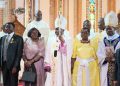
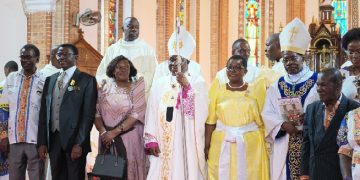
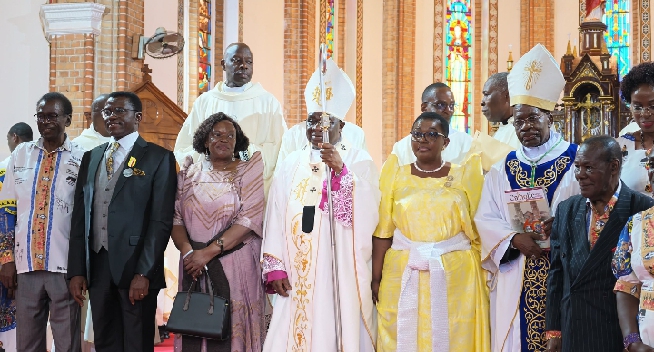
The question featured prominently as Archbishop Paul Ssemogerere led Catholics in marking the Archdiocese’s 60th anniversary at St Mary’s Cathedral, Lubaga, on Sunday, October 25, with thanksgiving, reflection and recognition of people who have contributed to the Church’s work.
The celebrations combined a look back at the institution’s history with a message about the responsibilities facing Christians today.
Ssemogerere urged believers to examine whether their conduct reflects the values they profess, pointing to concerns about lawlessness and declining moral standards.
His message placed the emphasis on what happens beyond church services: the choices people make in their homes, workplaces and communities, and the extent to which their faith influences how they treat others.
The Archbishop also highlighted the importance of unity, using the example of the human body to illustrate how different members can perform separate functions while contributing to one purpose. The message was a reminder that the Church’s strength depends not only on its leadership but also on the willingness of its members to work together.
Among those recognised during the celebrations was Buganda Kingdom Katikkiro Charles Peter Mayiga, honoured for his contribution to the Church through his role as patron of the Lweza Parish Men’s Guild.
Mayiga was among Christians awarded medals named after former leaders of the Archdiocese, including Joseph Kiwanuka, Cardinal Emmanuel Nsubuga and Cyprian Kizito Lwanga. The awards highlighted the contribution of lay people whose involvement in parish activities, mobilisation and community service helps sustain the Church beyond its formal leadership structures.
The recognition also reflected the longstanding place of parish associations in Catholic life. Through fellowship, prayer and community initiatives, such groups help connect the Church’s broader mission with the daily needs of its members.
The anniversary marked a defining moment in the history of Uganda’s Catholic Church. On August 5, 1966, the Holy See established the Kampala Archdiocese by reorganising ecclesiastical territories associated with the former Diocese of Kampala and the Archdiocese of Rubaga.
Monsignor Emmanuel Nsubuga, previously vicar general of the Rubaga Archdiocese, became Kampala’s first Archbishop. His episcopal consecration took place at Nakivubo War Memorial Stadium on October 30, 1966, marking the beginning of a new chapter in the administration of Catholic communities in central Uganda.
Nsubuga went on to become Uganda’s first cardinal in 1976, cementing his place among the country’s most influential Catholic leaders. His legacy remains part of the Archdiocese’s institutional memory, reflected in the naming of awards presented to Christians for distinguished service.
The creation of Kampala Archdiocese was part of a broader evolution in Uganda’s Catholic organisation. The country’s Catholic hierarchy had been formally elevated in 1953, when Rubaga became an archdiocese. Subsequent territorial changes created additional dioceses as the Church expanded its administration and pastoral reach.
Kiyinda-Mityana was established in 1981, while Kasana-Luweero and Lugazi became dioceses in 1996, following the division of territories previously under Kampala. These changes reshaped the Church’s geographical structure while preserving its wider ecclesiastical links.
Today, the Kampala Archdiocese covers about 3,645 square kilometres and serves an estimated population of 3.59 million people through 77 parishes, according to its official history. Its work encompasses worship and pastoral care alongside education, and healthcare among others.