


Every light that flickers on in a Ugandan village tells a story, one of innovation, collaboration, and hope. Across the country, from the shores of Lake Victoria to remote rural villages, the glow of electricity marks a quiet but powerful transformation.
Through the Global Gateway, the European Union and Uganda are rewriting the nation’s energy story, turning challenges into opportunities and ambition into action.
For decades, countless Ugandan households depended on firewood and charcoal, fuels that were expensive for families and destructive to forests.
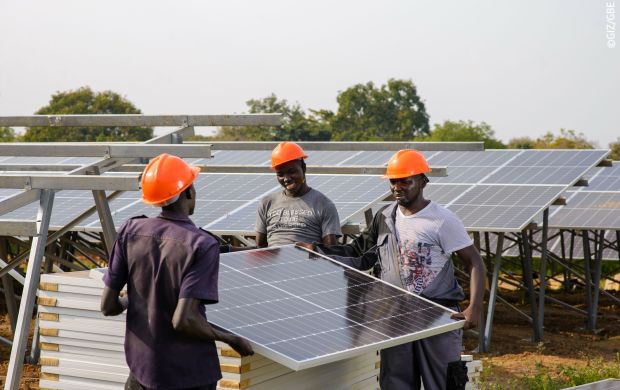
Today, solar panels glimmer across rooftops and rural landscapes, symbols of a clean energy revolution driven by Team Europe’s commitment to sustainability. Projects such as GET Access Uganda and the Beyond the Grid Fund for Africa are bringing off-grid solar power to millions. In homes once lit only by kerosene lamps, children can now study after dark.
Small shop owners keep their fridges running, and farmers use solar-powered irrigation pumps to water their crops.
Each connection, each spark of light, reflects a nation moving closer to its ambition:
Universal access to electricity by 2030.
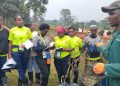
With EU support, Uganda is extending power lines across districts and islands, constructing 1,500 kilometres of new transmission lines and 1,300 kilometres of distribution networks. These projects are reaching homes, schools, and health centres that were once left in the dark. Mini-grids are now powering rural trading centres and refugee settlements, while more than 250 solar technicians have been trained to sustain the momentum of this clean energy surge.
Uganda’s transformation is not confined within its borders. Through initiatives like the Uganda–Kenya interconnector and its participation in the Zambia–Tanzania–Kenya power line, Uganda is joining a regional energy network that promises lower costs, greater stability, and stronger cooperation across the continent.
Shared prosperity
The EU’s Global Gateway strategy, with over EUR 3.4 billion dedicated to renewable energy in Sub-Saharan Africa, represents more than just infrastructure investment, it is a commitment to inclusion, sustainability, and shared prosperity. Uganda’s Energy Transition Plan, launched at COP28, sets a bold course toward climate resilience and the creation of green jobs.
“Every solar panel installed, every kilometre of power line built, is a step toward a just energy transition,” says Ambassador Jan Sadek. “Together, we’re lighting up lives and building Uganda’s greener tomorrow.”
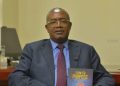
In his message in the 2024 EU brochure, Sadek explains that the Global Gateway embodies the EU’s dedication to bridging the global infrastructure investment gap, projected to reach USD 15 trillion by 2040.
The strategy, he notes, promotes smart, clean, and secure investments in both soft and hard infrastructure, adhering to the highest environmental and social standards.
By investing in climate-resilient infrastructure, the Global Gateway aims to accelerate sustainable development while offering fair financial conditions and an ethical approach, ensuring that infrastructure projects do not create unsustainable debt.
“Our ambitious goal is to mobilise EUR 300 billion by 2027 across the globe, with EUR 150 billion targeted for Sub-Saharan Africa. EUR 3.4 billion of EU funding are dedicated to supporting the transition to renewable energy and enhancing energy efficiency in the region,” Sadek notes.
Through these investments, the EU aims to deploy at least 50 GW of additional renewable electricity and connect 100 million people to power across Africa by 2030.
Sadek emphasizes that Uganda and the EU share a unified vision for a just and clean energy transition. “As Uganda’s largest development ally, we mobilise financing that leverages both private and public investments, prioritising green and climate transitions, sustainable growth, and job creation,” he says.
He highlights Uganda’s energy sector as a prime example of Team Europe’s collaborative strength: “Pooling the expertise and resources of EU Member States and institutions allows us to maximise impact. Our efforts improve electricity access, particularly in rural communities, and mobilise investments in renewable energy generation and regional power interconnectors,” he adds.
“These efforts,” he adds, “aim to strengthen energy security in Uganda, enable the export of surplus renewable power, and help combat deforestation, a tangible contribution to Uganda’s forthcoming National Development Plan IV. This will further consolidate Uganda’s role as a global frontrunner in green energy.”
Through these collective efforts, the EU and Uganda are not merely lighting homes, they are illuminating a path toward a sustainable, inclusive, and prosperous future.
“Together, we are working towards a lasting legacy of sustainable development and shared prosperity for Uganda and its people,” Sadek notes.
Disclaimer
The views and opinions expressed in this article are those of the author(s) and do not necessarily reflect the official position of the European Union. Responsibility for the content lies solely with the author(s) and the publishing platform.