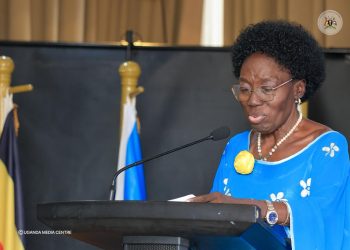




President Yoweri Kaguta Museveni, represented by the Minister of Trade, Industry and Cooperatives (MTIC), Francis Mwebesa, has officially launched the much-anticipated National Cooperatives Savings and Credit Society Ltd—a precursor to the National Cooperative Bank, which will become a cooperators-owned bank.
The high-profile launch took place yesterday during the National Cooperatives Conference 2025 at UMA Grounds, Lugogo, attended by over 2,000 delegates, including District Cooperative Officers (DCOs), leaders of various cooperative bodies, and SACCOs, among others. The event was held under the theme: “Driving Inclusive and Sustainable Livelihoods Through Cooperatives for a Better World.”
The President, in his speech read by Minister Mwebesa, congratulated and appreciated the efforts of the UCA Board, government ministries, departments and agencies (MDAs), and all stakeholders. He emphasized that cooperators must work as a team to safeguard the interests of their new bank.
State Minister for Cooperatives, Fredrick Ngobi Gume, together with the Board of the Uganda Cooperative Alliance (UCA), expressed collective appreciation for the efforts that brought this two-decade-long dream to fruition.
The UCA General Secretary, CPA Ivan Asiimwe, pointed out that cooperators in Uganda could soon have access to affordable and appropriate financing following the formal inauguration of the new society, a key step toward reviving the defunct Cooperative Bank, whose assets were taken over by the Bank of Uganda (BoU) in May 1999.
Background
This development follows a recent Cabinet meeting, where the revival of a cooperative sector lender was approved.
A 14-member committee was appointed and launched in Kampala by Minister Mwebesa. The government reiterated its determination to restore the bank. The committee includes representatives from seven institutions such as Walimu Cooperative Union, Wazalendo SACCO, the Parliamentary SACCO, and the Uganda Central Cooperative Savings and Credit Union Ltd, among others.
According to Minister Gume, the committee will remain active until the Farmers’ Bank is fully operational.
“We have about three months to study what led to the bank’s downfall and how we can circumvent it,” he said, urging the committee to fast-track the development of a roadmap, conduct wide consultations, and submit regular reports to stakeholders.
Minister Mwebesa added that reviving the former farmers’ bank will ease access to affordable and suitable credit for cooperatives across all sectors of the economy.
The Cooperative Bank was closed on 19 May 1999 by the late Charles Kikonyogo, then Governor of the Bank of Uganda, due to “inadequate capitalization” and “insolvency to the tune of Shs 4.8 billion” as of 31 December 1998.