


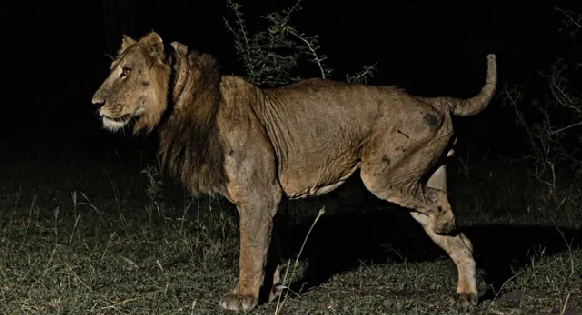
According to Forbes.com, few wild animals have defied death as many times as Jacob, a male lion living in Uganda’s Queen Elizabeth National Park.
His remarkable survival story has become the inspiration behind the upcoming wildlife documentary Nine Lives, which follows not only one extraordinary predator but also the conservationists determined to protect Africa’s shrinking lion population.
Jacob’s life has been shaped by relentless adversity.
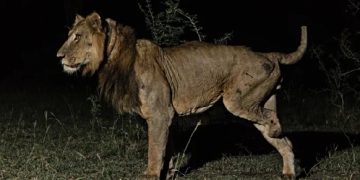
Years ago, he was caught in a poacher’s steel trap, suffering devastating injuries that eventually cost him one of his hind legs. For most lions, losing a limb in the wild would almost certainly mean death, as hunting, defending territory, and surviving against rivals require tremendous strength and mobility. Jacob, however, adapted.
Despite becoming a three-legged lion, he continued hunting, defending himself, and navigating one of Africa’s most challenging ecosystems.
His resilience stunned researchers who had monitored him for years, but even greater challenges lay ahead.
Jacob survived the poisoning of members of his pride, attacks from rival lions fighting over territory, and a serious encounter with a buffalo that left him badly injured. Each incident could have ended his life, yet he recovered and kept moving.
Perhaps his most astonishing feat came when he crossed Uganda’s crocodile- and hippo-filled Kazinga Channel alongside his brother, Tibu.
The swim stretched more than a mile, an extraordinary distance for any lion. What made the achievement even more remarkable was that Jacob completed it on only three legs.
The rare behavior was captured on camera by conservation researchers and later earned recognition from Guinness World Records.
Researchers believe the crossing was driven by more than survival.
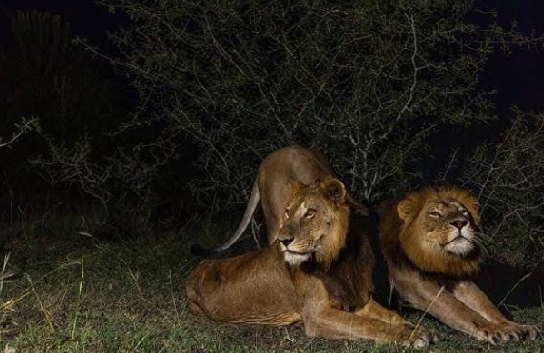 Jacob and Tibu were searching for breeding females, making the dangerous journey part of a broader struggle to ensure the survival of their species in an increasingly fragmented habitat.
For years, conservation biologist Dr. Alexander Braczkowski and the Kyambura Lion Monitoring Project have followed Jacob’s life almost chapter by chapter.
Their work has documented how lions in Queen Elizabeth National Park are adapting to growing pressure from habitat loss, expanding human settlements, poaching, and increasing competition for territory.
Their research also highlights a worrying trend. Lion numbers in the park have declined significantly over recent years, making every surviving breeding animal increasingly important to the future of Uganda’s lion population.
Jacob’s story therefore represents far more than the survival of one animal. It reflects the daily struggle faced by wildlife living alongside expanding human communities.
His rescue after being trapped, along with years of scientific monitoring, demonstrates how conservation partnerships between researchers, veterinarians, wildlife authorities, and local organizations can make a measurable difference.
Transforming Jacob’s life into the documentary Nine Lives has required years of work from filmmakers, researchers, trackers, and conservation teams. Much of his habitat consists of dense vegetation that makes conventional filming nearly impossible, forcing crews to rely on drones, thermal cameras, and long-term field tracking to capture his behavior.
The filmmakers hope Jacob’s story will accomplish something scientific reports alone often cannot, build an emotional connection between audiences and wildlife conservation.
Rather than presenting statistics about declining lion populations, the documentary follows the journey of one unforgettable lion whose determination illustrates both the fragility and resilience of nature.
According to Forbes.com, Jacob has become a powerful symbol of hope because his survival proves that conservation efforts can succeed when wildlife receives timely protection and long-term monitoring.
His story highlights the importance of preserving habitats, reducing human-wildlife conflict, and investing in research that helps endangered species survive.
More than a tale about a lion that refused to die, Jacob’s journey is ultimately about endurance.
Against impossible odds, he transformed from a severely injured animal into one of Africa’s most recognizable symbols of resilience, reminding the world that sometimes the greatest wildlife stories are not about the strongest animals, but about those that simply refuse to give up.