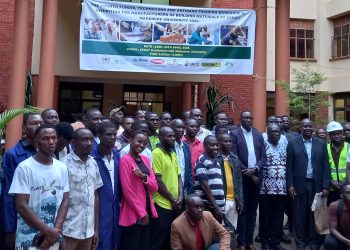




NAKWERO, WAKISO: Professor Moses Mulumba, the Vice Chancellor of Afya na Haki Institute, has emphasized the urgent need to understand the intersections between health issues and justice systems, noting that these connections are becoming increasingly critical in a rapidly changing world.
Speaking during the second orientation for the institute’s February intake, Professor Mulumba said global health systems are under immense pressure, losing significant resources, while Africa continues to grapple with long-standing structural challenges.
He observed that Africa’s understanding of health systems has historically differed from dominant global models. “For a long time, African health systems have been community-oriented, yet many interventions introduced to us focus on individuals rather than communities,” he said.

“Africa has offered some of the strongest communitarian approaches to health, and these have proven effective, especially in dealing with infectious diseases,” he added.
He cited Africa’s response to COVID-19 as a powerful example, noting that the continent’s ability to mobilize communities left the world “speechless.” According to Professor Mulumba, these African-rooted practices must be reclaimed and strengthened, particularly in the training of health professionals and legal practitioners.
Afya na Haki Institute, he explained, deliberately focuses on the intersections of health, human rights, and sexual and reproductive health and rights, areas that are often contested but deeply interconnected.
With students drawn from 17 African countries, the institute provides a unique space for understanding how justice systems interact with health systems.
“Many professionals working in NGOs, embassies, and global institutions like the World Bank are involved in funding and shaping health systems,” he said. “Yet they continue to grapple with how health issues intersect with justice systems. That is the unique contribution Afya na Haki brings.”
Ms. Halima Komuhangi, Dean of the Faculty of Health Sciences and Acting Dean of Students, described the day as a milestone moment for the institute. The February orientation marks the physical component of Afya na Haki’s blended learning model, where 70 percent of learning is virtual and 30 percent is face-to-face.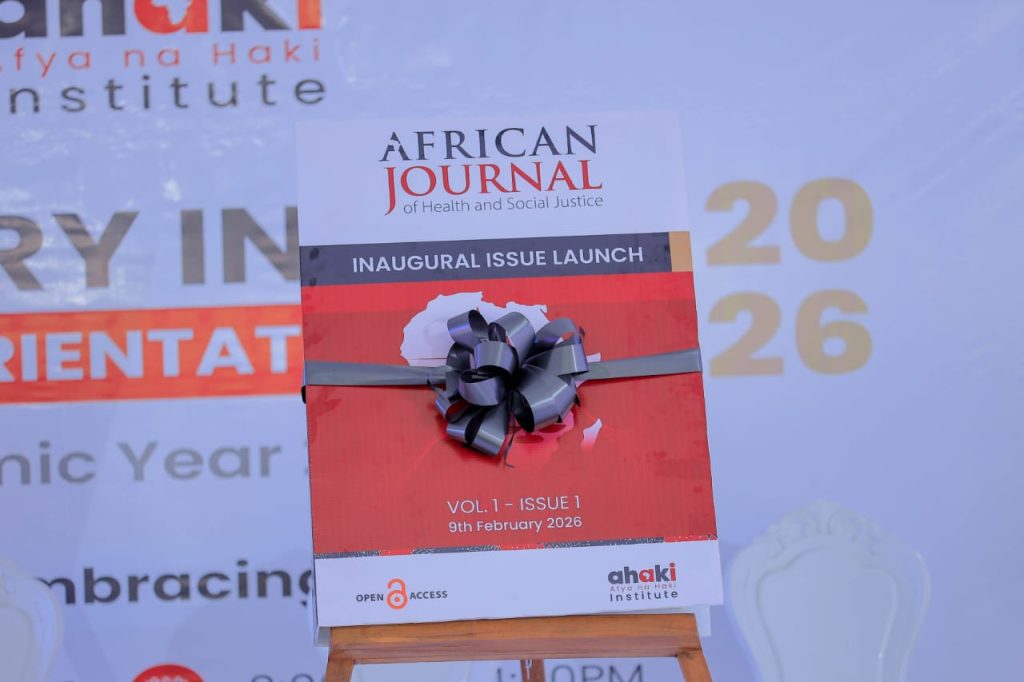 “This week is meant to introduce students to what they will study throughout the semester,” she said. “Today was special because we welcomed new students, launched our journal, and swore in the new guild cabinet.”
The newly launched Africa Journal for Health and Social Justice is a major achievement for the institute. Ms. Komuhangi noted that African scholars often face barriers publishing through European platforms, making the journal a critical space for African voices.
“This journal allows Africans to write, to tell stories, to express knowledge through poetry, literature, and African ways of knowing,” she said. “It means a lot to us.”
She also highlighted the institute’s transition from short courses to fully accredited academic programs. What began as short courses in reproductive justice attracting thousands of participants from over 53 African countries, has now evolved into accredited programs approved by the National Council for Higher Education.
“We now offer a Bachelor’s degree and a Postgraduate Diploma in Sexual and Reproductive Health,” she said, adding that the establishment of the Faculty of Health Sciences marks another step in the institute’s growth, with more programs to be announced soon.
Ms. Komuhangi reminded students of the institute’s core values: integrity, respect, accountability, inclusivity, and excellence. She urged them to embrace Afya na Haki’s Afrocentric identity, prioritize their studies, care for their health, and learn not just to pass exams but to solve real problems and advance justice in their communities.
Ms. Mercy Agaba, the inaugural Guild President of Afya na Haki Institute, described the orientation as a unifying moment for students, staff, and leadership. She reaffirmed that the institute currently offers two accredited programs: a Bachelor’s degree and a Postgraduate Diploma in Sexual and Reproductive Health.

“Afya na Haki is one of a kind,” she said. “It is intentionally grounding Afrocentrism in health and social justice, empowering students to develop African solutions for African problems.”
She noted that the institute hosts students from nearly 17 African countries, including Nigeria, Cameroon, Madagascar, and Benin, reflecting its continental reach and commitment to African-led ideas.
Ms. Agaba emphasized the importance of decolonizing education, research, and governance systems by drawing on African ideologies such as Ubuntu—I am because we are. She called on African governments and institutions to work collaboratively, adopt Afrocentric frameworks, and strengthen existing African instruments like the Maputo Protocol.
“At Afya na Haki, research and innovation are at the core,” she said. “We are revisiting our past, strengthening African knowledge systems, and using them to address today’s challenges.”
With its flexible learning model, Afrocentric philosophy, and focus on multidisciplinary training in health and social justice, Afya na Haki Institute continues to position itself as a hub for nurturing leaders committed to transforming health systems and advancing social justice across Africa and beyond.