



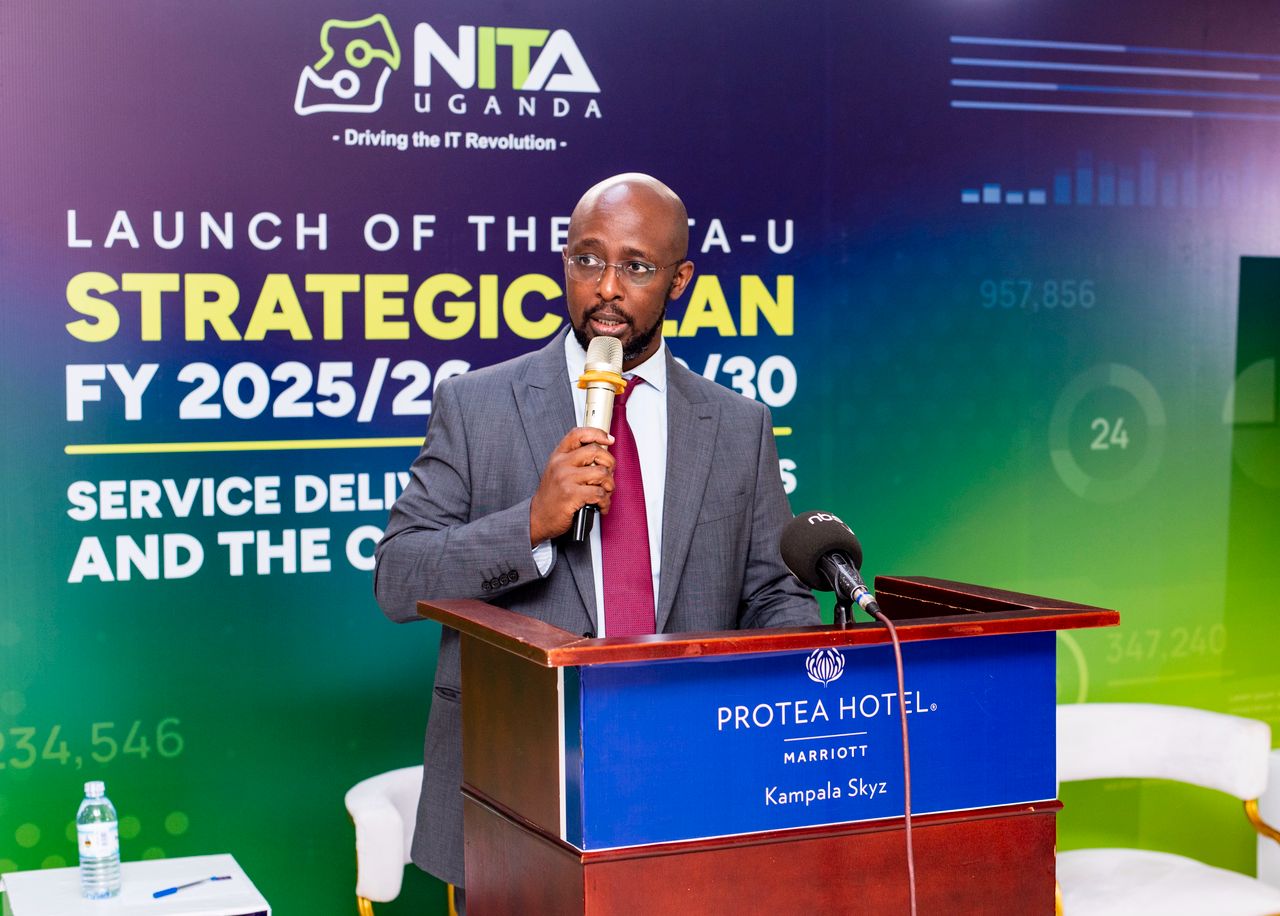
The National Information Technology Authority-Uganda (NITA-U) has launched its Strategic Plan for FY2025/26–FY2029/30, outlining an ambitious five-year roadmap aimed at accelerating digital transformation and significantly increasing the adoption of online government services across Uganda.
The Strategic Plan, unveiled at Skyz Hotel in Naguru, Kampala, sets a bold target of increasing the proportion of Ugandans actively using e-government services from 9.2 percent to 40 percent by FY2029/30. The launch attracted stakeholders from government, the private sector, development partners, and the ICT industry.
Anchored in Uganda Vision 2040, the Fourth National Development Plan (NDP IV), and the National Digital Transformation Programme, the plan marks a strategic shift in NITA-U’s focus—from building digital infrastructure to ensuring that citizens actively use and benefit from digital government services.
Representing the Minister of ICT and National Guidance, Hon. Justine Kasule Lumumba, Mr. Kenneth Bagarukayo, Commissioner for Data Networks Engineering, described the launch as a demonstration of government’s commitment to Uganda’s digital future.

“Uganda has invested significantly in building the digital foundations—the infrastructure, platforms, and regulatory framework. What this plan now demands is that government fully utilizes what has been built. Every Ministry, Department and Agency has a role to play, and the Ministry of ICT and National Guidance will continue providing oversight and support,” he said.
Speaking at the launch, NITA-U Executive Director Dr. Hatwib Mugasa said the new strategy builds on gains made under previous strategic plans and reflects a deliberate transition toward citizen-centred service delivery.
“For many years, our focus was on building the infrastructure required to support digital government. We have laid fibre across the country, established data centres, connected institutions, and built digital platforms. The next phase is ensuring that citizens can easily access and use these services,” Dr. Mugasa said.
He noted that while several government services—including passport applications, driving licence services, National Identification and Registration Authority (NIRA) services, and National Social Security Fund (NSSF) services—are already available online, utilization remains below expectations.
“Our focus over the next five years is to increase usage of these services by removing barriers to access, expanding connectivity, and ensuring citizens can conveniently engage with government through digital platforms,” he added.
The Strategic Plan is built around six strategic objectives: expanding ICT infrastructure, enhancing e-government service delivery, strengthening cybersecurity, promoting data protection and privacy, improving compliance with ICT regulations, and strengthening institutional performance management.
Dr. Mugasa highlighted several key targets under the plan. NITA-U aims to increase the integration of government systems through the UGHub platform from 37 percent to 73 percent of Ministries, Departments and Agencies (MDAs). Utilization of the National Data Centre is expected to rise from 70 percent to 83 percent, while public satisfaction with e-government services is projected to increase from 22.2 percent to 35 percent.
The Authority also plans to strengthen cybersecurity capabilities, expand local hosting infrastructure, and support the growth of locally developed digital solutions by increasing access to data centre resources.
“We want Uganda to become a hub for locally developed digital solutions. Many innovators and institutions have applications and services that need secure, reliable hosting. Expanding our data centre capacity will help create an enabling environment for local digital innovation,” Dr. Mugasa said.
A key component of the strategy is extending digital access beyond major urban centres. NITA-U plans to continue expanding fibre connectivity with the long-term goal of connecting all districts in Uganda while working with the Ministry of ICT and National Guidance to provide digital devices and public access points in underserved communities.
NITA-U Board Chairman Alexander Kibandama said the new strategy represents a significant shift in how the Authority measures success.
“For years, success was measured by infrastructure built—data centres established, fibre laid, and networks connected. This plan changes that narrative. Going forward, success will be measured by how many Ugandans are using these services and whether they are making a meaningful difference in their lives,” he said.
Also speaking at the launch, Ms. Gloria Katuuku, Director of Planning, Research and Development at NITA-U, emphasized the Authority’s commitment to accountability through a robust monitoring and evaluation framework.
“Every target in this plan was set deliberately based on evidence, stakeholder consultations, and lessons learned from previous strategic periods. We have developed a framework that will enable us to track progress quarterly and make timely interventions where necessary,” she said.
Alongside the Strategic Plan, NITA-U also unveiled its Client Charter and Service Delivery Standards. The Client Charter outlines the rights, responsibilities, and expectations of both NITA-U and its stakeholders, while the Service Delivery Standards establish minimum benchmarks for the quality and timeliness of services offered by the Authority.
With the Strategic Plan, Client Charter, and Service Delivery Standards now in place, NITA-U has signalled a new phase in Uganda’s digital transformation journey—one focused not only on building technology infrastructure, but on ensuring that digital services are accessible, trusted, and widely used by citizens and businesses alike.