


ABU DHABI, United Arab Emirates — Uganda has urged the international community to confront a rapidly changing crime landscape in which criminal and terrorist networks are increasingly exploiting artificial intelligence, encrypted communications, virtual assets and cross-border financial systems to expand their reach.
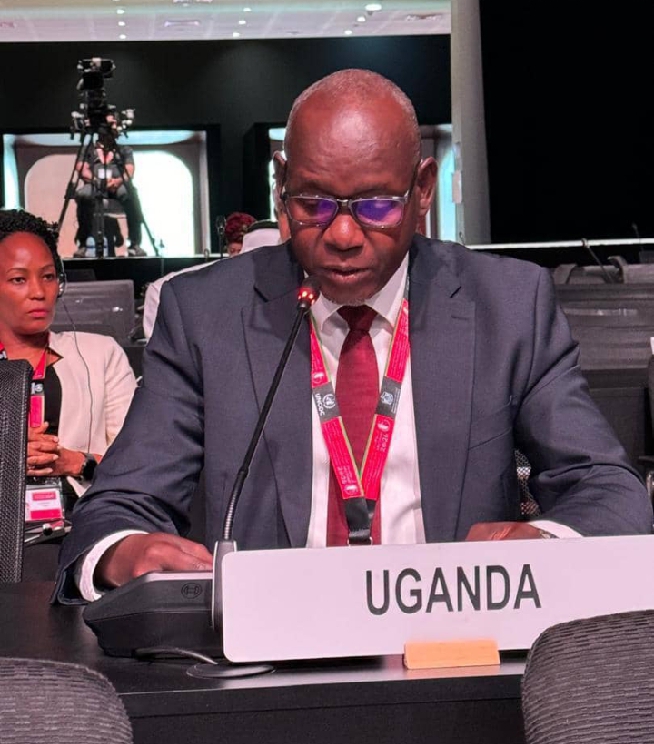
Uganda’s Director of Public Prosecutions, Lino Anguzu, delivered the warning on September 29, 2026, as he presented the country’s position on addressing and countering crime, including organised crime and terrorism, at the 15th United Nations Congress on Crime Prevention and Criminal Justice in Abu Dhabi.
The congress, which brought together ministers, prosecutors, judges, law-enforcement officials, experts and representatives of international organisations from around the world, is examining how countries can strengthen crime prevention and criminal justice systems in an era increasingly shaped by digital technology. The gathering is being held under the theme of accelerating crime prevention, criminal justice and the rule of law while protecting people and the planet and advancing the Sustainable Development Goals in the digital age.
For Uganda, Anguzu’s presentation placed the country’s experience within a much wider international challenge: organised crime is no longer confined by national borders, and technology has become both a tool for law enforcement and an instrument increasingly exploited by sophisticated criminal networks.
Anguzu told delegates that Uganda’s criminal justice institutions had demonstrated resilience since 2020 in responding to terrorism, organised crime and transnational crime. He pointed to official crime statistics as evidence of the changing security environment, noting that reported criminal cases rose from 195,931 in 2020 to 231,653 in 2022 before falling to 196,405 in 2025.
The latest Uganda Police Force Annual Crime Report confirms that 196,405 cases were reported in 2025, a 10.2 per cent decline from 218,715 cases recorded in 2024. Of the cases reported in 2025, 115,301 were submitted to the Office of the Director of Public Prosecutions, while 79,291 were taken to court. The report says 24,899 cases resulted in convictions involving 31,732 people.
But the decline in overall reported crime does not mean the threat has become simpler.
Anguzu highlighted emerging and evolving forms of crime that are increasingly difficult to investigate because they operate across jurisdictions and make use of rapidly changing technologies. These include cyber-enabled offences, illicit financial flows, money laundering, terrorism financing and the use of virtual assets.
The challenge is particularly significant because digital platforms can allow criminals to communicate, move money and coordinate activities across borders without maintaining a conventional physical presence in the countries they target.
UNODC has similarly warned that organised crime and illicit trafficking are becoming increasingly dependent on online technologies. The agency has identified the growing use of virtual assets as one of the developments requiring investigators and prosecutors to acquire new technical skills and strengthen their ability to conduct parallel financial investigations.
Uganda’s own figures illustrate the emerging pressure. Anguzu told the Abu Dhabi congress that the country recorded 412 cybercrime cases, 18 money-laundering cases and one terrorism-financing case in 2025, with the financial crimes involving billions of Ugandan shillings.
The figures point to a criminal justice environment in which conventional policing alone is increasingly insufficient. Investigators must now be able to follow digital evidence, trace financial transactions, identify beneficiaries of illicit funds and work with counterparts in other jurisdictions where suspects, victims, evidence or proceeds of crime may be located.
Uganda has responded by strengthening specialised structures across its criminal justice institutions, expanding intelligence-led investigations and increasing the role of prosecutors in guiding investigations. The country has also placed greater emphasis on international cooperation and the recovery of assets linked to criminal activity.
The approach is consistent with Uganda’s broader national strategy on combating money laundering, terrorism financing and proliferation financing, which emphasises stronger legislation, institutional capacity, investigation and prosecution, national coordination and international cooperation.
The country has also been working with international partners to improve its capacity to address financial and technology-enabled crime. UNODC, for example, has supported Uganda’s Financial Intelligence Authority and other institutions in strengthening oversight of virtual assets and virtual-asset service providers, reflecting growing concern over the potential misuse of new financial technologies for money laundering and terrorism financing.
Uganda’s international cooperation agenda received another boost in August 2026 when Kampala and UNODC signed a host-country agreement to establish a UNODC office in Uganda. The planned office is expected to support work on transnational organised crime, cybercrime, money laundering, wildlife trafficking, people smuggling and anti-corruption, strengthening the country’s role in regional crime-prevention efforts.
At the domestic level, Uganda has also turned to measures aimed at making the criminal justice system more efficient. Plea bargaining has helped address case backlogs, while an Inter-Agency Committee on International Cooperation has been established to improve coordination in international legal cooperation.
For prosecutors, the changing nature of organised crime means that the courtroom battle increasingly begins long before a case reaches court. Evidence may be stored on foreign servers, money may pass through several financial systems and suspects may use encrypted platforms that complicate traditional investigative methods.
That reality makes cooperation between police, prosecutors, financial intelligence authorities, courts, technology specialists and international partners increasingly important.
It also explains why the issue of technology featured prominently in Uganda’s message at the Abu Dhabi congress. The same technologies transforming economies and connecting societies can be exploited by criminal organisations seeking to conceal identities, communicate securely, move illicit proceeds and coordinate activities across borders.
The UN crime congress therefore provides Uganda with an opportunity to share its experience while learning from other countries facing similar threats. The gathering, which ran from September 25 to October 1 at the Abu Dhabi National Exhibition Centre, brought together governments and experts to examine crime prevention, criminal justice and the rule of law in a rapidly changing global environment.
Uganda reaffirmed its commitment to working with other UN member states and international partners to build specialised, adequately resourced and coordinated criminal justice institutions capable of responding to new and emerging threats.
Anguzu also acknowledged the support of President Yoweri Kaguta Museveni’s government to the Uganda Police Force, particularly in providing technical and logistical assistance that has enabled stronger collaboration among agencies and other stakeholders in combating organised crime.
The message from Abu Dhabi was ultimately broader than Uganda’s domestic crime statistics. It was a recognition that the future of crime prevention will increasingly depend on the ability of justice institutions to keep pace with technology while strengthening cooperation across borders.
For Uganda and many other countries, the challenge is no longer simply how to catch criminals operating within national boundaries. It is how to dismantle networks that can communicate digitally, move money electronically and operate across several jurisdictions almost simultaneously.
That emerging reality is placing a premium on intelligence, specialised expertise, international legal cooperation and the ability of prosecutors and investigators to follow the evidence wherever it leads.
Uganda’s presentation at the UN congress placed that challenge firmly on the international agenda, underscoring the country’s call for a coordinated response to an increasingly connected and technologically sophisticated world of organised crime.


Namirembe road crash claims three lives, leaves four injured
Three people have died following a grisly road crash along Namirembe Road near KK Building in Kampala on Monday morning,...