


Dozens of worshippers were brutally killed during a church vigil in northeastern Democratic Republic of Congo (DRC), in one of the deadliest attacks this year by the Allied Democratic Forces (ADF).
According, to reports, the night-time attack occurred in the town of Komanda, located in the conflict-torn, mineral-rich province of Ituri.
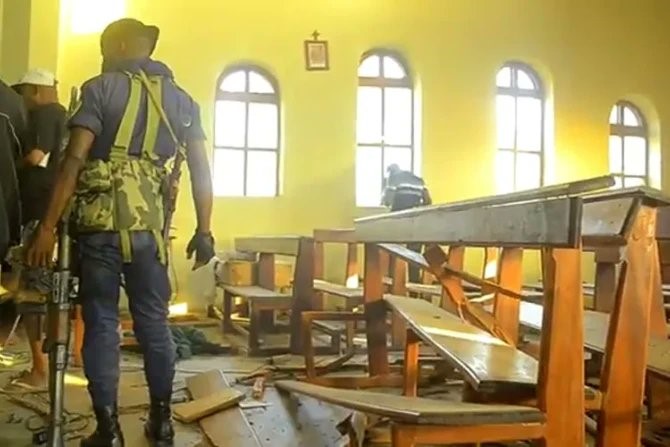
Local officials say ADF fighters stormed a church where members of the Eucharistic Crusade youth movement were gathered in prayer, shooting indiscriminately and setting buildings ablaze.
It is alleged that more than 21 people were shot dead inside and outside the church and several houses burnt.
Father Aimé Lokana Dhego, a local Catholic priest, told AFP that at least 31 of the victims were youth members of the church group, while six others were seriously wounded. Some youths were abducted by the attackers and remain missing.
“We have at least 31 dead members of the Eucharistic Crusade movement, with six seriously injured. Some young people were kidnapped, we have no news of them,” he said.
Seven additional bodies were later recovered elsewhere in the town. While the UN-backed Radio Okapi put the death toll at 43, the Congolese army has so far only confirmed 10 fatalities, reflecting the confusion and chaos in the aftermath of the assault.

The ADF over time, entrenched itself in eastern DR Congo and has evolved into one of the deadliest armed groups in Central Africa, regularly targeting civilians regardless of religious affiliation.
Since pledging allegiance to Islamic State (IS) in 2019, the ADF has operated under the banner of Islamic State Central Africa Province (ISCAP), alongside jihadist factions in Mozambique. Analysts say Africa now accounts for nearly 90% of IS-linked activity globally, based on data monitored by BBC researchers and independent conflict trackers.
Despite joint military operations launched in 2021 between Ugandan and Congolese forces to neutralize the group, attacks by the ADF have continued, often targeting remote villages, schools, and churches in eastern DR Congo.
The town of Komanda, like much of Ituri province, has long been the scene of bloody conflicts involving militias, local defense groups, and foreign fighters. Residents, many of whom were already displaced by previous violence, say the lack of consistent state protection has left communities vulnerable.
“This wasn’t just an attack on people, it was an attack on hope,” said one resident, who lost family members in the church massacre. “We were praying, and they turned it into a slaughterhouse.”
Churches across eastern Congo have become both spiritual sanctuaries and tragic sites of mass killings in recent years, as extremist groups seek to instill fear and division.
The Komanda massacre is another grim reminder of how Islamic State continues to thrive through its African affiliates, exploiting weak governance, porous borders, and regional instability.
The increasing reliance on local insurgent proxies poses challenges not only for national armies but also for international peacekeeping efforts.
The United Nations, African Union, and regional governments have all condemned the attack, but tangible progress against the ADF has been elusive. Humanitarian agencies are warning of further displacement and trauma in the wake of the church attack.
As the search continues for survivors and the missing, communities in Ituri, and beyond, are left grappling with a hard truth: the frontlines of global jihadism have shifted, and Africa is now the epicenter.