


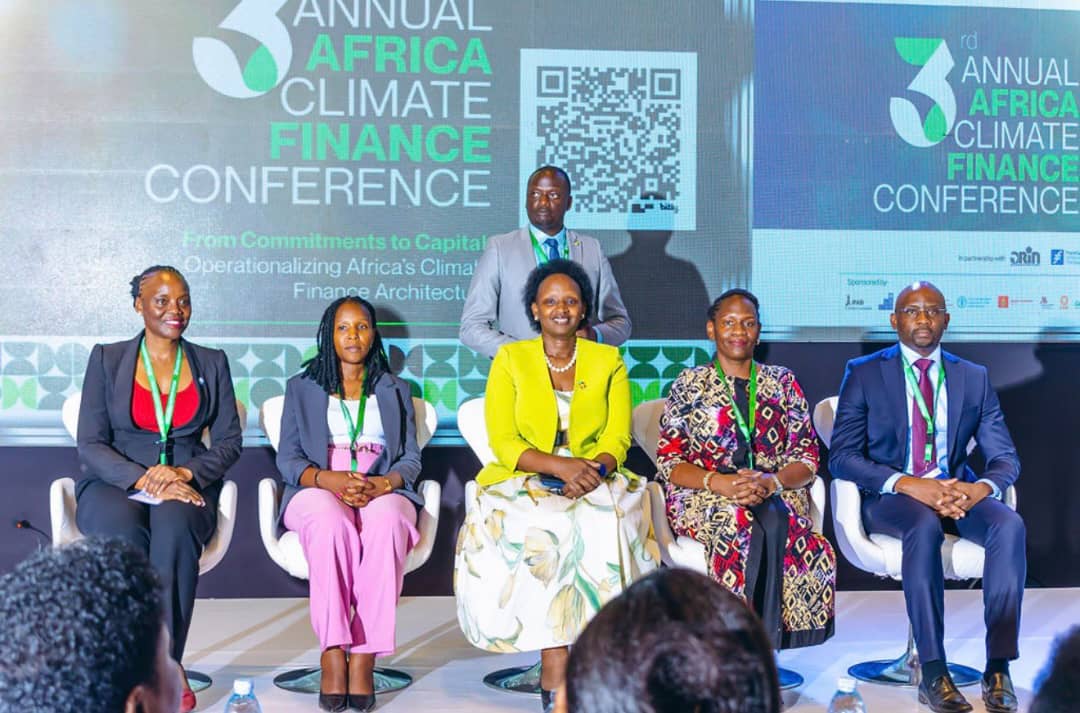
The Third Annual Africa Climate Finance Conference (#3ACFC26) has concluded in Kampala with a strong call for African governments, financial institutions, development partners, businesses and communities to move beyond climate commitments and accelerate the deployment of capital into bankable projects, enterprises and locally led solutions.
Held under the theme “From Commitments to Capital: Operationalizing Africa’s Climate Finance Architecture,” the two-day conference was convened by the Climate Finance and Sustainability Centre (CFSC) at Makerere University Business School (MUBS) in partnership with the Africa Research and Impact Network (ARIN), Frankfurt School of Finance and Management (FS), and the Uganda Institute of Banking and Financial Services (UIBFS).
The conference brought together policymakers, regulators, financial institutions, development partners, researchers, private-sector actors, innovators, youth and civil society to examine practical ways of strengthening Africa’s climate finance ecosystem and ensuring that climate capital translates into tangible economic and social outcomes.
CFSC: From Knowledge and Policy to Capital and Community Impact
Speaking at the conference, Dr. Maria Nantongo, Executive Director of the Climate Finance and Sustainability Centre (CFSC), said the conference was established as a neutral platform for bringing together actors working across different parts of the climate finance ecosystem.
“At the university, we do research and capacity building. But we also realised that we have the space, as a neutral voice, to convene people, and that is why we started these conferences,” Dr. Nantongo said.
She stressed that CFSC’s role goes beyond generating knowledge to creating connections between research, policy, finance and practice. This, she said, enables evidence to inform decisions while creating opportunities for capital to reach the people and enterprises that need it.
A central concern throughout the conference was the gap between climate finance commitments and the ability of African economies, institutions and enterprises to access and deploy the funds effectively.
Dr. Nantongo noted that climate finance must ultimately respond to the realities of communities most affected by climate change, particularly women, young people, small businesses and vulnerable households whose livelihoods are closely linked to agriculture, water, food and energy systems.
The conference therefore placed strong emphasis on strengthening investment pipelines, improving project preparation, developing appropriate financing instruments and building the capacity of local institutions and enterprises to access capital.
Government: Climate Finance Must Deliver Economic Outcomes
Opening the conference, Hon. Shartsi Kutesa Musherure, Minister of State for Finance, Planning and Economic Development (Microfinance), challenged stakeholders to assess Africa’s climate finance architecture based on the capital and economic activity it ultimately delivers.
“We should not confuse architecture with outcomes. A strategy is useful if it mobilises capital. A taxonomy is useful only if it influences financing decisions. A pipeline is useful only if projects reach financial close. A tracking system is useful only if it improves decisions and accountability. And an institution is useful only if it delivers,” Musherure said.
She emphasised that climate finance should be viewed as an economic and development imperative rather than solely an environmental issue, particularly as climate shocks increasingly affect agriculture, infrastructure, energy, water, household incomes and public expenditure.
Uganda has continued to strengthen its climate finance architecture through initiatives including the Climate Finance Unit, the Climate Finance Strategy 2025–2030 and the National Green Taxonomy, alongside work on blended finance, guarantees, green bonds, insurance, carbon markets and other financing instruments.
MUBS Calls for Climate Finance to Reach Beyond the Conference Room
Prof. Moses Muhwezi, Principal of Makerere University Business School (MUBS), challenged participants to ensure that climate finance discussions do not remain confined to conference rooms, institutions and government offices.
He called on the media, researchers, practitioners and other stakeholders with public platforms to take the climate finance conversation to wider society, particularly communities experiencing the effects of climate change but lacking access to the platforms represented at #3ACFC26.
He stressed that there is a collective responsibility to communicate issues that affect humanity and ensure that climate finance becomes a matter of public understanding and priority.
The Principal also underscored that financing climate action cannot be left to government alone. The private sector, financial institutions, investors, communities, development partners and other actors must take ownership of the transition and contribute to financing solutions.
For MUBS, he said, this responsibility extends to the university’s core mandate of education, research and engagement with practitioners and communities.
He called for research to be more closely connected to the needs of society, noting that “our research must be tied to what the community requires.”
He further urged the Business School to continue involving practitioners in its teaching, research and engagement activities so that students and researchers remain connected to developments beyond the university.
The Principal also called for stronger African collaboration, noting that climate challenges are not unique to individual countries and therefore require a collective continental approach.
He challenged African institutions to demonstrate ownership and sustainability in responding to climate change and to use knowledge, research and business education to influence decisions that can deliver meaningful change.
Africa Must Change Its Climate Finance Narrative
In her address, Dr. Akinyi J. Eurallyah, Programme Manager at the Africa Science Policy Fellowship at ARIN, challenged stakeholders to move away from presenting Africa solely through the lens of climate vulnerability and instead position the continent as an investment destination with significant opportunities for climate-resilient growth.
“Africa’s climate story should not be reduced to vulnerability. The continent also possesses extraordinary opportunities for a different development trajectory,” Dr. Eurallyah said.
She noted that Africa continues to receive only a small share of global climate finance despite the scale of its climate financing requirements.
“We need to change the way we talk about Africa’s climate finance gaps. The problem isn’t just one of volume but also a problem of structure, access and allocation,” she added.
The financing imbalance reinforced one of the conference’s central messages: mobilising additional capital alone will not be sufficient unless African countries simultaneously address project preparation, risk allocation, institutional capacity, financial intermediation, accessibility and the structures through which finance reaches projects.
Building Financial Systems That Move Capital
Goretti Masadde, Chief Executive Officer of the Uganda Institute of Banking and Financial Services (UIBFS), said Africa had reached a point where climate ambition must be supported by the institutional and financial infrastructure necessary to turn commitments into investment.
“For nearly a decade, global climate discourse has been dominated by commitments, declarations and frameworks. However, intent without an operationalised infrastructure is merely a liability,” Masadde said.
She underscored the critical role of financial institutions and finance professionals in developing the capacity, products, risk frameworks and investment structures needed to mobilise and deploy climate capital at scale.
The conference placed particular emphasis on the role of African banks, development finance institutions, pension funds, insurers, SACCOs and capital-market actors as intermediaries capable of moving climate capital from global and national commitments into the real economy.
From Climate Projects to Bankable Investments
Across the two days, delegates examined some of the structural constraints preventing climate capital from reaching African projects at the scale required.
Discussions covered climate finance accountability, tracking and transparency; nature-based finance; financial institutions as climate finance intermediaries; sector-specific financing; blended finance; green taxonomy and institutional capacity; localising climate finance and last-mile delivery;