






Heifer International has announced plans to support one million smallholder farmers in Uganda over the next five years as part of a new strategy aimed at improving agricultural productivity, market access and household resilience.
The organisation’s Country Director, William Matovu, said the commitment will be unveiled during the Signature Programme Forum scheduled for August 13, 2026, as Heifer marks 44 years of operations in Uganda.
Matovu said the forum will bring together government officials, development partners, private-sector players, farmers and other stakeholders to reflect on the organisation’s work in Uganda, share lessons and outline its priorities for the next five years.
Heifer International was established in Uganda in 1982 and has reached about 5.5 million people through its agricultural and livelihood interventions, according to Matobu.
The organisation’s new strategy will focus on strengthening smallholder farmers’ resilience and sustainability while helping them contribute to national economic development.
Matovu said the strategy is aligned with Uganda’s Fourth National Development Plan (NDP IV) and the government’s 10-fold growth strategy, particularly through interventions aimed at increasing agricultural production, productivity and market participation.
“Our work is to support government achieve its aspiration and strategy,” Matovu said, explaining that Heifer intends to organise farmers, improve their production and productivity and connect them to markets.
He said the organisation will identify specific agricultural value chains in which to work with farmers and strengthen linkages between producers, input suppliers, financial institutions, processors and buyers.
Heifer shifts from livestock handouts to market facilitation
Matovu and other officials said Heifer’s approach has significantly changed from its earlier model of providing livestock to vulnerable households.
Ronald Wabwire, signature program lead at Heifer international Country office, said the organisation has moved from what was traditionally known as “passing on the gift” where farmers received livestock such as cows to a broader focus on sustainable agriculture and market systems.
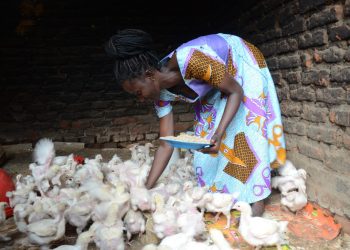
The organisation no longer distributes cows to farmers under the former model but instead works across several value chains, including poultry, oilseeds and other agricultural enterprises.
Mr. Matovu further said the organisation has transitioned from being primarily a livelihood-based organisation to becoming a market facilitator that works with different actors within agricultural value chains.
He said the approach is intended to make smallholder farmers more attractive to commercial players by helping them organise, improve production, understand agribusiness and produce sufficient volumes for the market.
“When we come in and we’re able to organise, we now make them appetizing for the other actors to come and nurture a relationship with them,” he said.
He added that organized farmers are more likely to attract commercial banks, private companies and other investors because they are better equipped to manage agricultural enterprises and meet market requirements.
Heifer calls for stronger partnerships
Mr. Matovu said partnerships with government, financial institutions, development partners and the private sector will be critical to achieving the target of reaching one million farmers.
He said government remains a key partner because of its regulatory role and existing programmes designed to support farmers.
He cited the Parish Development Model (PDM) and other government initiatives as examples of programmes that can complement Heifer’s interventions.
In the cattle Corrido, for example, Heifer helped organise farmers, strengthen their production and productivity, and supported them to establish milk aggregation facilities. Government later supplemented these efforts by providing additional milk coolers and, in some cases, modular processing units for value addition.
In another intervention involving sunflower and soybean farmers, Heifer helped farmers organise and increase production, after which government supported them with oil-processing equipment and an aggregation store under PDM.
Matovu said such partnerships allow different actors to build on one another’s investments instead of duplicating efforts.
Heifer also works with financial institutions ranging from Tier One to Tier Four because limited access to finance remains one of the major constraints facing smallholder farmers.
Extension worker shortage blamed for persistent food insecurity
Matovu attributed persistent food insecurity and poverty in some parts of Uganda to inadequate access to productive resources, agricultural information and extension services, as well as logistical challenges.
He said Uganda has millions of smallholder farmers but only a few thousand extension workers, making it difficult for every farmer to receive adequate technical advice.
“The resources which we have in the country are not enough,” Matovu said, arguing that the shortage affects agricultural production and productivity.
He said Heifer is exploring private-sector-driven extension systems to complement government efforts and increase farmers’ access to knowledge and advisory services.
Matovu also cited challenges in moving food between regions as another factor contributing to food insecurity.
He noted that some parts of the country can experience bumper harvests while others face scarcity because agricultural produce cannot always move efficiently from surplus-producing areas to deficit regions.
He said government efforts to promote agro-industrialisation, alongside programmes such as PDM, could help address some of these structural challenges.
Climate action and digital solutions
Heifer also plans to strengthen climate-smart agriculture and the use of technology to improve farmers’ resilience.
Matovu said the organisation is investing in irrigation to help farmers cope with climate-related production risks and improve profitability.
He also pointed to solar energy as another intervention being promoted for productive agricultural use.
In some communities, Heifer has supported farmers to replace diesel-powered generators at milk collection centres with solar systems, allowing the facilities to operate more reliably and provide farmers with access to aggregation services.
Matovu said reliable energy enables farmers to deliver their produce to collection centres without disruptions, while also reducing dependence on conventional power sources.
Organisation highlights impact of farmer enterprises
Heifer officials said some of their interventions have helped transform smallholder farming communities into commercially viable enterprises.
Matovu cited a cooperative that grew from farmers earning little or no income to an enterprise generating about Shs8 billion in annual turnover.
He said increased agricultural incomes have enabled some households to improve their housing, keep children in school and improve access to nutrition.
The organisation’s officials said such results demonstrate the potential of organized smallholder farmers when they receive appropriate production support, finance, market access and technical assistance.
The August 13 Signature Programme Forum will therefore be used to showcase some of the impacts achieved over Heifer’s 44 years in Uganda while setting out its plans to reach one million smallholder farmers by 2030.
The forum will be held under the theme “Celebrating Progress, Sharing Lessons, Shaping the Future of the Agri-Food System.”