


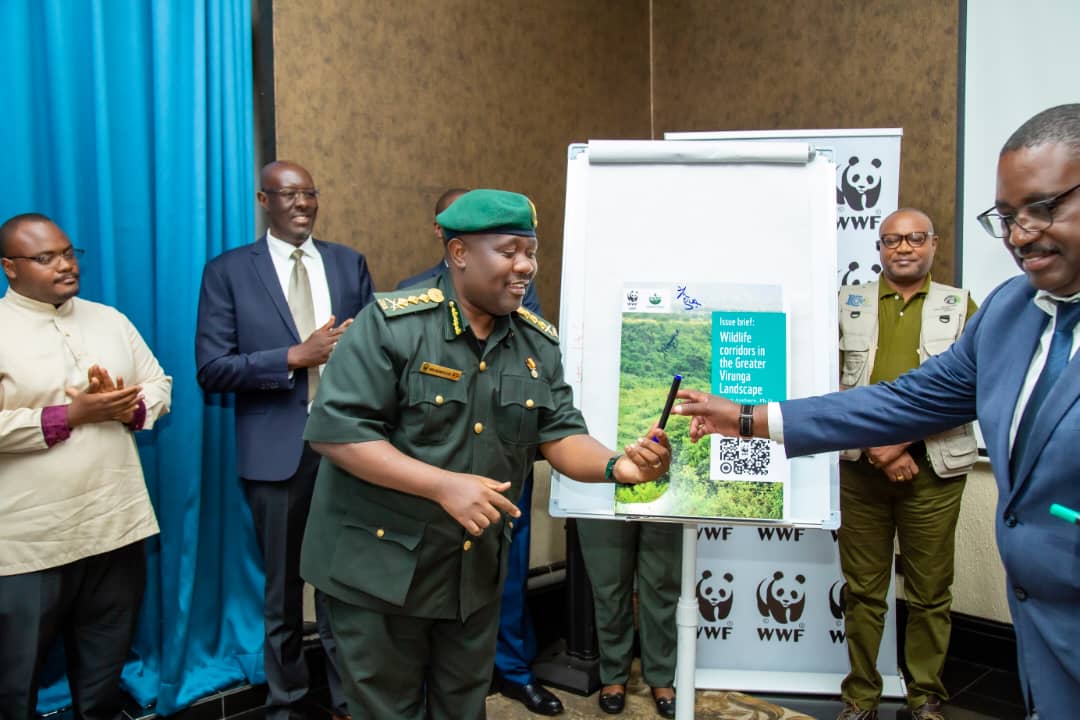
KAMPALA, Uganda – A new comprehensive study on wildlife corridors within the Greater Virunga Landscape (GVL) has revealed that while most ecological corridors remain functional for endangered species movement, habitat degradation, poaching, and human-wildlife conflict continue to threaten conservation gains across Uganda and the Democratic Republic of Congo (DRC).
Released by World Wide Fund for Nature, Greater Virunga Transboundary collaboration and Partners, the study assessed the status and functional connectivity of 20 wildlife corridors that support the movement and survival of four key species — elephants, lions, chimpanzees, and mountain gorillas — across one of Africa’s most biodiverse conservation regions.
Researchers found that 75 percent of the corridors assessed remain natural and functional, enabling ecological connectivity between and within protected areas. However, five corridors were identified as potentially dysfunctional due to habitat destruction and increasing human pressure.
The Greater Virunga Landscape spans protected areas managed under a transboundary conservation framework involving Uganda, Rwanda, and the DRC. Key conservation agencies include the Uganda Wildlife Authority, Institute Congolais pour la Conservation de la Nature, and Rwanda Development Board under the coordination of the Greater Virunga Transboundary Collaboration.
Elephants Most Widely Distributed
According to the report, elephants were the most widely distributed species and were potentially utilizing almost all the assessed corridors except the Kalinzu–Kasyoha Kitomi corridor. Lions were mainly concentrated in the northern and Ishasha sectors of Queen Elizabeth National Park and the southern sector of Virunga National Park.
Researchers identified four major corridors used by lions, including the Ishasha, Kasenyi, Bwera, and Muhokya corridors.
Chimpanzees were documented in six corridors, including the Virunga–Semuliki corridor linking northern Virunga National Park and Semuliki National Park, as well as forest corridors connecting Kyambura Wildlife Reserve, Kalinzu Forest Reserve, and Kasyoha Kitomi Forest Reserve.
Mountain gorilla movement was documented between Bwindi Impenetrable National Park and Sarambwe Nature Reserve, as well as within the Virunga Massif connecting protected areas in Uganda, Rwanda, and the DRC.
Populations Increasing for Gorillas and Elephants
However, lion populations were reported to be declining, raising concerns among conservationists about the long-term survival of the species within the ecosystem. Researchers identified habitat degradation and poaching as the leading threats affecting wildlife movement and species abundance across the assessed corridors.
The 2025 land cover and land use mapping revealed that nearly half of the identified corridors have been affected by habitat loss and degradation, particularly within Virunga National Park, Kasyoha Kitomi Forest Reserve, and areas around the Kyambura Gorge corridor.
The report warned that habitat destruction increases resistance to wildlife movement, disrupts ecological connectivity, and heightens the risk of human-wildlife conflict.
Poaching Still a Major Threat
Poaching was reported to be highly prevalent in several corridors, including Ishasha, Muhokya, Bwera, and Virunga north and south corridors, based on ranger monitoring data collected between 2000 and 2012.
However, recent data from the Queen Elizabeth Protected Area showed a decline in poaching incidents from 605 cases in 2019 to 178 in 2022.
Researchers attributed the reduction partly to strengthened law enforcement efforts and the construction of electric fencing that began around 2019 and 2020. Despite the decline, the report cautioned that reduced reporting could also contribute to the apparent improvement.
Human-Wildlife Conflict Dominated by Elephants
The study found that elephants were responsible for the majority of human-wildlife conflict incidents across all assessed corridors.
Communities living near wildlife corridors reported crop destruction, livestock loss, and property damage as major challenges associated with living near protected areas.
Conflicts involving lions, chimpanzees, and mountain gorillas were more localized in areas such as Muhokya, Ishasha, Kyambura, and the Bwindi-Sarambwe ecosystem.
Researchers noted that communities strongly preferred compensation schemes for losses caused by wildlife, followed by community conservation projects and alternative livelihood programs such as beekeeping.
The study also found that communities viewed government-led interventions as more sustainable than projects initiated by non-governmental organizations.
Physical barriers such as electric fences and trench systems were identified as the most preferred methods of reducing human-wildlife conflict.
Governance and Land Use Challenges
The report highlighted governance challenges affecting corridor conservation, especially where multiple agencies and local communities share management responsibilities. While some corridors are directly managed by wildlife authorities, others operate under hybrid systems involving the National Forestry Authority and local communities.
Researchers observed that some collaborative forest management practices, including eucalyptus and pine planting within corridor areas, may negatively affect wildlife movement and habitat functionality.
The report stressed that effective conservation will depend on harmonizing land-use goals among government institutions, conservation agencies, and local communities.
Key Recommendations
To strengthen wildlife corridor conservation in the Greater Virunga Landscape, the study recommended intensified law enforcement to combat habitat encroachment and poaching, restoration of degraded habitats, and increased community engagement.
Other recommendations included expanding electric fencing, strengthening compensation schemes for affected communities, promoting community-led conservation initiatives, reviewing collaborative forest management practices, and exploring the expansion of narrow corridor sites.
Researchers concluded that wildlife corridors remain critical for maintaining ecological connectivity and supporting the long-term survival of endangered species across the Greater Virunga Landscape.